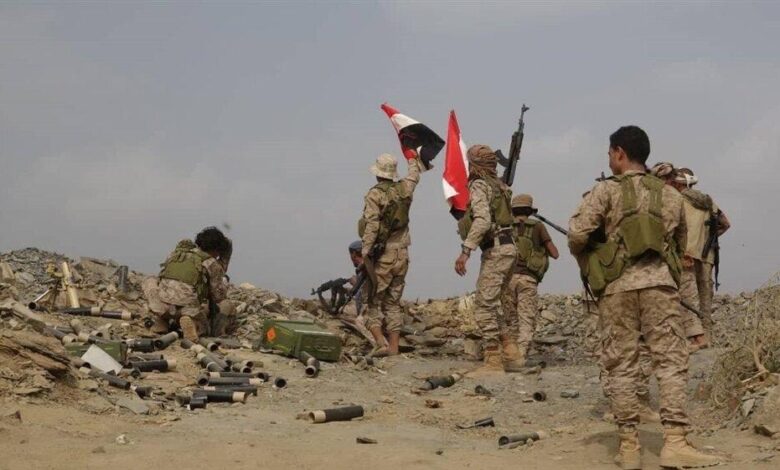
Yemen’s internationally recognised government has announced a major military campaign to retake territory controlled by the Iran-backed Houthi movement, escalating a conflict that threatens to further destabilise the country and put pressure on a crucial international shipping corridor.
Rashad al-Alimi, chairman of Yemen’s Presidential Leadership Council, announced the offensive on Sunday, saying government forces would move to recover areas held by the Houthis after efforts to prevent further escalation had failed.
“I announce today the start of military operations to retake the remaining territories of the republic,” al-Alimi said in a televised address.
The announcement came as Houthi forces made fresh territorial gains in southwestern Yemen, increasing pressure on government positions around the strategic city of Taiz.


HOUTHI ADVANCE PUTS TAIZ UNDER GREATER PRESSURE
The Houthis captured the town of Turbah on Sunday, in a move that strengthens their position along a major road linking Taiz with Aden, the temporary seat of Yemen’s internationally recognised government.
The capture is strategically significant because the road has been an important supply route for government forces operating around Taiz.
READ RELATED STORY
United Nation Envoy holds talks with Houthis as Yemen violence escalates
Iran says Strait of Hormuz will remain closed until conditions are met
Higher military pay meets public workers’ strike over hardship
The Houthis had already advanced through several areas surrounding the city, raising concerns that they could further isolate Taiz, Yemen’s third-largest city.
Houthi forces have also made gains on strategic hilltops near Taiz and are advancing towards the remaining road linking the city with Aden. Control of the route could further restrict the movement of government forces and supplies and increase pressure on civilians in Taiz.
The Institute for the Study of War said the capture of Turbah would likely severely restrict the ability of government-aligned forces to reinforce and resupply positions across Taiz province.
BATTLE FOR THE RED SEA CORRIDOR
The latest fighting has implications well beyond Yemen’s borders.
The Houthis have recently expanded their control along Yemen’s western Red Sea coast, including the strategic port city of Mokha and several nearby islands. Their advances have also given them control of the Yemeni side of the Bab el-Mandeb Strait.
Bab el-Mandeb is one of the world’s most important maritime chokepoints, linking the Red Sea with the Gulf of Aden and providing a key route for international trade between Europe and Asia.
The expansion of Houthi control in the area has therefore raised concerns over the security of commercial shipping and the potential for the Yemen conflict to affect wider regional trade.
The renewed fighting comes after a period of relative calm following a 2022 truce that substantially reduced large-scale combat, although it did not produce a permanent political settlement.
SAUDI ARABIA PLEDGES FULL SUPPORT
Saudi Arabia, which backs Yemen’s internationally recognised government, has pledged military support for the new campaign.
Saudi military spokesperson Maj. Gen. Turki al-Malki said Riyadh would provide “full operational support” to Yemeni government forces until the Houthis were defeated.
The Saudi commitment raises the possibility of a broader confrontation between the kingdom and the Houthis.
The Houthis have in recent weeks intensified attacks involving missiles and drones against Saudi Arabia. They also claimed responsibility for attacks on Saudi Aramco facilities, although Saudi authorities had not immediately confirmed the Houthi claims.
Saudi Arabia intervened militarily in Yemen in 2015 at the head of a coalition supporting the internationally recognised government after the Houthis seized the capital, Sanaa, in 2014.
HUMANITARIAN CRISIS DEEPENS
The renewed fighting is also worsening an already severe humanitarian crisis.
According to the United Nations, more than 830 people have been killed and 4,481 casualties recorded since August 6 amid the latest escalation. The International Organization for Migration said about 145,000 people had been displaced within Yemen, while more than 3,600 Yemenis had crossed into Djibouti.
The World Food Programme has also warned that the surge in violence is disrupting supplies and worsening food insecurity. Reuters reported that three out of four families in some parts of Yemen were going hungry because of the fighting and disruption to supplies.
With fighting now intensifying around Taiz and the Red Sea coast, humanitarian organisations face growing difficulties in reaching vulnerable communities.
A NEW PHASE IN YEMEN’S WAR
The latest offensive marks a major escalation in Yemen’s long-running conflict.
The Houthis still control Sanaa and large parts of northern and western Yemen, while the internationally recognised government and its allies maintain control over significant areas in the south and east.
The government’s decision to launch a broad counteroffensive, combined with the Houthis’ recent territorial gains and Saudi Arabia’s pledge of military support, risks turning the latest escalation into a wider and more sustained conflict.