The Federal Government has introduced an online teaching programme that will allow pupils in schools without qualified subject teachers to receive lessons from instructors remotely, while also providing free internet data to enable students to access the platform.
The initiative, known as Inspire Live, is designed to address the shortage of teachers in underserved communities and improve access to education, particularly in rural areas where schools struggle to find qualified personnel for certain subjects.
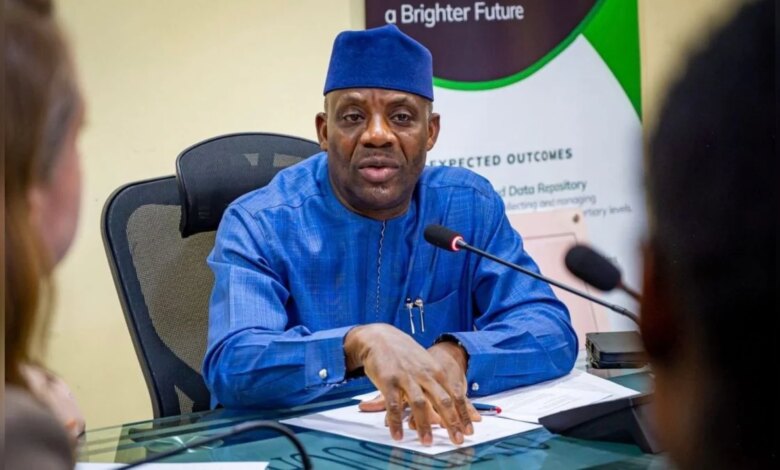
Minister of Education, Dr Tunji Alausa, disclosed this during an interview on Channels Television’s Politics Today on Tuesday night.
He explained that the programme would connect pupils in primary, junior secondary and senior secondary schools with qualified teachers through live and interactive online classes.


Under the arrangement, schools without teachers for particular subjects would be able to follow a central timetable and connect their pupils to instructors conducting lessons remotely.
This would allow children to continue receiving instruction without waiting for additional teachers to be recruited or posted to their schools.
Alausa used Kaura Namoda in Zamfara State to illustrate how the programme would work.
He explained that pupils in a school without an English Language teacher could access the platform and participate in lessons delivered by an instructor elsewhere in the country.
“Any school, say you are in Kaura Namoda today and you don’t have an English teacher, you can go online and log on when that teacher will be teaching English. You can log on to it in an interactive way,” he said.
The minister explained that Inspire Live was developed to cover all subjects contained in Nigeria’s approved school curriculum.
These include English Language, Mathematics, Social Studies, Civic Education, Nigerian History, Physics, Chemistry and Biology, among others.
He dismissed suggestions that the programme covered only selected subjects, stressing that students would have access to instruction across the curriculum.
“Not almost every subject. Every subject that is in the curriculum.”
According to Alausa, the platform would operate with an organised timetable to guide participating schools.
This would enable teachers and school administrators to know when particular subjects would be taught and ensure that pupils connect at the appropriate time.
He also explained that students would not depend entirely on live classes. The platform would contain recorded lessons that could be accessed whenever necessary.
This means pupils who miss a live lesson would still have an opportunity to study the topic later.
Students could also revisit previously taught subjects to improve their understanding and prepare for examinations.
“They will have recorded lessons. You just need to log on, and you get linked to a live teacher. You can also go and do a recorded lecture,” he stated.
One of the major provisions highlighted by the minister is the government’s plan to eliminate data charges for students accessing the platform.
Alausa said the Federal Government had reached an arrangement with the Nigerian Communications Commission (NCC) to provide zero-rated internet data for the educational service.
The arrangement is expected to remove the cost of purchasing data as a barrier for pupils, especially those from low-income households and communities where access to digital learning resources remains limited.
“We have collaborated with the Nigerian Communications Commission. We have zero-rated data, free data, to log on to the site. You log on free, you get live teachers,” Alausa said.
The minister added that the platform contained additional educational materials that students could use alongside their regular classroom lessons.
He also addressed concerns about children living in communities with limited access to electricity and internet facilities.
Using Irepodun Local Government Area of Kwara State as an example, he maintained that the government had made provisions for free access to the platform.
However, the success of the programme will also depend on the availability of functional devices, electricity and reliable connectivity in participating schools.
Free data can remove subscription costs, but schools will still need the necessary equipment and facilities to make virtual lessons accessible to pupils.
Beyond the introduction of online teachers, Alausa disclosed that the Federal Government was also deploying digital tools to improve the performance of teachers already working in schools.
He identified another initiative known as Ignite, a cloud-based platform created to assist teachers with lesson preparation, curriculum materials and other educational resources.
The platform is expected to help teachers organise their lessons and access relevant teaching materials without having to depend entirely on printed resources.
“We are also supporting our teachers. We have Ignite, a cloud-based platform where teachers can go to help them prepare their lesson plans and look at the curriculum,” he said.
Alausa explained that the government was adopting a two-sided approach to education reform by providing additional learning opportunities for students while strengthening the capacity of teachers.
He maintained that improving education required more than placing additional resources in the hands of pupils.
Teachers also needed continuous training, professional support and access to materials that would improve their classroom delivery.
“So, it’s full support for teachers, support for children, support for teachers, support for the students,” he added.
The minister further revealed that the government was implementing a Teacher Preparedness Programme to improve the skills and professional capabilities of educators across the country.
According to him, the initiative currently provides support for almost 50,000 teachers. The programme is expected to strengthen their preparedness and improve the quality of instruction they deliver to learners.
“At this moment, we’re running what we call a Teacher Preparedness Programme that we’re paying for almost 50,000 teachers,” he said.
He described the programme as an important intervention for teachers, adding that many educators were already participating and making use of the opportunities provided.
“It’s been a remarkable, remarkable support for our teachers. They’re latching on to it.”