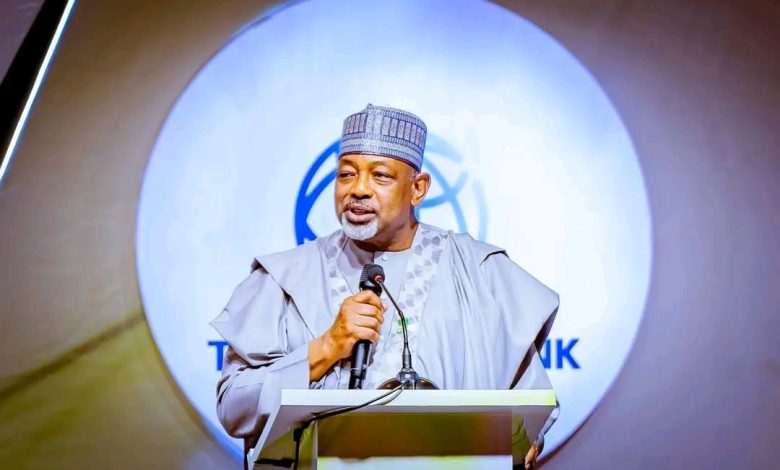
Nigeria’s Agriculture Minister, Abubakar Kyari, has challenged claims that the country loses N2.5 trillion annually in the agricultural sector, citing fresh production figures which he said contradict allegations of a worsening industry collapse.
Kyari, Minister of Agriculture and Food Security, referenced the 2026 Wet Season Agricultural Performance Survey conducted by the National Agricultural Extension and Research Liaison Services (NAERLS), Ahmadu Bello University, Zaria, which recorded 29.393 million metric tonnes of cereal production nationwide.
The figure represents a 1.84 per cent increase over the 2025 output, while rice production alone reached 9.626 million metric tonnes, according to the minister.
In a statement on Thursday, Kyari dismissed the reported N2.5 trillion annual loss and an additional projected N10 trillion loss as claims unsupported by credible evidence, accusing their promoters of seeking to discredit President Bola Tinubu’s administration.


“The facts are different and brighter than the gloom picture painted by the mischief-makers,” he said, adding that the reported production figures contradicted narratives portraying the agricultural sector as being in total collapse.
However, the figures cited by the minister principally address cereal production. They do not, on their own, establish the overall financial performance of the agricultural sector, the scale of post-harvest losses, farmers’ profitability or the affordability of food for households.
The distinction is important as Nigerians continue to grapple with food prices and the cost of agricultural inputs.
Kyari also defended the Federal Government’s 150-day duty-free food import window introduced in 2024, explaining that it was designed to temporarily bridge supply shortages, improve availability and stabilise prices rather than displace local production.
He said the initiative expired on December 31, 2024, and had neither been renewed nor reintroduced.
RELATED NEWS:
The minister listed financing from the Bank of Agriculture, National Agricultural Development Fund interventions, mechanisation partnerships and Special Agro-Industrial Processing Zones among the government’s efforts to stimulate domestic output.
He disclosed that 2.15 million bags of fertiliser had been distributed free to farmers, while funding had been approved for the supply of more than three million additional bags of NPK fertiliser ahead of dry-season cultivation.
Kyari also pointed to the National Postharvest Systems Transformation Programme, which is expected to strengthen food preservation through storage facilities, warehouses and cold-chain infrastructure.
He rejected claims that more than half of Nigeria’s rice mills had shut down, maintaining that local processors were still receiving government support. He also cautioned against indiscriminate food imports, arguing that excessive dependence on foreign supplies could expose domestic farmers to unfair competition.
The minister’s defence places production growth at the centre of the government’s agricultural narrative. Yet, beyond harvest volumes, the sector’s performance will also be judged by whether farmers can access affordable inputs, preserve their produce, earn sustainable returns and ultimately supply food Nigerians can afford.
Kyari said the ministry’s priority was to increase domestic production, strengthen local industries, reduce post-harvest losses and lower food prices.