Apple and Google Maps have become the primary cartographic imagination of the world. Two billion people navigate through them, trust them, defer to them. When Apple Maps displays no village names across Lebanon, not only in the south facing Israeli invasion but nationwide, while nearby Israeli and Syrian localities remain clearly labelled, only a handful of larger cities remain: Beirut, Tyre, Sidon and a small number of others. Everywhere else, the map went completely blank. Which raises the question: is this the next phase of the ground invasion, even amidst a ceasefire? Who made that choice of rendering the Lebanese villages invisible, when, and on what basis?
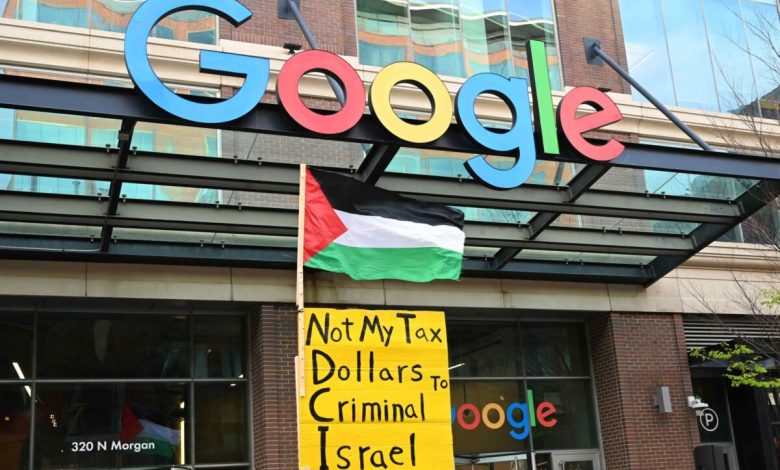
On Google Maps, Israeli settlements in the West Bank appear as though located inside Israel. Palestinian villages unrecognised by Israel are either misrepresented or left out entirely.
Even relatively small Jewish-Israeli communities appear at a glance, while Palestinian villages become visible only when zoomed in almost intentionally closely. According to “Mapping Segregation,” a 2018 report by 7amleh, the Arab Centre for the Advancement of Social Media, Google Maps does not recognise Palestine, with the browser navigating instead to an unlabelled area, and its entire user experience ignoring the reality of the Israeli occupation of that area. A Bedouin community that have existed before the creation of the colonial state is marked by tribal designation rather than its name. The heritage disappears alongside the geography.


The prototype of Israeli colonial instruments
By now, it is clear that whatever the Israeli occupation does in Palestine functions as a test run. A way of seeing how far it can push, with neighbouring countries either completely silent or offering, at best, words of condemnation. This act of live erasure on the digital footprint carries far more dangerous ramifications than it first appears. The scholar Michael Kwet, writing on what he calls digital colonialism, argues that by controlling the digital ecosystem, Big Tech corporations control computer-mediated experiences, giving them direct power over political, economic and cultural domains of life. That power actively shapes living situations, which is, most of the time, life threatening for those on the other end. In Jerusalem, Palestinian families, among them the Abu Rajab family, face orders to demolish their own homes by their own hands under occupation command, knowing that refusal means demolition regardless, accompanied by a fine so large it cannot be paid.
The erasure of Lebanese villages from Apple Maps, seen alongside the new border lines cutting through Lebanese territory, follows the same logic: cartographic preparation for Israeli settlement building and, eventually, settler colonisation.
The disappearance of Palestinians villages
Colonial cartography has always operated this way. In late 1949, the Israeli government created a committee of nine scholars whose task was to assign Hebrew names to towns, mountains, valleys, springs and roads across the Negev. Prime Minister David Ben-Gurion wrote to its chairman: “We are obliged to remove the Arabic names for reasons of state. Just as we do not recognise the Arabs’ political proprietorship of the land, so also do we not recognise their spiritual proprietorship and their names.”
The names being removed were not abstractions. Saffuriyya, a village in the district of Nazareth, home to thousands. Lifta, on the western edge of Jerusalem, completely cleansed of its 2,500 Palestinian residents by January 1948. In Deir Yassin, Jewish militias killed between 107 and 250 Palestinians, including women, children and elderly people. Within a year, the village was repopulated with Jewish immigrants from Poland, Romania and Slovakia.
The Islamic cemetery was bulldozed and the name Deir Yassin was wiped from the map. Today, Kfar Shaul Mental Health Centre stands on top of its ruins. Dayr Yassin became Kfar Shaul. Al-Mujaydil became Migdal HaEmek. Qalunya became Mevasseret Zion.
Between 400 and 600 Palestinian villages were destroyed or depopulated during the 1948 war, the majority left uninhabitable, their place names replaced with Hebrew ones.
What is most concerning in the digital era is the scale of which the speed and the invisibility of the mechanism. Google sparked widespread controversy after the labels for the West Bank and Gaza Strip disappeared from its maps. The company attributed the incident to a technical glitch. Yet more recent updates show that Area C in the West Bank is not clearly represented, while Israeli settlements appear with striking clarity. A glitch that always seems to fall in one direction. An absence that always benefits one set of territorial claims, and serves perfectly the Israeli expansionist agenda.
Kwet’s framework of digital colonialism is useful here precisely because it insists on looking at the architecture, not just the interface. Who designed the system, who governs its updates, who decides what counts as a legible source of data. Under classic colonialism, Europeans took ownership and control of critical infrastructure, including ports, waterways and railroads, designing them to bypass the villages of indigenous populations and link commercial and military outposts to the sea ports. These mapping platforms do something structurally similar. They connect certain places to the world and leave others invisible, and they do so through the same logic: whose presence is infrastructure, and whose presence is an obstacle.
Basma Abu-Qwaider, a Palestinian Naqab villager, has captured this, as he wrote back in 2018: “Google Maps acts in a discriminatory manner towards the unrecognised village the same way as the Israeli government does. Google ignores the existence of these villages just like Israel and for me if you do not exist on the map it means that you are invisible and that’s exactly what Israel wants us to be.”
Greater Israel, beyond the infrastructure of occupation, requires a geography that reflects its claims as though they were already there, rendering the villages as invisible as to make them ready to be claimed, and the digital maps provide exactly the instrument to do so.
The Lebanese villages absent from Apple Maps and the Palestinian villages absent from Google’s belong to the same project, carried forward through different instruments across different decades.
To insist on the name of a village, Saffuriyya, Lifta, Dayr Yassin, al-Kabri, Kuwaykat, al-Bassa, is to refuse the erasure before the erasure is complete. The name is not a symbol. It is the thing itself. It is the record that a people were here, that they built, that they buried their dead, that they pressed olives, that they belonged. No database update can settle that question.
The views expressed in this article belong to the author and do not necessarily reflect the editorial policy of Middle East Monitor.
🚨BREAKING: Watch The Video Clip Here ➤