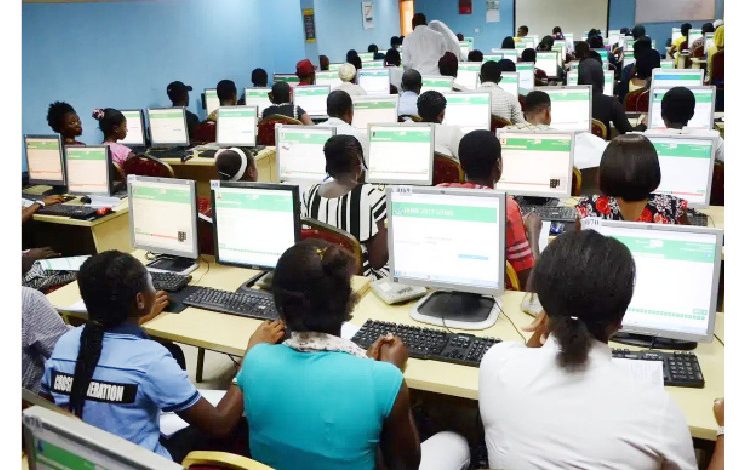
As candidates sit for this year’s Unified Tertiary Matriculation Examination (UTME), computer literacy continues to pose anxiety for many.
Despite years of transition to Computer-Based Testing (CBT), anxiety over basic digital skills continues to shape performance, exposing a persistent gap in Nigeria’s education system.


UTME, organised by the Joint Admissions and Matriculation Board (JAMB), is conducted entirely as a Computer-Based Test. The system was introduced to modernise assessment, reduce malpractice, speed up result processing, and align Nigeria with global examination standards.
Over time, it has succeeded in improving efficiency and transparency in many respects. However, it has also revealed deep inequalities in access to digital literacy.
Despite the technical structure of the CBT system, many candidates continue to struggle with its practical demands.
Across examination centres, candidates often arrive early, clutching their printouts and revising possible questions. However, once seated in front of a computer, confidence frequently gives way to confusion for some candidates.
Some candidates struggle with basic tasks such as moving between questions, using the mouse effectively, or interpreting on-screen instructions.
For first-time users, the presence of a ticking timer increases pressure and heightens anxiety.
In an interview with LEADERSHIP, candidates shared real-time accounts of their experiences. Many admitted that unfamiliarity with the system cost them valuable time, while others said fear of pressing the wrong button disrupted their concentration.
A recurring concern is that academic preparation alone is no longer sufficient; digital competence has become an unspoken requirement.
Stakeholders have attributed this challenge to systemic gaps in access to ICT training. While private schools and well-funded institutions often introduce students to computers early, many public schools still lack functional ICT laboratories.
In several cases, students only encounter computers for the first time during UTME registration or practice sessions.
Even where ICT facilities exist, irregular power supply and limited access mean that hands-on experience remains minimal. This creates an uneven playing field between candidates who are digitally comfortable and those who are not.
Parents of UTME 2026 candidates also said disparity affects performance in subtle but significant ways. According to them, while some candidates focus entirely on answering questions, others must divide attention between understanding the system and solving academic problems.
This imbalance, they said can influence overall outcomes, even when subject knowledge is adequate.
For many candidates, the CBT environment itself becomes a source of pressure rather than a neutral testing platform.
Some candidates who participated in the 2026 examination described their experiences as overwhelming, especially in rural areas. One candidate, Mercy Christopher, who wrote the UTME on a Monday, said she was touching a computer for the first time during the examination.
According to her, while JAMB has made efforts to simplify the process, it remains challenging for candidates without prior experience.
“When I sat on the computer, I first had anxiety. I was even scared to touch it. Calculating Mathematics questions within the short time frame was also difficult for me. One of my friends pressed the submit button even before finishing the exam by mistake,” she said.
Christopher who confirmed to LEADERSHIP on Tuesday that she scored 177, said she will enroll for computer programme to prepare well for next year as she intend to study nursing.
🚨BREAKING: Watch The Video Clip Here ➤