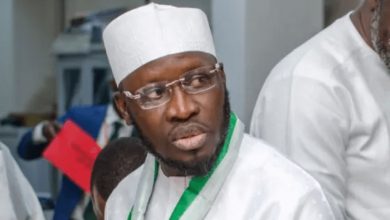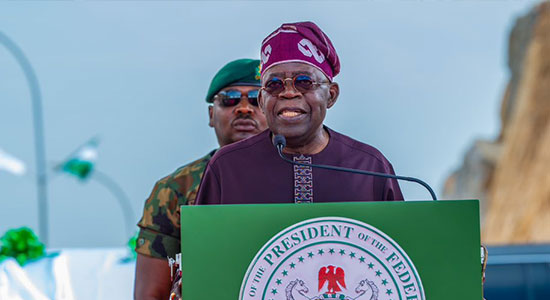
With Enugu’s entire political establishment trooping to Aso Villa to pledge their votes, President Bola Tinubu’s most audacious political project is coming into sharp focus. JONATHAN NDA-ISAIAH writes.
For a president whose economic reforms have made him one of the most contested figures in contemporary Nigerian politics, Bola Tinubu permitted himself a rare moment of undisguised satisfaction last Tuesday. Seated at the Presidential Villa in Abuja, he received a delegation that, by any political measure, represented a remarkable trophy, the governor of Enugu State, Peter Mbah, flanked by former governors, a former Senate President, a former Chief of Naval Staff, a sitting Minister of the Federal Republic, the Chief of Air Staff, traditional rulers, religious leaders, academics, and members of the National Assembly, all arriving with a single message: we are with you in 2027.
“You were in the other party,” Tinubu told Governor Mbah, with the quiet satisfaction of a man who has watched a long strategy yield its intended result. “I don’t want to give them credit by naming them. But you are a member of the progressive family today. I am proud of that.”
That moment, brief, almost casual, contained the essence of what may prove to be the most consequential political project of Tinubu’s presidency. Not the fuel subsidy removal. Not the exchange rate unification. Not even the sweeping economic reform agenda has simultaneously freed up federal resources and inflicted considerable pain on ordinary Nigerians.
The project that may ultimately define whether Tinubu wins a second term is simpler and older in its logic: the systematic political reintegration of the Southeast, Nigeria’s most consistently marginalised and oppositional region, into the ruling party’s coalition, and he is doing it by making governance the instrument of politics.
To understand what Tuesday’s visit represents, it is necessary to understand what it is responding to.
In 2023, the Southeast delivered one of its most emphatic rejections of the federal ruling establishment in recent memory. The region rallied overwhelmingly behind Peter Obi’s Labour Party presidential candidacy, a vote that was as much a statement of Igbo political identity and frustration with systemic exclusion as it was an endorsement of any particular programme. Tinubu won the presidency, but only without the Southeast. In Enugu State specifically, his party, the APC, was a marginal presence.
Two years later, Enugu’s entire political class has assembled at Aso Villa to pledge their support for his re-election. That transformation did not happen by accident, and it did not happen primarily through persuasion. It happened through a deliberate, structured deployment of federal resources into a region that had been starved of them and through a calculated political offer: align with the federal government, and watch what becomes possible.
Tinubu’s Southeast strategy has a visible spine, built on concrete, tarmac, and aviation infrastructure. The concessioning of Akanu Ibiam International Airport in Enugu is perhaps the single most symbolically loaded intervention. For years, the airport functioned as a domestic terminal masquerading as an international gateway, a monument to the region’s disconnection from the global economy despite having one of Nigeria’s largest and most economically active diaspora populations. Its effective restoration as a functioning international airport does not merely improve flight options. It signals, in the most material way available, that the federal government is prepared to treat the Southeast as an economic priority rather than a political afterthought.
The reconstruction of the Enugu-Port Harcourt expressway a highway so dangerous that “death trap” was not hyperbole but clinical description has transformed a corridor connecting two of the South’s most economically significant cities. Over 100 kilometres have been rebuilt. Progress on the Enugu-Onitsha road, stalled through years of false contractor starts, is now visibly advancing. A federal emergency intervention after the collapse of the New Artisan Bridge demonstrated something equally important: that Enugu now has direct access to federal responsiveness.
The approval of the Port Harcourt-Enugu rail line reconstruction, a corridor that has been dormant for decades, carries transformative potential for trade, mobility, and economic integration across the South. Work has reached Aba. Funding delays have stalled further progress, and Governor Mbah raised this directly with the President on Tuesday, urging continuity.
Tinubu’s response “we will do more” was warm but non-specific, a gap between presidential intent and implementation detail that remains the most persistent vulnerability in the entire project.
Then there is the structural innovation that may matter most in the long run: the South East Development Commission, backed by the South-East Vision 2050 framework, a coordinated federal architecture for regional development that cuts across state lines and operates at a scale no individual state government could sustain alone. For a region whose development challenges have historically been fragmented across five states with competing priorities and limited federal support, a single coordinated framework represents a genuine departure.
Tinubu framed this infrastructure offensive not as patronage but as economic logic. “The political realignment favouring the governing APC,” he told the delegation, “has been largely driven by the outcome of economic reforms.” He is making the case that good governance and political realignment are not separate phenomena that produce one another, and that the Southeast’s shift toward the APC is evidence not of political manipulation but of reform working as intended.
The infrastructure story, however compelling, is only half of Tinubu’s Southeast strategy. The other half is appointments, the deliberate placement of Southeast figures in positions of national consequence.
Air Marshal Sunday Kelvin Aneke, a son of Enugu, now serves as Chief of Air Staff. Dr Kingsley Udeh holds a ministerial portfolio. Professor Simon Ortuanya has been appointed Vice Chancellor of the University of Nigeria, Nsukka — a 65-year milestone, as the institution finally has a son of Nsukka in its most senior academic seat. Former Governor Ifeanyi Ugwuanyi has been appointed Nigeria’s Ambassador to Greece.
The delegation that arrived at Aso Villa on Tuesday included more than ten presidential appointees from Enugu State alone. This is not incidental. It is intentional representation politics, deployed alongside infrastructure investment to make a coherent argument to a region historically suspicious of federal intentions: you are seen, you are valued, and you are included.
Mbah articulated the cumulative effect of this combination at the Villa: “This relationship has earned our trust and support.”Trust, in Nigerian federal politics, is the rarest and most valuable currency. That a Southeast governor is now using the word in the context of his relationship with a Tinubu-led federal government is, by any historical measure, a significant political development.
The exchange is not one-directional, and Tinubu would not have it any other way. What the federal investment is producing in Enugu State is the kind of governance evidence that a president seeking re-election needs from his allies, and Governor Mbah arrived at Aso Villa carrying plenty of it.
The more remarkable story, however, may not be the federal inputs but what the Mbah administration is doing with them at the state level and the ambition of the numbers it is now prepared to defend publicly.
🚨BREAKING: Watch The Video Clip Here ➤