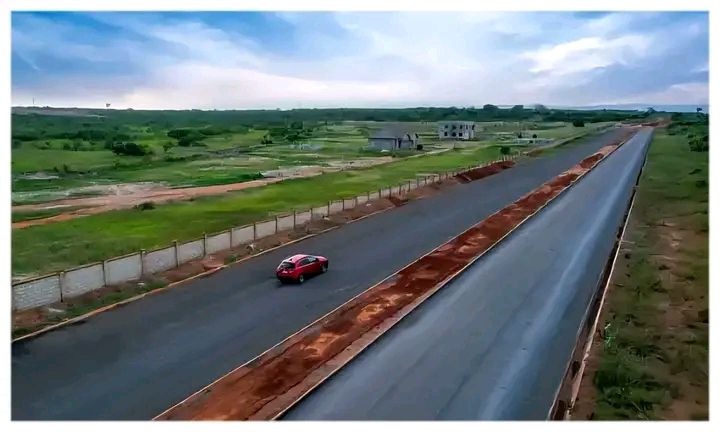
The federal government has reaffirmed commitment to the actualization of the 1,028km Lagos–Abidjan Corridor, a major regional highway expected to transform trade and connectivity across West Africa.
The project is connecting Cote D’Ivoire from Abidjan, Ghana, Togo, Benin, and Nigeria from Lagos.

The Minister of Works Engr. David Umahi, gave the assurance on Thursday during a high-level meeting in his office, Mabutshi, Abuja with delegations from the ECOWAS Commission and the African Development Bank.
Umahi in a statement by his Special Adviser on Media Mr Francis Nwaze, said the team visited Nigeria in his capacity as chairman of the Steering Committee for the project and the country’s representative at the ministerial level, to brief him on progress and resolve outstanding technical and financing issues.
Umahi conveyed the backing of president Bola Ahmed Tinubu, stressing that infrastructure development remains central to the administration’s agenda.
“I bring greetings from His Excellency, President Bola Tinubu, who is fully committed to infrastructural development in Nigeria,” the minister said.
He explained that the Lagos–Abidjan corridor, spanning about 1,028 kilometres, is being developed to match the scale and ambition of Nigeria’s ongoing Sokoto–Badagry Superhighway. According to him, the project will feature reinforced concrete pavement, three lanes on each carriageway, and modern road design standards aimed at long-term durability.
Umahi highlighted the scale of ongoing road investments across Nigeria, linking them directly to the regional corridor vision.
He noted that major sections of the Sokoto–Badagry route are already under construction, with significant financial commitments.
“At the end of the corridor, which will connect with the Lagos–Abidjan route at Badagry, we have the Badagry section, one hundred and sixty-two kilometers, already awarded and ongoing,” he said. “We are also going to the Federal Executive Council for the Uyo section, one hundred and eighty kilometers, for award this week.”
He emphasized that the Lagos–Abidjan project is not isolated but part of a broader network of interconnected highways, including the Lagos–Calabar Coastal Highway and several legacy routes cutting across all six geopolitical zones.
“This project will drive trade across West Africa and the African coast,” Umahi stated, adding that the coastal highway alone covers 750 kilometres, with multiple sections already completed, ongoing, or nearing commissioning.
Providing further updates, he said, “Section one, forty-seven point four seven kilometers in Lagos, is completed and will be commissioned in May. Section two, fifty-five kilometers, will reach the Ogun boundary and is expected to be completed by December.”
He added that construction is also advancing steadily in Akwa Ibom and Cross River States, with additional sections heading to the Federal Executive Council for approval.
Beyond the coastal route, the minister outlined a third legacy corridor linking Lagos to Abuja through Ebonyi, Benue, Kogi, and Nasarawa States, as well as a fourth corridor extending from Abuja through the North-Central and North-East regions.
“These projects represent a major transformation not just for Nigeria but for the wider West African region,” he said.
Umahi also pointed to ongoing work on critical national highways such as the Abuja–Kano road, parts of which are expected to be completed within the year, alongside projects like Sokoto–Zamfara–Kaduna–Katsina, Enugu–Onitsha, and the East–West Road.
According to him, the Tinubu administration is deliberately prioritizing durability by adopting reinforced concrete technology for many of the roads.
“President Bola Tinubu is delivering durable infrastructure designed to last over one hundred years,” he said. “His approach to economic reform, including subsidy removal and currency adjustments is long-term national planning, even if not fully understood by the public.”
On the Lagos–Abidjan corridor itself, the minister explained that there are unresolved issues. He raised concerns about design and unequal distribution of the corridor length among participating countries.
“On the engineering side, I will be direct. There are unresolved issues on the Lagos–Abidjan corridor,” Umahi stated. “The distribution of corridor length across countries is unequal and can only be resolved at the level of heads of state.”
🚨BREAKING: Watch The Video Clip Here ➤