Health Minister, CSOs, Diabetes Association Back Senate’s Move to Review, Earmark SSB Tax …N10 per litre no longer realistic — Senate President

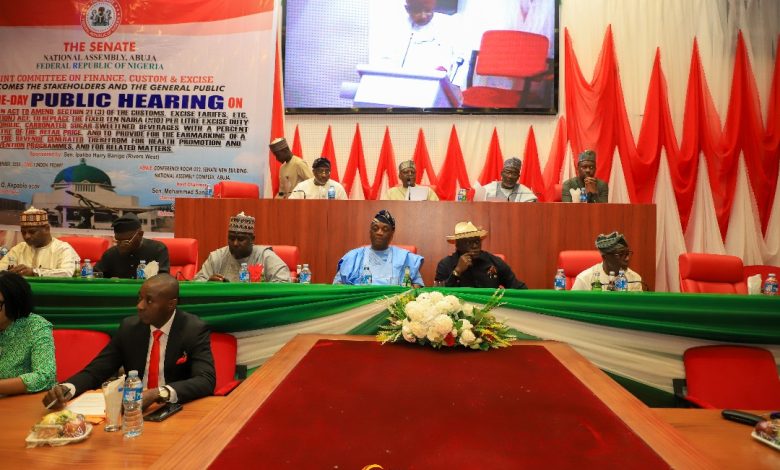
The Minister of Health and Social Welfare, Prof. Ali Pate, along with key civil society organisations (CSOs) and medical associations, has backed the Senate’s plan to review and restructure Nigeria’s Sugar-Sweetened Beverage (SSB) Tax, calling for a shift from the current ₦10-per-litre rate to a stronger, percentage-based system that reflects market realities and supports public health financing.
They made the call on Thursday in Abuja during a public hearing organised by the Senate Joint Committee on Finance, Customs and Excise on a bill seeking to amend Section 21(3) of the Customs and Excise Tariffs Act. The bill, sponsored by Senator Ipalibo Harry Banigo, proposes replacing the fixed ₦10 duty with an ad valorem levy tied to the retail price of sugary drinks and earmarking part of the revenue for health promotion and disease prevention.
Representing Senate President Godswill Akpabio, Senator Adeniyi Adegbonmire (SAN) said the amendment aligns fiscal policy with public health priorities.
“This amendment is a public health investment strategy,” he said. “The ₦10 excise duty is no longer realistic—both in terms of the value of the naira and the rising cost of health interventions.”


Health Minister: Set SSB Tax at No Less Than 20%
Prof. Pate, citing World Health Organisation data, urged lawmakers to set the SSB tax at a minimum of 20% and earmark at least 40% of generated revenue for public health programmes. He described the measure as critical for all “230 million Nigerians,” saying it would provide a “valuable funding stream” to strengthen the health system and support Universal Health Coverage, referencing the successful implementation model in the Philippines.
According to him, Nigeria’s current SSB tax—introduced in 2021 when a bottle of soda averaged ₦150—has lost its effectiveness due to inflation and can no longer deter excessive consumption of sugary drinks linked to a surge in non-communicable diseases (NCDs) such as diabetes, stroke, obesity, and heart disease.
Finance Ministry Raises Procedural Concerns
Representing the Minister of Finance, Olawale Edun, Technical Services Director Bashir Abdulkadir said the ministry aligns with the policy direction but reminded the Senate that Section 13 of the existing law empowers the President to vary excise rates. He noted that a broader review of SSB and alcohol taxes was already underway.
The Joint Committee, however, maintained its constitutional authority to amend legislation, saying the matter concerns public health and responds to Nigerians’ demands.
CSOs Push for 50% Levy, Revenue Earmarking
Executive Director of Corporate Accountability and Public Participation Africa (CAPPA), Akinbode Oluwafemi, urged the Senate to go further by adopting a 50% retail-price–based levy, with a minimum floor of 20%.
“The ₦10 duty has lost both value and purpose,” he said. “Only a percentage-based levy reflecting real market prices will meaningfully reduce consumption and align Nigeria with global best practice.”
CAPPA also called for earmarking revenue for NCD prevention and the establishment of a national monitoring and evaluation task force to track health and fiscal impacts.
Medical Associations: Diabetes Prevalence Rising
Several health bodies—including the Diabetes Association of Nigeria, Nigerian Cancer Society, Healthy Food Policy Vanguard, and CISLAC—expressed full support for the amendment.
Vice President of the Diabetes Society of Nigeria, Dr. Mansur Ramalan, said diabetes prevalence has risen to about 7%, warning that sugary drinks are a major contributing factor. He dismissed concerns about potential revenue losses, arguing instead that tax revenue could “increase by 200%” under a stronger structure.
Broad Support for Reform
Others who backed the bill include the National SSB Tax Coalition, Redeemers University, the Nigerian Tobacco Control Alliance, and the Civil Society Legislative Advocacy Centre (CISLAC).
Stakeholders agreed that a robust SSB tax is essential for reversing Nigeria’s escalating NCD burden, reforming the food environment, and securing sustainable funding for health services.
🚨BREAKING: Watch The Video Clip Here ➤