OAKLAND, California – Mr Elon Musk took the stand on April 28 at a high-stakes trial over the future of OpenAI, casting his lawsuit against the ChatGPT maker as a defence of charitable giving.
The world’s richest person is suing OpenAI, its co-founder and Chief Executive Sam Altman and its President Greg Brockman, saying they betrayed him and the public by abandoning OpenAI’s mission to be a benevolent steward of AI for humanity, and transforming the nonprofit into a profit-seeking juggernaut.
“If we make it okay to loot a charity, the entire foundation of charitable giving in America will be destroyed,” Mr Musk testified on the first day of the trial. “That’s my concern.”
Mr Musk, who founded automaker Tesla and rocket company SpaceX, also said he is committed to serving the public, by working 80- to 100-hour weeks and generally not taking vacations. “I like working and solving problems that make people’s lives better,” he said.
Before Mr Musk began testifying, Mr Bill Savitt, a lawyer for OpenAI and Mr Altman, told jurors during his opening statement it was Mr Musk who saw dollar signs as he helped finance OpenAI’s early growth and pushed it to become a for-profit business, one he might eventually lead as CEO.
Mr Savitt said Mr Musk wanted “the keys to the kingdom,” and sued only after he failed and then in 2023 started his own AI business, xAI, now part of SpaceX.
“What he cares about is Elon Musk being on top,” Mr Savitt said in his opening statement. “We are here because Mr Musk didn’t get his way.”
OpenAI’s lawyer also framed OpenAI’s March 2019 creation of a for-profit entity as critical to letting it buy computing power and pay top scientists to stay competitive with Google’s DeepMind AI lab.
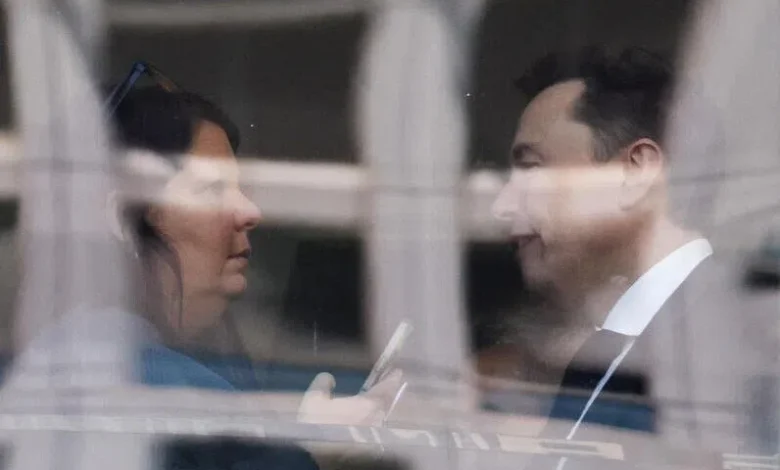
Elon Musk at a federal courthouse during a recess of the trial in his lawsuit over OpenAI for-profit conversion, in Oakland, California.
PHOTO: REUTERS
Mr Musk’s lawyer Steven Molo told jurors in his opening statement it was the OpenAI defendants who were greedy for money, as OpenAI began drawing investors including Microsoft. “It wasn’t a vehicle for people to get rich,” Mr Molo said.
Mr Musk is seeking US$150 billion (S$191 billion) in damages from OpenAI and Microsoft, one of its largest investors, with proceeds going to OpenAI’s charitable arm. He also wants OpenAI to revert to a nonprofit, with Mr Altman and Mr Brockman removed as officers and Mr Altman removed from its board. Mr Musk’s claims include breach of charitable trust and unjust enrichment.
Before jurors were seated, US District Judge Yvonne Gonzalez Rogers admonished Mr Musk after OpenAI lawyers complained about his posts on X on April 27, in which he assailed Mr Altman as “Scam Altman” and accused him of stealing a charity.
Judge Rogers said she was loath to issue a gag order, but urged Mr Musk to “try to control your propensity to use social media to make things work outside the courtroom … Perhaps you’ve never done that before.”

OpenAI CEO Sam Altman walking at a federal courthouse during a recess of the trial.
PHOTO: REUTERS
Mr Musk agreed to minimise his social media activity, as did Mr Altman. Both are expected to testify at trial, as is Microsoft chief Satya Nadella.
The trial could offer a window into some of the egos and personalities that shaped OpenAI as it evolved from a nonprofit research lab in Mr Brockman’s apartment to a company worth more than US$850 billion. It also risks complicating OpenAI’s plans for a potential initial public offering by casting doubt on its leadership, and could intensify Americans’ fears about AI technology more broadly.
OpenAI was co-founded by Mr Musk and Mr Altman in 2015 with a goal of developing AI to benefit humanity and fend off rivals such as Google.
Mr Musk testified that “I’ve had extreme concerns about AI for a very long time,” and focused more intently on it after meetings with former US President Barack Obama and Google didn’t address AI’s risks.
“I was very close friends with Larry Page at Google,” Mr Musk testified, referring to Google’s co-founder. “We would talk for many hours about AI safety. At a certain point it was clear to me Larry Page was not sufficiently caring about AI … We had to have a counterpoint against Google.”
Mr Savitt, in his opening statement, said AI safety wasn’t a priority for Mr Musk, and that Mr Musk denigrated OpenAI employees who focused on it. “Jackasses is what he called them,” Mr Savitt said.
Mr Musk has said he provided about US$38 million to OpenAI for its original mission, only to see OpenAI create a for-profit entity 13 months after he left its board.
Mr Molo said a major turning point for Mr Musk came when Microsoft invested US$10 billion in OpenAI in January 2023. “It violated every commitment (the defendants) made, not just to Elon, but to the world,” he said.
Mr Russell Cohen, a lawyer for Microsoft, said in his opening statement that the company didn’t do anything wrong, and has been “a responsible partner every step of the way.” OpenAI also faces growing competition from rivals including Anthropic, and is spending billions on computational resources.
A potential IPO could value the company at US$1 trillion, Reuters has reported. Mr Musk’s xAI trails far behind OpenAI in usage. He has folded that business into SpaceX, whose own potential IPO this year could be the largest ever.
In 2025, OpenAI overhauled its structure again to become a public benefit corporation, in which the nonprofit and other investors including Microsoft hold stakes. The nonprofit holds a 26 per cent stake, plus warrants if OpenAI hits certain valuation targets. REUTERS
🚨BREAKING: Watch The Video Clip Here ➤