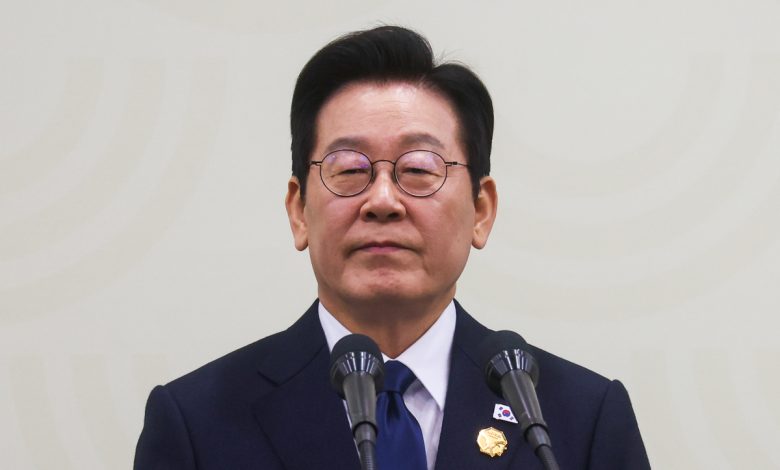
“It is disappointing that they do not reflect on the criticisms of people around the world who are suffering and struggling due to ceaseless actions against human rights and international law.”
South Korean president, Lee Jae Myung, stated this in a post on the social media platform X on 11th April. Lee’s “stance” is drawing significant attention beyond political circles and reaching a public that has long remained silent on Israel’s continued actions against human rights. However, it raises a question: is this really about human rights?
The dispute began suddenly on 10th April. Lee shared a video on X showing Israeli soldiers pushing a Palestinian off a rooftop, claiming the victim was a tortured child, and compared the incident to the Holocaust. The video, however, does not support such a claim. It was taken in September 2024 in Qabatiya, West Bank, and was widely reported only in connection with the desecration of corpses.
The following day, Israel’s Ministry of Foreign Affairs responded on X, stating that the incident had already been thoroughly investigated and addressed, and criticised Lee’s remarks as a “trivialization of the massacre of Jews,” calling them “unacceptable and warranting strong condemnation.”
The debate has now largely centered on whether presidential intervention was diplomatically appropriate.
Politically, Lee appears to have more to lose than gain from this dispute domestically. Nevertheless, he maintained his stance, stating on 12th April that “the sovereignty of each nation and universal human rights must be respected, and aggressive war must be rejected.”
His remarks have been reported internationally and have received support. However, caution is warranted. So far, rhetoric has not been followed by action.
READ: Russia questions Trump’s Board of Peace
Political implications behind sudden rhetoric
Israel expressed puzzlement, stating that Lee’s remarks were made “for some strange reason.” This observation is not without merit. South Korea itself has not sufficiently supported Palestinians’ rights. It continues to refrain from recognizing Palestinian statehood and often abstains from UN votes on Palestinian human rights issues, including last month’s UN Human Rights Council resolution. More importantly, South Korea has been involved in the exploitation of Gaza’s offshore gas resources, bypassing the Palestinian government. Given these factors, a fundamental question arises: when there are many areas in which South Korea could meaningfully advance Palestinians’ rights, why provoke diplomatic tension with Israel, a strategic partner?
It is also difficult to attribute Lee’s conduct to long-standing personal conviction. Throughout his approximately 20-year political career, he has not taken notable steps in support of Palestinians or in opposition to Israel. On the contrary, on 13th February, 2025, as opposition party leader, Lee praised Israeli Ambassador Rafael Harpaz for reaching a ceasefire and “returning to a peace framework.” He also highlighted Israel’s “remarkable achievements in the defense industry” and emphasized the value of bilateral cooperation. Notably, he made no mention of indiscriminate mass civilian killing and destruction that Israel has caused.
What, then, explains the emergence of this rhetoric? In analysing policymakers, timing is often the most revealing factor. South Korea is currently facing serious and urgent energy security concerns due to disruptions in the Strait of Hormuz, through which approximately 70 percent of its imported crude oil and up to 30 percent of its natural gas pass.
READ: Sanctioned tanker crosses Hormuz despite US blockade
Against this background, the government has sought solutions through international coordination while avoiding direct negotiations with Iran, particularly out of concern that doing so could set a visible precedent for toll payments in the Strait. However, on 5th April, Lee signaled a shift toward bilateral engagement by exploring bypass arrangements, such as humanitarian assistance. On 10th April, he dispatched a special envoy to Iran. This is also the day he made his first anti-Israel remarks and established a dedicated Middle East peace representative position. It is difficult to dismiss the possibility that these three developments are connected.
In negotiating with Iran, South Korea has limited strategic flexibility. Explicitly aligning with Iran or paying a toll will face backlash from the United States. In such circumstances, South Korea seems to be willing to risk its relationship with Israel in order to gain favourable positioning with Iran.
It is revealing, in this context, that Lee invoked a Palestinian-related past incident to raise human rights concerns, rather than addressing Israel’s ongoing operations in Iran or Lebanon, which are more closely tied to US responsibility.
At present, there is little indication that South Korea considers shifting its long-term diplomatic position. Public and political discourse remains focused on rhetoric, either defending or criticising Israel. Korea’s relationship with Palestine, where constructive measures could be taken to support Palestinians’ rights, remains untouched so far.
If South Korea continues to struggle to reach an understanding with Iran regarding the Strait of Hormuz, would it consider strengthening support for Palestinian self-determination? Unless Iran formally requests it in exchange for opening the Strait—which is unlikely—South Korea would remain within its current position. Taking a concrete step for Palestine would not only aggravate its long-term relationship with Israel, but also provoke the United States.
A government’s diplomatic stance hardly changes overnight. Diplomacy lies in an area where conservative caution prevails. As a result, foreign policy typically follows social change, rather than leading it. Rhetoric driven by temporary political considerations is unlikely to bring about such necessary change. If the current rhetoric is to be taken seriously, it must be followed by corresponding actions such as recognition of Palestinian statehood or withdrawal from Gaza’s offshore resources. Rather than celebrating sudden rhetoric, the international community should therefore demand consistency between words and action.
OPINION: How South Korea’s gas ambitions sustain the occupation of Gaza
The views expressed in this article belong to the author and do not necessarily reflect the editorial policy of Middle East Monitor.
🚨BREAKING: Watch The Video Clip Here ➤