For decades, the Transatlantic alliance was presented as the cornerstone of the so-called liberal international order—a partnership portrayed by shared values, mutual defence, and coordinated foreign policy. However, the recent US-Israeli war on Iran, which erupted on 28th February 2026, has contributed greatly to shattering that illusion. As the repercussions of such conflicts still cast its effects on the world, the divisions between Washington and its European allies have widened into a chasm, exposing a Western world more fractured and less cohesive than at any time in recent memory.
The war itself was considered perhaps the most significant rupture in the alliance between Washington and Europe. Multiple European leaders have confirmed that they were not consulted before the US and Israel launched their massive strikes on Iranian leadership and infrastructure. John Bolton, former US national security adviser, acknowledged that Trump made a “big mistake not consulting European NATO allies before the war.”
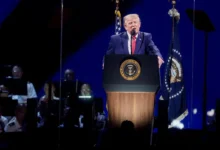
In late April, German Chancellor Friedrich Merz openly stated that the US was being “humiliated” by Iran’s leadership and expressed doubt about any “strategic exit” from the conflict. This prompted an angry response from Trump, who took to social media to attack the German leader directly, telling Merz to focus on Germany’s own problems rather than “interfering in countries that are eliminating the Iranian nuclear threat.” This scenario was also repeated with the leaders of the United Kingdom (UK), France and Spain, who all received similar harsh critics from Trump over their anti-war positions.
The Strait of Hormuz and energy security
If the war’s initiation exposed divisions, its economic consequences have transformed those divisions into active confrontation. The closure of the Strait of Hormuz—through which approximately 20 percent of the world’s oil and gas passes—has devastated energy-dependent European economies.
European Commission President Ursula von der Leyen recently informed the European Parliament that in just 60 days of conflict, Europe’s fossil fuel import bill has increased by over €27 billion ($31.3 billion) “without a single molecule of additional energy.” Valdis Dombrovskis, EU economy commissioner, bluntly stated that “Europe is facing a stagflationary shock—a slowdown of economic growth with a simultaneous increase in inflation.”
READ: Israel economy shrinks 3.3% due to war with Iran
The rift became even more visible when the UK and France hosted a 40-nation meeting in early April 2026 to discuss the security of the Strait of Hormuz — conspicuously excluding the United States from core planning. Weeks later, on 4th May, Washington unilaterally launched “Project Freedom,” a naval military escort operation, while pressing European allies to contribute forces. Even the operation was canceled a few days after its initiation under regional pressure, the European response was largely negative: Spain had already barred US warplanes from its bases and airspace for Iran-related operations, and German officials repeatedly stressed that this was “not their war,” favoring strictly diplomatic and multilateral solutions instead. This sequence — Europe organising independently first, then largely rejecting or distancing itself from the US initiative — starkly illustrates the depth of the transatlantic rift: two traditional allies no longer coordinate effectively or speak from the same strategic page.
US no longer a reliable partner for Europe
The rupture runs deeper than political disagreements. In early May, a comprehensive survey by the Bertelsmann Foundation across all 27 EU member states found that 58 percent of Europeans no longer consider the United States a reliable partner—and in Germany, that figure rises to a staggering 73 percent. Only 31 percent of Europeans now view the US as the EU’s “most important partner”—a sharp drop from 51 percent just months earlier. Another study cited by El Español found that merely one in four Europeans now see the US as an ally.
Perhaps most tellingly, 73 percent of Europeans now believe that after decades of close Transatlantic ties, Europe must “go its own way.”
This represents a fundamental reorientation of European public opinion, driven by the perception that Washington has become unreliable, reckless, and willing to sacrifice European interests for American and Israeli priorities.
Europe’s quiet preference for Trump to lose the November 2026
A final, largely unspoken dimension of the Transatlantic rift is Europe’s clear preference regarding American domestic politics. Publicly, European leaders maintain diplomatic niceties. Privately and through polling data, the picture is unmistakable.
Surveys consistently show that most Europeans strongly oppose Donald Trump’s approach to foreign policy, multilateralism, and international law. The same Bertelsmann study showing 73 percent of Germans no longer trust the US was conducted in March 2026, amid the Iran crisis—and its authors explicitly noted that “a controversial, polarising US president” combined with “increasingly tense geopolitical circumstances” have jointly driven European public opinion “in the direction of seeking greater independence.”
READ: Netanyahu says Israeli army nearing completion of Gaza mission, signals readiness for all Iran scenarios
Many European politicians and mainstream media outlets have openly portrayed Trump as a threat to European stability. In Germany, France, and Scandinavia, unfavorable views of Trump consistently exceed 70 percent. Behind closed doors, the preference among European elites for Trump to lose the November 2026 elections is an open secret—reflecting a fundamental divergence in political values and strategic vision.
Conclusion: Interest-based alliance, not value-based
Has the Western world reached a full rupture? Not yet. NATO still enjoys majority support as the “core pillar” of European security. Diplomatic channels remain open. European and American intelligence services continue to share information. And it remains unlikely that Europe will formally detach itself from the US in the immediate future.
However, the trends are unmistakable and deeply troubling for the alliance’s durability. What we are witnessing is the exposure of a fundamental truth:
the Transatlantic partnership has always been an interest-based alliance, not a value-based one. When American and European interests align—regarding global issues—the alliance appears cohesive and effective. When they diverge—as they clearly have during the Iran war—the underlying fractures become visible.
Europe now faces an excruciating choice: continue subsidizing American strategic priorities that may harm European interests, or accelerate the painful process of moving away further from the US and acting based on their own interests worldwide. The US also faces an equally difficult choice: rebuild trust with alienated allies through genuine consultation and respect for European concerns, or accept a future where Washington acts unilaterally without its traditional ally Europe.
The US war on Iran and its repercussions were the latest—and most damaging—in a series of major rifts within the Transatlantic alliance in recent years, including over relations with China and the role of NATO. As European economies continue to suffer stagflation as a result of US policies, as European publics lose trust in the Trump administration, and as European politicians openly question the reliability of American leadership, one conclusion becomes clearer and inescapable: the Western world has not fully split—but it has fractured. And fractures, once they occur, rarely heal completely.
OPINION: After US-Israeli war on Iran: What is left of the Gulf countries’ trust in America?
The views expressed in this article belong to the author and do not necessarily reflect the editorial policy of Middle East Monitor.