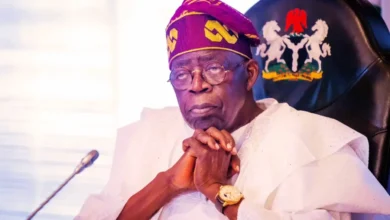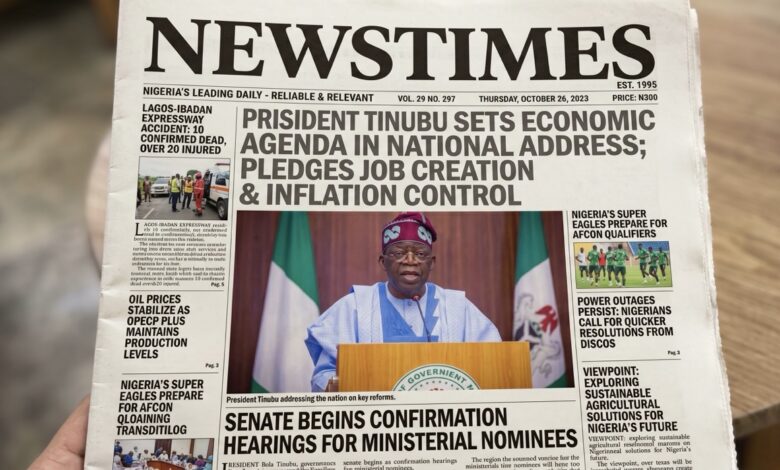
President Bola Tinubu has disclosed that he stopped reading newspapers and commentary at the height of public criticism against his administration’s economic reforms, saying he anticipated resistance after taking what he described as difficult but necessary decisions.
Tinubu spoke on Friday during a session at the Africa CEO Forum in Kigali, Rwanda, where he defended the removal of fuel subsidy and other reforms introduced since he assumed office.

The President said the reforms were painful but necessary to prevent Nigeria’s economy from collapsing.
“The reform is a very difficult decision, but necessary for the country. We cannot continue to spend our future generations’ endowment before they are born. It is necessary to reset, recalibrate, and reform the economy,” he said.
According to him, the fuel subsidy had become unsustainable and had encouraged corruption, smuggling, and falsification.
“It is a fake life to think you can, in a global economy, continue with a subsidy that is wasteful. It encourages falsification of documents, smuggling, and that is a very critical situation for the country,” Tinubu said.
The President said Nigeria was already facing severe fiscal challenges before the reforms were introduced.
“When you look at the economic problem of the country, you see that you are almost going bankrupt.
“Of the 36 states, 27 were unable to pay workers’ salaries. Where is the money? You are an oil-producing nation, you are earning revenue, yet you have no functional refinery. It is not possible to continue that trend,” he said.
Tinubu likened the reform process to childbirth, saying painful sacrifices were required to achieve long-term benefits.
“It is difficult, it is painful, but it is like the human reproduction process. A woman carries a pregnancy, endures labour pains, and smiles when she sees a live child,” he said.
Speaking on the backlash that followed the reforms, the President said he deliberately ignored media criticism in order to remain focused.
“First, I took hard decisions regardless of the pain. I stopped reading newspapers and commentary because I knew I would get a strong pushback—and I did,” he said.
He added that despite initial difficulties, the reforms were beginning to yield positive results.
“I was sitting on a hot burner, but we made the curve. Today, there is a bright light at the end of the tunnel.
“The economy is stable, Nigeria is stable and predictable. Planners can now prepare reasonable budgets and plan effectively,” he said.
Tinubu also said his administration was supporting vulnerable Nigerians through direct cash transfers and education support programmes.
“We are helping vulnerable households through direct transfers. Many poor families are now able to support their children’s education,” he said.
The President defended taxation as essential for national development, arguing that citizens cannot demand infrastructure without contributing revenue.
“Nobody likes to pay taxes. Taxation is not friendly to the wealthy, the middle class, or the poor. Everyone expects development, but the question is: how do you pay for it?” he asked.