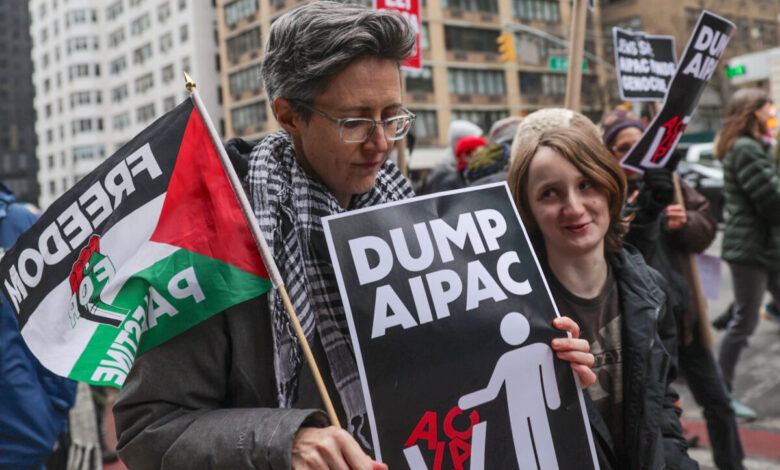
Pro-Israel donors linked to the American Israel Public Affairs Committee (AIPAC) are reportedly using new, innocuous-sounding fundraising vehicles to direct money to favoured candidates in high-stakes Democratic primaries, as support for Israel becomes increasingly toxic in US politics.
According to details reviewed by The Lever, a newly formed joint fundraising committee, Better Blue Fund is one of the groups using weakened campaign finance rules to act as a “one-stop shop” for contributions from some of the pro-Israel lobby’s largest longtime donors. More than $250,000 has been raised by the fund in under two months for Democratic candidates who have faced scrutiny over their support for military aid to Israel or past links to pro-Israel groups.
The committee is currently supporting former Utah congressman Ben McAdams, New York representatives Adriano Espaillat and Dan Goldman and Missouri representative Wesley Bell, all of whom face contested primaries. It is also fundraising for representatives Bob Menendez of New Jersey, Grace Meng of New York, Steve Cohen of Tennessee and Jeremy Moss, a Democratic challenger in Michigan’s 11th District. All eight candidates are currently endorsed by pro-Israel groups or have been in the past.
The Better Blue Fund was formed in March as a joint fundraising committee, a structure which allows multiple candidates to raise funds collectively and attract larger contributions from wealthy donors. Critics say such vehicles can obscure the political interests behind the money, particularly when the committee’s name gives no indication of a pro-Israel agenda.
In one example cited in the report, pro-Israel contributions appear to have been routed through a more discreet channel. McAdams was publicly endorsed by Democratic Majority for Israel in 2020 and received $5,000 from its PAC, but this year the group has offered no public endorsement or direct financial support.
Instead, the Better Blue Fund is backing his campaign, as he faces criticism from progressive rival Nate Blouin over his past support for unrestricted US military aid to Israel. As a congressman, McAdams voted with pro-Israel groups on military funding, opposed boycotts of Israel and joined congressional delegations to the occupation state.
The fund’s donor list also highlights the depth of its links to the pro-Israel donor network. It has reportedly raised nearly $300,000 from pro-Israel donors, including $28,000 from financier Jonathan Jacobson, who gave $2.5 million in 2024 to AIPAC’s super PAC, United Democracy Project. Rob Stavis, a partner at Bessemer Venture Partners, contributed $24,500 to the Better Blue Fund after giving $50,000 to Democratic Majority for Israel in 2024. Its largest reported contribution so far is $31,500 from investor Erich Mindich, who gave $250,000 to Democratic Majority for Israel in the last cycle.
The beginning of the end of unshakeable support: Why US public opinion is turning away from Israel
The report notes that once the Better Blue Fund distributes money to participating candidates, the donations will appear in campaign filings under the fund’s name, rather than clearly identifying the donors’ wider pro-Israel affiliations. This has raised concerns that the new model gives AIPAC-aligned donors a way to support pro-Israel candidates while shielding them from the backlash increasingly attached to the lobby’s brand.
A similar strategy is said to have appeared in Michigan’s Democratic Senate primary, where a new PAC called the Center for Democratic Priorities, with no prior campaign history, reportedly spent $5.3 million on ads supporting congresswoman Haley Stevens shortly after AIPAC promoted her to donors in a fundraising email. Registration documents reportedly showed that the PAC shared a treasurer with other pro-Israel groups and used the same strategy firm employed by such groups to place the ad buy.
The apparent shift comes as opinion polls show Israel losing support among the American public. A Pew Research Center survey in April found that 53 per cent of US adults held an unfavourable view of Israel, up from 42 per cent in 2022. Gallup reported in July that only 32 per cent of Americans approved of Israel’s military action in Gaza, while 60 per cent disapproved, the lowest level of support Gallup had recorded since it began asking the question in November 2023.