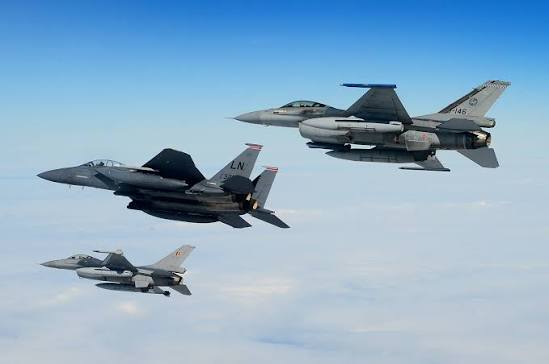
The Nigerian Air Force (NAF) has reportedly carried out another wave of precision airstrikes targeting suspected terrorist enclaves within the Sambisa Forest in Borno State, in what security sources describe as part of a sustained campaign to dismantle insurgent strongholds in the North-East.
According to multiple security and media reports, the operation focused on deep forest locations believed to be serving as logistics bases, training points, and temporary shelters for fighters linked to insurgent groups operating across the Lake Chad Basin region. Several terrorists were reportedly neutralized during the bombardment, although official casualty figures are still being assessed.
Military sources indicate that the latest strikes were conducted following intelligence surveillance missions that tracked suspicious movement within remote parts of Sambisa. The Nigerian Air Force, working under ongoing counter-insurgency operations, is said to have deployed precision-guided air assets to hit identified targets.
The operation is believed to be part of broader efforts under Nigeria’s counter-terrorism framework in the North-East, where the military has continued joint air and ground offensives aimed at weakening insurgent capabilities and cutting off supply routes.


Residents in surrounding communities reportedly heard loud explosions during the air raids, which lasted for several minutes. While some accounts suggest multiple camps were destroyed, the military has maintained that full battle damage assessment is still underway.
Sambisa Forest has long been recognized as one of the most fortified hideouts used by insurgent groups over the years. Despite repeated military offensives, the vast forest terrain has continued to serve as a difficult operational environment for both ground troops and aerial surveillance.
Over the years, similar airstrikes have reportedly led to the destruction of command centers, weapons storage sites, and makeshift camps within the forest. However, security experts note that insurgent groups often attempt to regroup in deeper and more isolated sections of the forest after such operations.
Recent reports from defense analysts suggest that the Nigerian military has increased aerial patrols and intelligence-driven strikes in response to renewed attempts by fighters to reorganize in scattered cells across the region.
The Nigerian military, through its ongoing operations in the North-East, has repeatedly emphasized its commitment to sustaining pressure on insurgent groups until they are completely degraded. Air operations like the recent Sambisa strikes are often coordinated with ground offensives to prevent escape and regrouping.
Security observers say the continued use of precision airstrikes has significantly disrupted insurgent mobility and reduced the frequency of coordinated large-scale attacks in some parts of Borno State. However, they also caution that sporadic attacks and ambushes still occur in remote areas.
As of the time of filing this report, there has been no official confirmation of the exact number of casualties recorded in the latest airstrikes. Military authorities are expected to release an operational update once reconnaissance teams complete assessments of the affected locations.
Nevertheless, security watchers suggest that the strikes achieved significant impact on suspected terrorist positions, further weakening their operational capacity within the Sambisa axis.
The Nigerian Armed Forces have continued to reassure citizens that operations against insurgency will remain active and sustained. The focus, according to defense communications, remains the restoration of lasting peace, safe return of displaced persons, and rebuilding of communities affected by years of conflict in the North-East.