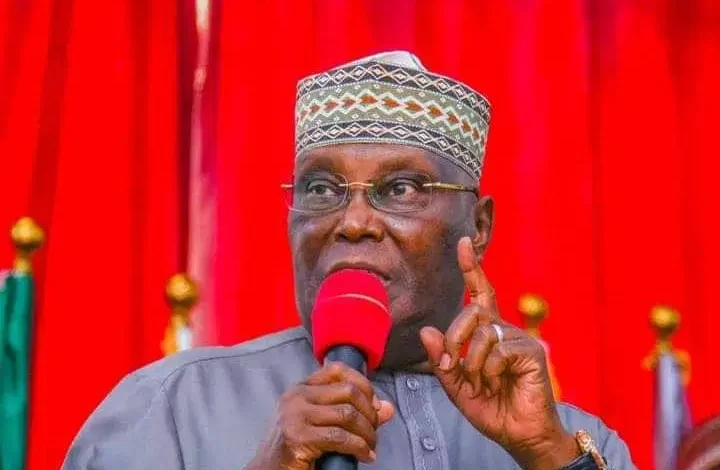
Former Vice President Atiku Abubakar has stated that President Bola Tinubu has turned Nigeria from “Africa’s giant into a hunger hotspot,” following the latest warning by the United Nations (UN) that nearly 35 million Nigerians could face acute hunger between June and August 2026.
This was contained in a statement signed by Atiku’s Senior Special Assistant on Public Communication, Phrank Shaibu, and issued in Abuja on Tuesday, shortly after the former vice president participated African Democratic Congress (ADC) presidential primaries in Yola, Adamawa State.


Atiku said the grim projection by the UN should “shake the conscience of the nation,” stressing that no responsible government should preside over such widespread suffering while still speaking the language of progress.
“This is not just another alarming statistic to be debated on television panels and forgotten by the next news cycle. This is a human tragedy of terrifying proportions.
“Thirty-five million Nigerians. That is more than the population of many African countries.
“That is tens of millions of citizens — mothers rationing food in silence, fathers crushed by the humiliation of empty pockets, children going to bed hungry, young people losing hope, and vulnerable households slipping daily from poverty into desperation.”
According to him, the crisis was not caused by war, drought, or any natural disaster, but by what he described as “economic illiteracy, policy recklessness, and leadership failure” on the part of President Tinubu.
He accused the Tinubu administration of turning its “Renewed Hope” agenda into “renewed hunger, renewed inflation, renewed insecurity, and renewed despair.”
Atiku said the abrupt removal of fuel subsidy without adequate social protection measures triggered one of the worst cost-of-living crises in recent history.
“The abrupt and poorly sequenced removal of fuel subsidy without credible social buffers triggered the worst cost-of-living crisis in recent memory. Transport fares exploded overnight. Food distribution costs surged. Basic goods became luxuries,” he said.
He also faulted the government’s handling of foreign exchange policies, saying the naira’s depreciation had wiped out purchasing power, inflated import costs, crippled manufacturers, and weakened small businesses.
The former vice president lamented rising food inflation, noting that staple foods such as rice, garri, beans, yam, and bread had become unaffordable for ordinary Nigerians.
He further linked the worsening food crisis to insecurity across farming communities in states including Benue, Plateau, Kaduna, Zamfara, Niger, Katsina, Sokoto, and Borno.
“How can a nation feed itself when farmers cannot safely access their farms?” he asked.
“For years now, farmers across Benue, Plateau, Kaduna, Zamfara, Niger, Katsina, Sokoto, Borno, and other agrarian belts have been trapped between banditry, terrorism, mass abductions, violent land invasions, and state helplessness.
“You cannot talk about food security while abandoning the people who produce food.”
Atiku also criticised what he described as the government’s “reckless borrowing addiction,” extravagant public spending, weak social protection systems, declining investor confidence, and collapsing productive capacity.
“The tragedy is even more painful because Nigeria should be one of the easiest countries in the world to feed.
“We have the land. We have the climate. We have the manpower. We have the entrepreneurial energy.
“What we clearly do not have at the moment is competent leadership,” he said.