Tinubu Unveils 145 Tricycle, Six Boat Ambulances To Tackle Emergency Healthcare Gaps Nationwide

0
Toyin Adebayo
President Bola Ahmed Tinubu has launched the National Emergency Medical Service and Ambulance System (NEMSAS), unveiling 145 tricycle ambulances, six boat ambulances, and emergency communication equipment aimed at improving access to life-saving healthcare services across Nigeria, particularly in rural and riverine communities.
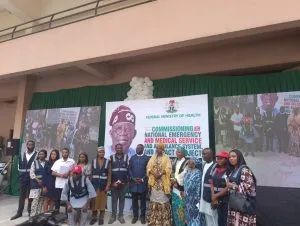
The initiative, unveiled during the virtual commissioning of Federal Ministry of Health and Social Welfare projects on Friday, is part of efforts to reduce avoidable deaths and strengthen emergency response under the Renewed Hope Agenda.

Speaking during the virtual commissioning of Federal Ministry of Health and Social Welfare projects on Friday, Minister of State for Health and Social Welfare, Iziak Adekunle Salako, said the initiative represents a decisive shift in Nigeria’s emergency healthcare response system.
Salako said the programme reflects what he described as “a bold national vision where no Nigerian should lose their life because structured medical help could not reach them in time,” stressing that the intervention is designed to strengthen pre-hospital emergency care nationwide.
He explained that the NEMSAS rollout includes 145 tricycle ambulances, six boat ambulances, and a coordinated emergency communication and dispatch system to improve response times in underserved and hard-to-reach areas.
“This landmark occasion features the official launch of the National Emergency Medical Service and Ambulance System assets, including 145 tricycle ambulances, six boat ambulances, and emergency communication and dispatch equipment to strengthen pre-hospital care across the nation,” Salako said.
He added that the Federal Government was also commissioning several health infrastructure projects across the country, including emergency operations centres in Kano, Sokoto and Katsina, the Lagos Vaccine Hub, as well as multiple tertiary hospital projects.
Among the facilities listed are the Trauma Centre at Ahmadu Bello University Teaching Hospital, Zaria; the Mental Health Complex at the University of Maiduguri Teaching Hospital; the Infertility and Assisted Reproductive Technology Centre in Bauchi; the Laboratory Complex at the University of Uyo Teaching Hospital; and the President Bola Ahmed Tinubu Complex at the Federal Medical Centre, Abuja.
Salako disclosed that over 100 additional projects are lined up for commissioning to mark the third anniversary of the Tinubu administration, noting that they cut across emergency care, maternal and child health, mental health, and diagnostic services.
On sectoral performance, he said the administration had expanded health insurance coverage by more than 33 per cent, revitalised over 4,000 primary healthcare centres, and established 15 new federal tertiary health institutions.
He also noted that more than 500 specialist infrastructure projects, including cancer and diagnostic centres, had been delivered to reduce medical tourism.
Permanent Secretary of the Ministry, Daju Kachallom, said the ambulances would be deployed to primary healthcare centres, especially in rural areas, with trained drivers and health workers attached to ensure rapid response.
“These ambulances are going down to the rural areas, and they will be stationed at the primary healthcare centres where there are trained drivers, while nurses will accompany the ambulances anytime they need to be moved,” she said.
Kachallom added that emergency contact systems would be strengthened at primary healthcare facilities to improve referrals and response coordination, expressing optimism that the health sector would continue to record improvements under the Renewed Hope Agenda.
National Programme Manager of NEMSAS, Demuren Doubra, said the tricycle ambulances were designed specifically for emergency transport of pregnant women and newborns in difficult terrains where conventional ambulances cannot operate effectively.
He said the programme had already recorded significant impact, with more than 58,000 women and over 2,000 newborns benefiting from emergency transport services.
Doubra cited a case in which a pregnant woman was moved over 180 kilometres from Dukku Local Government Area in Gombe State and safely delivered triplets, describing it as a clear example of avoidable maternal deaths prevented.
“This is a woman that would have died because of a gap in transportation,” he said.
He further stated that Nigeria still records about 75,000 maternal deaths and 280,000 neonatal deaths annually due largely to delays in accessing care.
“As NEMSAS, with these facilities and equipment, we are trying to address the delay in reaching care for women and newborns,” he said.
Director of Community Health Services at the National Primary Health Care Development Agency, Dr. Nana Abubakar, said the initiative would significantly improve emergency transportation and referral systems.
“It will help reduce preventable deaths, especially amongst mothers, newborn children and other vulnerable groups,” she said, adding that emergency response begins at community level.
Also, the National Coordinator of the National Malaria Elimination Programme, Nnena Ogbulafor, linked the intervention to broader health gains, noting that malaria prevalence had dropped from 21 per cent in 2021 to 15 per cent in the 2025 survey.
She said 428 health workers had been trained across 15 states, alongside expanded awareness campaigns and emergency health communication strategies.
Meanwhile, the World Bank Task Team Leader, Onoride Ezire, described the initiative as a milestone in Nigeria’s push toward universal health coverage.
He said the tricycle ambulances were equipped with communication tools for real-time monitoring, adding that poor transport infrastructure often turns treatable emergencies into fatal outcomes in rural communities.
“These are not just vehicles, they are life-saving machines,” he said.
Ezire urged states benefiting from the programme to ensure proper maintenance and sustainability to guarantee long-term impact.