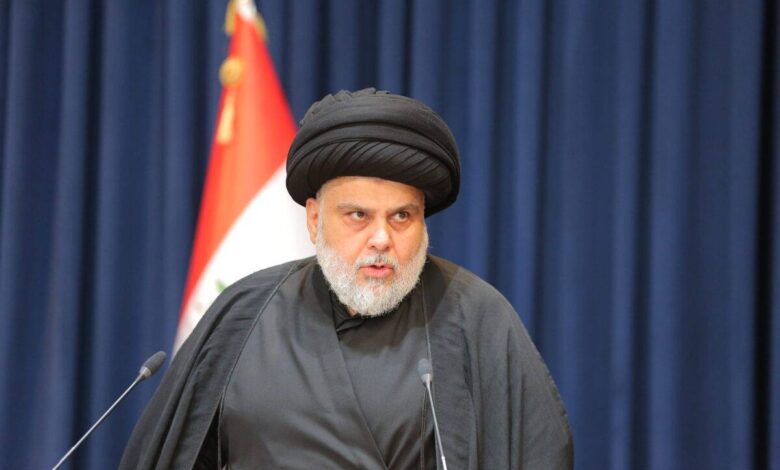
Muqtada al‑Sadr’s latest announcement—that his militia, Saraya al‑Salam, will be “integrated” into the Iraqi security forces—has been received with a mixture of skepticism and déjà vu inside Iraq. For many Iraqis, this is not a reformist gesture but another attempt by a political cleric to reinvent himself at a moment of shifting power balances. The question that imposes itself is simple: why does Sadr expect Iraqis, or the international community, to believe him now?
The answer begins with the nature of the movement he leads. Few episodes illustrate the contradictions of the Sadrist current more clearly than the trajectory of one of the former commanders of the Mahdi Army who defected years ago and sought asylum in Britain. Once a turbaned enforcer who led sectarian killings under the pretext of “protecting mosques,” he has since transformed into a political clown praising Israel and justifying the destruction of Gaza as a “humanitarian act.” He now markets himself as a paid voice for Gulf states, after having been a rented gun for Sadr’s militia. From London, he attacks his former leader daily, without expressing a shred of remorse for the crimes he committed—crimes documented by The New York Times, complete with photographs of him in clerical garb.
This example is not anecdotal. It is symptomatic of a movement that has repeatedly reinvented itself without ever confronting its own violent legacy. And it is precisely this legacy that casts a long shadow over Sadr’s latest claim that he is dissolving—or “integrating”—Saraya al‑Salam.
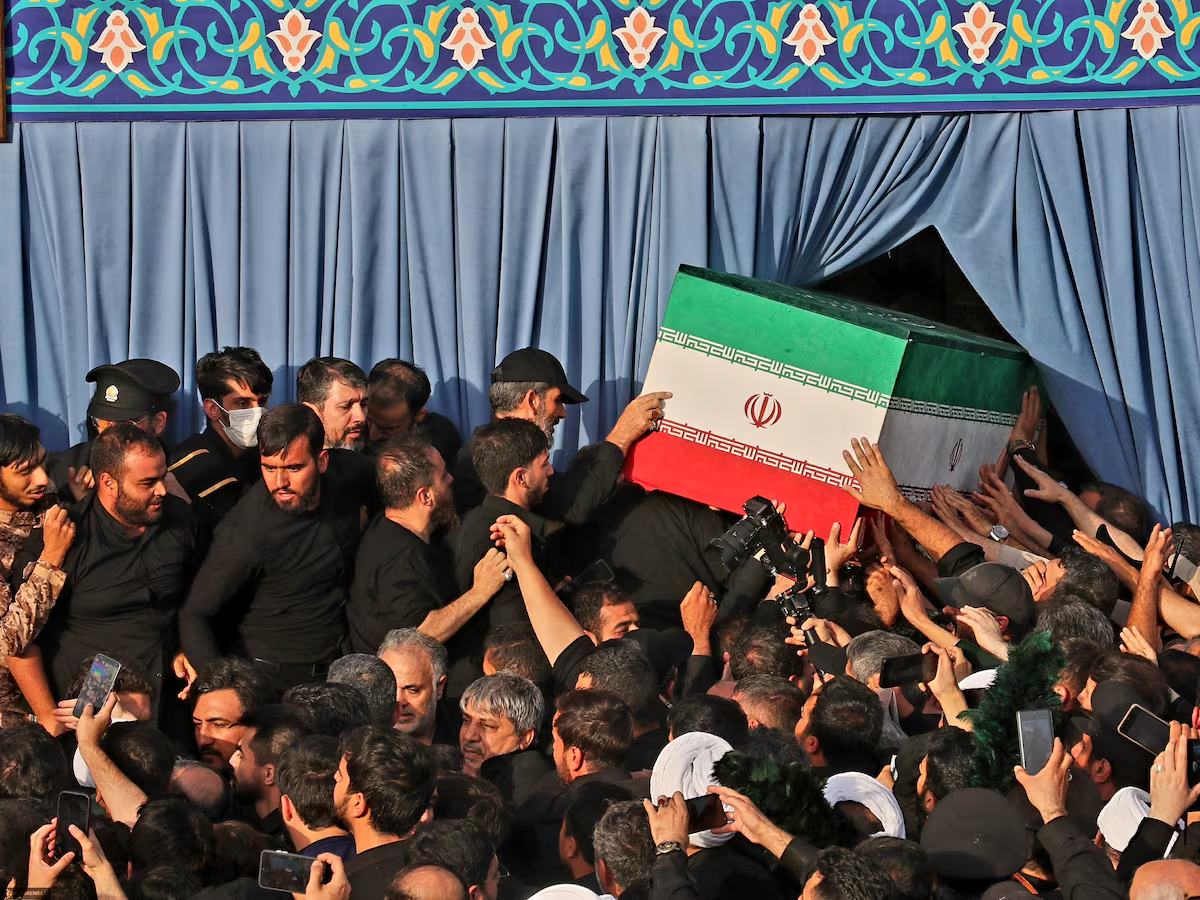
Saraya al‑Salam is not a new formation. It is a direct continuation of the Mahdi Army, which Sadr theatrically “disbanded” years ago while quietly preserving its weapons, commanders, and training camps.
In practice, Saraya al‑Salam has operated as a parallel authority, most notably in the city of Samarra, which it effectively seized under the pretext of protecting the shrines. The militia imposed a sectarian system of control so rigid that even native residents of Samarra were barred from entering their own city unless they could prove they had a relative inside. This is not the behavior of a force that believes in the state; it is the behavior of a force that replaces the state.
READ: UAE says drones targeting Barakah nuclear plant were launched from Iraqi territory
Against this backdrop, Sadr’s new declaration of “integration” appears less like a step toward demilitarization and more like a strategic repositioning. He is attempting to re-enter the political arena as a reformer, a guardian of the state, and a counterweight to Iranian-backed militias. But Iraqis have seen this performance before.
Two days before the Sadrist bloc claimed victory in the 2021 parliamentary elections, the body of activist Haider al‑Zamili was found floating in the waters of Diwaniyah, one day after he was abducted. His only “crime” was posting a caricature mocking Sadr. No serious investigation followed. Everyone understood why: the Mahdi Army’s fingerprints were all over the killing. This is the political culture Sadr built, and it is the culture he now claims he wants to reform.
Sadr’s rhetoric—civil state, sovereignty, anti‑corruption, ending foreign interference—collapses under the weight of his own record. His movement has controlled ministries that represent between one‑third and one‑half of Iraq’s 2021 budget, according to a Reuters analysis. These ministries became hubs of patronage, corruption, and political extortion. The Sadrist current has never governed professionally; it has governed through intimidation, populism, and the logic of the street.
Yet Western policymakers, anxious about Iran’s influence, have periodically flirted with the idea that Sadr could be a “useful counterweight.” Reports in The Financial Times and The Washington Post have portrayed him as a potential partner—an unpredictable one, but preferable to Tehran’s most loyal militias. Former U.S. ambassador Douglas Silliman even described Sadr as “one of the main brakes on Iranian expansion” after the 2018 elections.
But this framing ignores a fundamental truth:
Sadr is not outside the system Iran helped shape. He is a product of it. His religious authority is tied to Ayatollah Kazem al‑Haeri in Qom. His political survival has always depended on avoiding a direct confrontation with Tehran. His periodic “withdrawals” from politics are not acts of principle but tactical retreats.
Sadr’s relationship with Iran is not one of resistance; it is one of negotiation. He cannot afford to antagonize Tehran, and Tehran cannot afford to lose him. Their disagreements are about influence, not ideology.
This is why Iraqis do not trust him. They have lived through the consequences of Sadrist governance: collapsing health services, corrupt ministries, and a political culture that rewards loyalty over competence. They know that integrating Saraya al‑Salam into the state will not weaken the militia; it will embed it deeper into the state. It will give Sadr more leverage, not less. It will make the confrontation with corruption more dangerous, not safer.
Sadr is not a statesman. He is a political cleric who has mastered the art of improvisation in a broken system. His latest announcement is not a step toward reform but another maneuver in a long game of survival.
Iraq does not need another performance. It needs a state. And Muqtada al‑Sadr has spent two decades proving he cannot build one.
OPINION: The illusion of a political solution in Ali al-Zaidi and the Green Zone
The views expressed in this article belong to the author and do not necessarily reflect the editorial policy of Middle East Monitor.