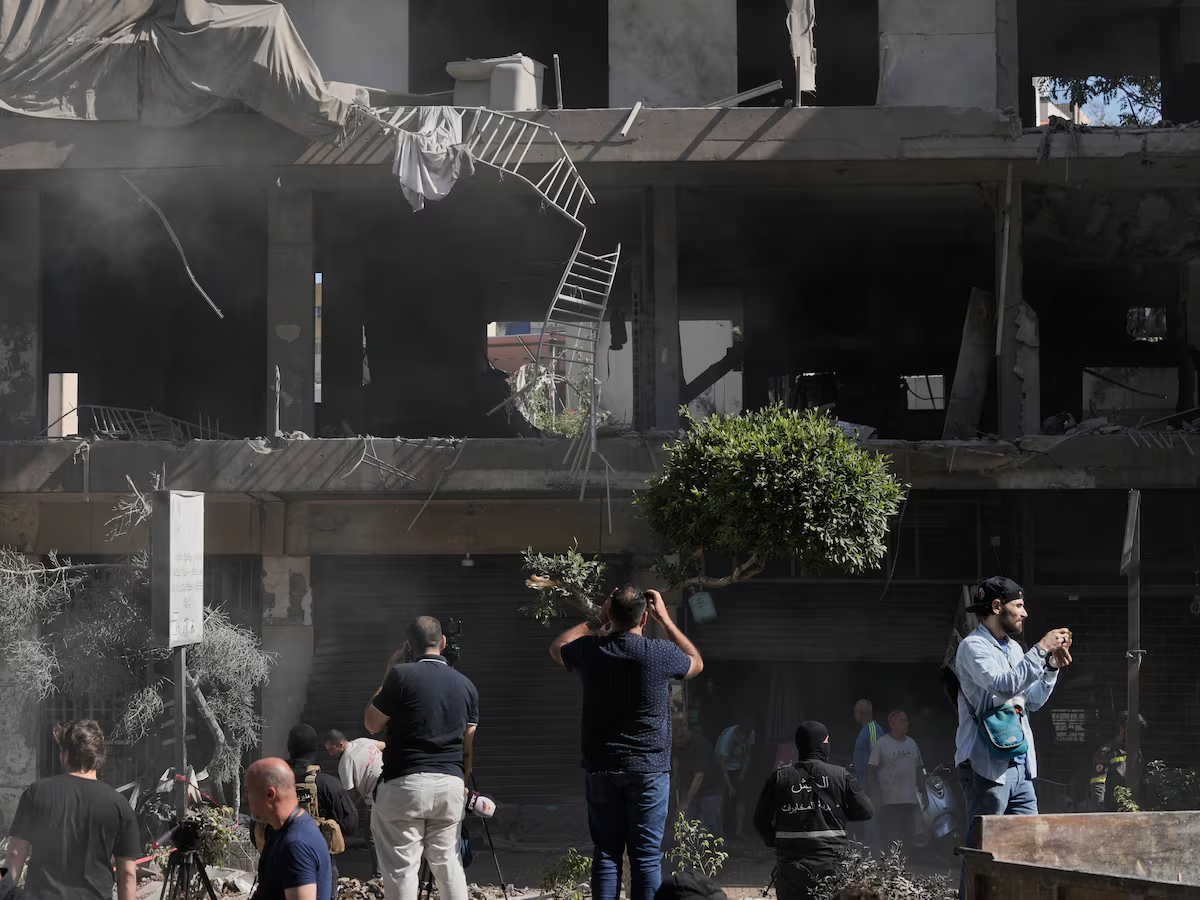
The purchase of massive properties in an abandoned village in Greek-administered Cyprus by an Israeli-linked ‘investor’ has caused a region-wide firestorm, shining a spotlight on what critics describe as Israel’s growing influence in Greek-administered Southern Cyprus.
The abandoned village of Trozena is located roughly 130 kilometres from the divided capital Lefkosa.
Once home to Turkish Cypriots forced out by Greek Cypriot attacks in 1963-64, Trozena’s sale – totalling around 94 plots across approximately 25 acres to a company tied to Hungarian-Israeli investor Uriel Kertesz – has been framed by local media and politicians as an example of “silent occupation” and land grab.
Analysts paint a picture of strategic deepening of Israeli influence that extends far beyond real estate, threatening demography, sovereignty, and regional stability in the Eastern Mediterranean.


The Island of Cyprus, which is geographically an extension of the Anatolian peninsula, is home to two distinct peoples: the Turkish Cypriots and the Greek Cypriots.
Ethnic attacks starting in the early 1960s forced Turkish Cypriots to withdraw into enclaves in the northern parts of the island for their safety.
In 1974, a Greek Cypriot coup aimed at Greece’s annexation of the island led to Türkiye’s military intervention as a guarantor power to protect Turkish Cypriots from persecution and violence.
As a result, the Turkish Republic of Northern Cyprus (TRNC) was founded in 1983.
Related
Zuleyha Karaman, a journalist and political analyst based in Lefkosa in the TRNC, tells TRT World that Trozena is a former Turkish village where Turkish Cypriots lived until 1963-1964, when the Greek Cypriots’ intense attacks on the Turks began.
Later, Greek settlers also abandoned the village in the 1990s.
“It has been interpreted as a new concrete manifestation of Israel’s expansionist and ‘silent occupation’ activities in the region, following years of policies aimed at permanent settlement in Greece-administered Cyprus,” she says.
The Israeli-linked buyer has acquired title deeds by paying 70 individuals for 94 plots, claiming an “eco-tourism” project to “revitalise” the village, she says.
However, construction reportedly began without full permits, fuelling accusations of “land grab” and “covert occupation”.
Zeki Akcam, Vice Rector at Ankara Social Sciences University’s Northern Cyprus Campus, tells TRT World that the Israeli investor secured roughly 70-80 percent of central properties in Trozena, with plans for 60 residential units, a campsite, and a winery.
While local authorities deny total closure of the church or village, the concentration of ownership has alarmed residents.
“The Israeli-linked real estate footprint in Greece-administered Cyprus cannot be interpreted merely as ‘foreigners buying homes’,” he says.
The purchases run into thousands across key districts of Larnaca, Limassol and Pafos, shifting the debate to sovereignty and security, he says.
Scale of acquisitions
Citing data from the Greek Cypriot land registry and interior ministry records, the experts say extensive Israeli activity is taking place at full speed on the Greek-administered part of the island.
Between 2021 and January 2025, Israeli citizens bought 1,406 properties in Larnaca, 1,154 in Limassol, and 1,291 in Paphos.
Overall, non-EU foreign buyers have carried out over 53,000 property transfers with another 29,000 contracts pending as of July 2025, totalling more than 82,000 transactions, Akcam notes.
Israelis rank among the top nationalities alongside Lebanese, Chinese, and Russians.
Karaman points to estimates that around 15,000 Israelis own property in the south, with Jewish organisations such as Chabad active in establishing religious and social infrastructure.
Akcam adds that Israeli-linked companies focus on coastal developments, tourism facilities, large residential projects, and village-scale acquisitions, particularly along the Larnaca-Limassol-Paphos corridor.
“These purchases are not limited to individual homes,” he says.
Related
Greek Cypriot concerns over demography, control
There is rising alarm among Greek Cypriots over the land-grabbing spree by Israeli ‘investors’.
Karaman notes that one in every four properties sold in Greece-administered Cyprus goes to a non-EU citizen, sparking fears of closed communities.
“The Cypriot public harbours deep anxiety over foreigners forming closed communities or ghettos on the island,” she says.