0
The African Agricultural Technology Foundation (AATF) has intensified efforts to improve maize productivity in Kano State by educating farmers and community members on the benefits and proper cultivation of TELA hybrid maize, a climate-smart technology designed to deliver higher yields while reducing crop losses.
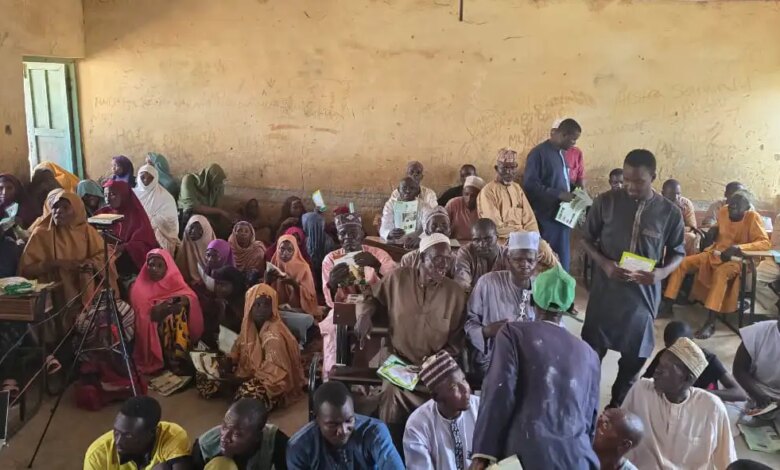
Speaking during a community sensitisation programme in Dawakin Tofa, AATF’s Hybrid Seed Market Development Manager, Mr Olawale Ojo, explained that the initiative was aimed at equipping farmers with the knowledge needed to increase their annual harvests.
He stressed that quality seed remains the foundation of successful farming and one of the most important determinants of crop productivity.


Ojo introduced participants to the TELA Maize Project, explaining its origin, objectives, and the science behind the technology in simple, relatable terms.
Using the example of two farmers cultivating different maize varieties, he demonstrated how modern breeding and biotechnology enabled desirable traits such as insect resistance and drought tolerance to be incorporated into improved seed varieties.
To further illustrate the benefits, he presented comparative images of farms planted with TELA maize and conventional maize.
Farmers unanimously identified the TELA maize field as healthier, more vigorous, and more productive, reinforcing the technology’s value in improving yields.
The session was formally introduced by one of the community’s agricultural extension agents, Malam Bashir, who welcomed participants and introduced the AATF team and other stakeholders present at the event.
Community members actively participated in the interactive discussion.
Jamila Bello recalled seeing a TELA maize demonstration farm and expressed admiration for the quality of the crop.
She said she had been searching for where to obtain the seeds and welcomed AATF’s decision to bring the sensitisation programme to her community.
Addressing widespread misconceptions about genetically modified crops, Mr Ojo clarified that claims suggesting GMO seeds cause cancer or render farmland infertile are false.
He reassured participants that TELA maize has undergone rigorous safety assessments and is safe for both human consumption and the environment.
The sensitisation programme also included practical guidance on recommended planting practices, spacing, fertiliser application and general crop management to enable farmers to maximise the performance of the improved seed.
During the question-and-answer session, farmers sought clarification on several production practices.
Isah Mai Unguwa requested guidance on the correct method of fertiliser application, particularly since TELA maize significantly reduces the need for insecticide sprays.
Another participant asked whether farmers should purchase fresh seed every planting season or could replant seed harvested from previous crops.
Saisu Magaji sought clarification on AATF’s role, asking whether the organisation is a government institution or a private company, while also inquiring about the availability of sample seeds for demonstration purposes.
Nura Usman requested more detailed recommendations on fertiliser measurement and application to achieve optimum yields.
Highlighting the importance of farmer education for women, Laima Bashir observed that many women involved in maize production lack adequate knowledge of proper planting techniques, including correct seed spacing and the number of seeds to place in each planting hole.
She noted that such training is essential for improving productivity while reducing waste of seed and other farm inputs.
One of the participants, Malam Magaji Usman, who has farmed for nearly 45 years, described the sensitisation programme as an eye-opener.
He said that despite decades of farming experience, he had never received such specialised training and expressed appreciation to AATF for bringing the knowledge directly to local farmers.
He encouraged fellow farmers to adopt TELA maize so they too could benefit from improved yields and better crop performance.