0
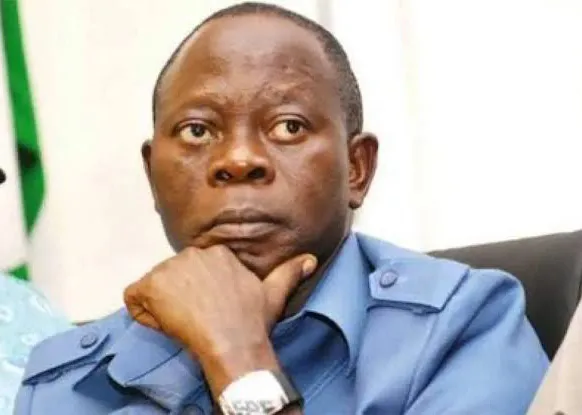
AKURE – Senator Adams Oshiomhole has disclosed that the winner of the June 12, 1993 presidential election, the late Chief MKO Abiola would have been released by the military Head of State, General Sani Abacha if he had accepted to trade off the people’s mandate.
Oshiomhole disclosed this on Friday in Akure Ondo State capital, while delivering the June 12 Democracy Day at the International Culture and Event Centre (The Dome), on “June 12 and Beyond: Reflecting On The Progress Of Democracy and Security Concerns.”
He revealed that the late General Abacha was ready to pay any amount named by Abiola to cover what he expended on his campaign so he could go public and apologize for declaring himself winner of the poll so far described as freest, fairest and most transparent election in the country.

Oshiomhole said: “Abiola could have sold his mandate. The military was ready to pay whatever he demanded to forgo his mandate.
“Abacha told us that he was ready to tolerate and do anything for Abiola, but he was not ready to tolerate that Abiola claimed that he won the election.
“You have to remind us of our history, of where we came from, of the fact that our tongues may differ but our destiny as a people remains shared.
“I remember General Sani Abacha saying that Chief M.K.O. Abiola had to renounce his mandate and even apologize on national television for calling himself President. Yet we could not understand how anyone could tell us that Abiola was not President when we were among those who voted. We were not just witnesses; we participated in the process. How could anyone say he was not President after Nigerians had freely elected him?
“After meeting Abacha, we also met senior government officials who urged us to persuade Abiola to accept certain conditions for his release. I recall that a senior government official requested an opportunity to speak with him if we were able to gain access. After several days, we were eventually allowed to see Abiola at the police headquarters. I handed him a mobile phone so he could speak with those seeking to persuade him.
“I do not know everything that was said to him, but I heard his responses. At one point he remarked that when a person is already inside the river, there is no need to worry about getting wet. Like many times before, he used proverbs to explain why compromise was not part of his character.
“He insisted that he had been elected by the Nigerian people and remained their President. He said he would not betray those who left their farms, offices, businesses and schools to stand in line and vote for him. According to him, their sacrifice could not be monetized or traded away by accepting conditions that undermined the people’s mandate.
“As young people, whether current or future politicians, we must ask ourselves what we would have done in such circumstances. Many people would have accepted a compromise simply to regain their freedom. Yet Abiola chose another path.
“The lesson of June 12 is persistence and loyalty to those who made sacrifices on your behalf. He taught us that not everything can be bought with money and that some principles are worth more than life itself.
“Abiola died, but history has remembered him with honour. Those who opposed him have faded into the background, while his legacy endures. That is why we continue to celebrate June 12 and the life of Chief M.K.O. Abiola.
“After one of our meetings, Abiola asked whether we could resume the strike. I told him that the people were ready. However, by then, certain divisive elements had infiltrated the struggle against the annulment of June 12, and even the pro-democracy movement had become divided.
“I personally experienced detention during that period. Security operatives picked me up and eventually transferred me to military intelligence detention facilities. It was there that I learned the difference between ordinary police detention and military detention.
“Some cells were underground, without windows or light, with water covering the floor. Spending even twenty-four hours in such conditions was enough to make anyone appreciate the value of freedom.
“That is why I always tell young people, civil society activists and journalists that freedom, even in poverty, is something to be treasured. It is possible to lose both freedom and prosperity.
“When people dismiss democracy because of economic hardship, they forget what life was like under military rule. A person who has experienced detention without trial understands that freedom alone can make one feel richer than any amount of money.
“Democracy does not promise a perfect society. What it guarantees is the freedom to speak, the freedom to criticize, and the protection of the rule of law. If you break the law, you are taken before a court, not detained indefinitely without trial.
“At the heart of the June 12 struggle is the understanding that democracy should not be measured solely by wealth or material comfort. If money were everything, Abiola could have accepted a settlement and walked away. Instead, he chose to defend the mandate given to him by Nigerians.