0
Michael David
The Nigerian Army says it will continue to explore innovative training approaches and strengthen inter-agency collaboration to enhance its capacity to address emerging security challenges across the country.
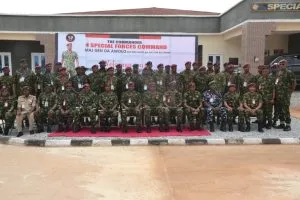
Maj.-Gen. Olurotimi Awolo, the Commander, 4 Special Forces Command, Doma, stated this on Thursday at the closing ceremony of the 2026 Operations Planning Cadre held in Doma, Nasarawa State.

Awolo said that the training programme wpas designed to equip junior commanders with operational and logistics planning skills required to function effectively in joint and multi-dimensional operational environments.
He noted that the cadre brought together seasoned resource persons and participants from different security backgrounds to exchange ideas and strengthen the operational effectiveness of the Nigerian Army and the Armed Forces.
According to him, the Army remains at the forefront of efforts to combat various security threats confronting the nation and must continually adapt to evolving challenges.
“To this end, we will continue to explore new ways and means such as this to train and retrain our junior commanders and personnel from other security agencies.
“This is aimed at developing the required approaches for addressing contemporary security challenges and preparing for future operational contingencies,” he said.
The commander expressed confidence that the cadre had enhanced participants’ capabilities in operational planning, intelligence gathering, logistics management and battlefield appreciation in both conventional and asymmetric warfare operations.
He said that the training was conducted under the theme: “Tactical Leadership Capacity Building and Multi-Agency Approach to Asymmetric Operations in Joint Operations Area.”
Awolo explained that lectures and discussions during the programme focused on key areas, including levels of warfare and operations planning, manoeuvrist approach to warfare, estimate process, operational planning and design concepts.
Others are intelligence and logistics preparation of the battlefield, as well as combat estimate.
He said that the topics were carefully selected to address operational, intelligence and logistics challenges that could affect mission success in the field.
The commander added that the presentations by resource persons and robust interactive sessions had achieved the objectives of the training programme.
Awolo reiterated the commitment of the 4 Special Forces Command and the Nigerian Army to their constitutional responsibility of defending Nigeria’s territorial integrity.
“The Nigerian Army remains highly committed to its constitutional role of defending the territorial integrity of our nation.
“We are also ready to support civil authorities in any capacity that will guarantee the maintenance of law and order within our area of responsibility,” he said.
He commended the Chief of Army Staff, Lt.-Gen. Waidi Shaibu, for supporting the successful organisation of the cadre and appreciated the organising committee, resource persons and observers from Army Headquarters for their contributions.
Awolo urged participants to apply the knowledge acquired during the training in their various units, particularly in joint operations involving different security agencies.
One of the participants, DSP Chukwu Friday Ogbonna of the Nigeria Police Force, said the course had deepened his understanding of collaboration among security agencies.
Ogbonna, who serves as Police Component Commander at Operation Whirl Stroke Headquarters, said the training underscored the importance of synergy between the police, military and other security agencies in combating insecurity.
He said enhanced cooperation among security agencies would provide a stronger advantage in confronting criminal elements and other threats to national security.