0
For more than four decades, Nigerian artist Asidere Duke has quietly documented life as he sees it, the joys and griefs of family, the strength of women, the contradictions of society, and the everyday experiences that define the Nigerian story.
Today, those stories come alive in a major solo exhibition currently showing at Adegbola Gallery in Victoria Island, Lagos.
Organised by Adegbola Gallery in collaboration with Fresco Gallery, the exhibition, titled ‘Asidere / Duke,’ opened on June 5 and will run until July 18, 2026. It offers art lovers a rare opportunity to journey through Duke’s extensive body of work, spanning from the 1980s to the present day.


Stepping into the gallery, visitors are welcomed by soft yellow lighting that casts a warm glow over the artworks adorning the walls. Each section of the exhibition tells its own story, inviting viewers to pause, reflect and engage with the artist’s world.
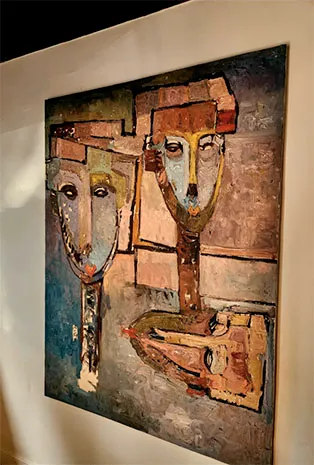
The exhibition explores themes of friendship, grief, domestic life and Nigeria’s social realities. Through paintings layered with memory and emotion, Duke pays tribute to the women who shaped the homes and communities around him, while also confronting the failures, contradictions and injustices that continue to define contemporary Nigeria.
Working across oil, graphite, watercolour, acrylic and mixed media, Duke creates textured surfaces that resist easy interpretation. He engraves lines into his paintings and embeds fragments of everyday life: bank cards, newspaper clippings and medical prescriptions — into the works, allowing each piece to reveal new meanings with every encounter.
The exhibition also reflects the dual identity that has shaped his artistic journey. On one hand is Asidere Duke, the instinctive painter guided by emotion, colour and memory. On the other is Duke Asidere, the disciplined artist trained at Ahmadu Bello University, Zaria, under the influence of technical rigour and experimentation.
Mentored by the legendary Professor Bruce Onobrakpeya, Duke belongs to an important generation of Nigerian artists whose works combine formal training with keen social observation.
Perhaps one of the exhibition’s most intriguing attractions is a collection of annotated clocks displayed as installations. Ordinary clock faces transformed with drawings, writings and observations from everyday Nigerian life become powerful records of time and society.
Where the paintings absorb fragments of the world into their surfaces, the clocks push those observations outward, turning time itself into both subject and witness.
Speaking at the opening of the exhibition, Duke described the showcase as a reflection of his life’s journey.
“This exhibition is a story with multiple events,” he said. “It covers story, history and emotion. All of that tells you the journey of the day.”
According to him, even he was surprised by some of the works that resurfaced from his personal collection.
“There are works I didn’t know were still in my collection until I saw them in this space. We have works from the 1980s, the 1990s and the early 2000s. It is just a story of experience, how I walk through a maze of the things in my life, and it means you need to experience this.”
Reflecting on his artistic journey, Duke likened it to reading a book in which he is both participant and observer.
“It’s been exciting,” he said. “It’s like reading a book, and you’re part of the book you’re reading. It’s fun.”
On navigating changes brought about by innovation and technology, he noted that adaptation remains essential.
“There will be adaptations. You have to understand the plan and be part of the plan. So it’s fun on both sides,” he said.
Despite decades of practice and public recognition, Duke insisted that he does not create works merely to attract attention.
“I don’t do headlines. I’m not an internet trender. I just create art,” he declared.
Explaining the origin of the clock installations, the artist revealed that they were never intended to be exhibited as artworks.
Some of the clocks, he explained, were made to mark personal milestones, including birthdays celebrated by members of his family.
“My kids were turning 10, so I did the ABC for them. People come and ask me to do a clock for them. Most of these clocks were in my bedroom. They were items for personal use. I didn’t create them as art pieces, but for this exhibition they are being shown as installations.”