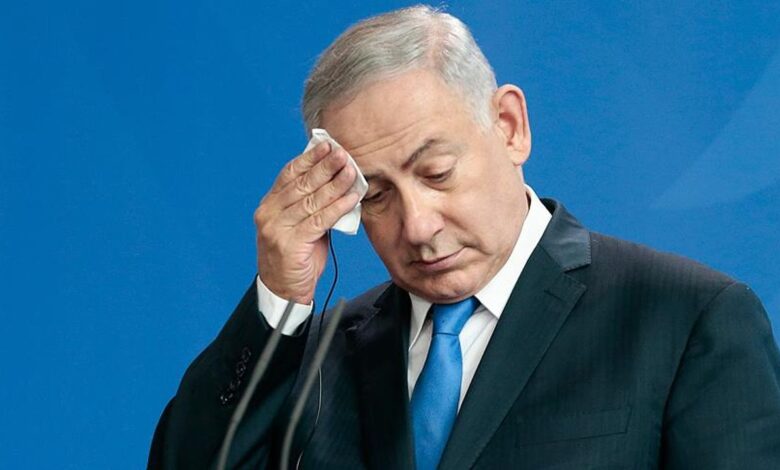
Benjamin Netanyahu walked into a Tel Aviv courtroom in October 2025 to answer for bribery, fraud and breach of trust, and walked out ninety minutes later because the nation, he said, needed him elsewhere.
He had been testifying in an underground hall in Tel Aviv, moved there from West Jerusalem on the Shin Bet’s recommendation for his security, in a trial that began in 2020 and has no end date in sight.
When Israel announced a ceasefire with Iran in April 2026, his lawyers filed for a further two-week postponement of his testimony, not because the war was still being fought, but because of what the filing called the dramatic events that had taken place across Gaza, Lebanon and Iran in recent times.
The trial has survived a genocide in Gaza, the war in Lebanon, and a forty-day illegal aggression on Iran, and so has he, for the sixth consecutive year.
On June 1, 2026, with five months until the national election that most polls show he will lose, Netanyahu ordered fresh strikes on Beirut’s southern suburbs, the third major escalation since the Iran ceasefire he had just asked his lawyers to use as grounds for delaying his court testimony.
In Beirut’s southern suburbs, residents fled again, carrying documents, children, medicine, keys, the accumulated weight of a life interrupted for the second time in eight months.
Since March 2026, Lebanese authorities have recorded more than 3,000 killed, including over 200 women and children, and more than one million displaced.
On the evening of May 28, an Israeli airstrike on a residential building in Gaza City killed four children. Others had been playing in a nearby park when it happened, according to health officials on the ground.
Since the nominal ceasefire of October 2025, Israeli strikes have continued across Gaza, adding to a toll that passed over 72,000 killed before the year was out.
In January 2026, the Israeli occupying army told journalists it accepted that approximately 70,000 people had been killed, a figure the Gaza’s Health Ministry had long published and Israel had long disputed, now confirmed by the institution conducting the genocidal campaign.
Related
The wars that share a coalition
Most Israeli political commentators have noticed that Netanyahu’s prolonged wars are good for his legal calendar. Fewer have asked why they have not rescued his politics.
Poll after poll since October 2023 has kept his coalition below a governing majority, ten seats short of the 61 he needs, despite three simultaneous fronts of active combat across Gaza, Lebanon and Iran.
When Netanyahu declared in September 2025 that Israel must become a “Super Sparta”, self-sufficient in arms, resigned to international isolation, his own stock market fell in response.
The explanation is structural rather than rhetorical: the wars serve the trial, the coalition serves the wars, and the politics has been left to manage itself.
The problem is not that Israelis have stopped fearing; it is that after three decades of permanent emergency, they have stopped believing the fear requires this particular man to manage it.
The political formation Netanyahu built to survive his trial – and even as the PM – has developed its own logic, its own territorial ambitions, and its own capacity for violence, leaving him dependent on it rather than the reverse.
In Gaza, the genocidal campaign has continued despite repeated Israeli acknowledgements that Hamas cannot be defeated by military force alone.
Its continuation is the price demanded by the far-right ministers, without whose votes, Netanyahu has no government and no shield from the verdict waiting in the underground hall in Tel Aviv.
In the occupied West Bank, Israel’s military commander warned in a closed forum in May 2026 that settler attacks on Palestinian civilians risked igniting an uprising. He called their conduct a disgrace to the Jewish people.