‘Charismatic but naive’: Taiwanese opposition KMT chief’s peacemaker pitch leaves US unimpressed

PHILADELPHIA/TAIPEI – Ambitious, energetic and perhaps a bit naive.
That might be a fair take on how Taiwan’s Beijing-friendly opposition leader Cheng Li-wun was sized up in Washington.
Cheng’s two-week-long US tour, which kicked off on June 1 in San Francisco, drummed up considerable interest, if not enthusiasm.
In April, the charismatic 57-year-old became the first leader of Kuomintang (KMT) in a decade to meet Chinese President Xi Jinping, who is also the general secretary of the Communist Party of China.

The spectacle of Cheng walking into the Great Hall of the People, where Xi also received US President Donald Trump in May, drove her political stock higher.
Could she become president of Taiwan one day? Within the US foreign policy establishment, the idea elicited caution. Washington, which seemed to be lukewarm to her visit, did not roll out the red carpet for her.
The requested meeting with US President Donald Trump did not materialise; that was a reach, as Cheng herself readily admitted.
But what may have stung is that a scheduled meeting at the White House with officials in the National Security Council did not pan out either.
First, its location was changed from the White House to the American Institute in Taiwan’s Washington headquarters and then it was called off for reasons that have not been made public. In Taipei, the American Institute in Taiwan is the de facto US embassy.
Cheng, however, did score closed-door meetings with influential Republican senators and congressmen like Dan Sullivan, who sits on the Senate Armed Services Committee, Brian Mast, who chairs the House Committee on Foreign Affairs, and Young Kim, who chairs the sub-committee on East Asia. She also met Trump’s ally Steve Daines, a senator who has helped spearhead the White House outreach to Beijing.
Several other lawmakers reportedly refused to meet her because of the way she used KMT’s legislative majority to considerably pare Taiwan’s defence budget. Sullivan, in February, had accused the KMT of “short-changing Taiwan’s defence to kowtow to the CCP (Chinese Communist Party)” and warned that it was “playing with fire”.
Her statement that the first island chain should transform “from a front line of geopolitical contestation into a chain of peace and prosperity” was also a point of contention. The first island chain is a string of major archipelagos, including Japan, Taiwan, the northern Philippines and Borneo, that blocks China’s access to the wider Pacific Ocean.
Cheng’s remarks effectively call for the dismantling of a core US defence strategy that has been in place for over 70 years. It also aligns with Beijing’s longstanding geopolitical narrative.
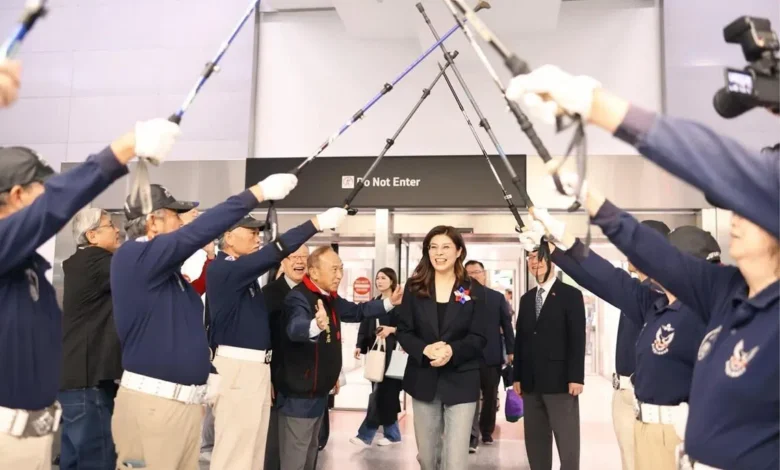
Taiwanese opposition leader Cheng Li-wun arriving in San Francisco and being welcomed by overseas Taiwanese on June 2.
PHOTO: KUOMINTANG
The one bright spot for Cheng during her visit was the boisterous welcome she got from the Taiwanese diaspora. Wealthy and keenly vested in politics back home, about 700 people of Taiwanese origin at a banquet in New York on June 8 were clearly happy to see her. The KMT leader will attend another similar event in Los Angeles before flying back to Taipei.
Cheng, who did her master’s in law at Temple University in Philadelphia, also drew curious and enthusiastic crowds at top US universities, including Harvard, Columbia and MIT.
But addressing hours-long private sessions with analysts at think-tanks like the Hoover Institution, the Stimson Center and the Eurasia Group, she faced a more sceptical audience.
Her aspirational role as a cross-strait peacemaker was probed for its soundness and mostly declared unconvincing.
At a time when Beijing and Taipei have no formal interactions under President William Lai Ching-te – who is also chairman of independence-leaning Democratic Progressive Party (DPP) – Cheng maintains that she is the leader best positioned to guarantee stability across the Taiwan Strait. Official communication mechanisms between Taipei and Beijing have been frozen since the DPP assumed power in 2016.
Cheng made a case for seeking reconciliation with Beijing in an article in Foreign Affairs magazine ahead of her US visit.
“Should the KMT return to power in Taiwan’s next presidential election, in 2028, its cross-strait agenda will focus on policies that aim to institutionalise peace,” she wrote in the March 3 piece, adding that the KMT would set up crisis-communication channels to establish direct contact between Beijing and Taipei.
“Working with both Beijing and Washington is not only possible but necessary. Neither side should view such an approach as a betrayal,” she said.
“For Washington, a Taiwan that maintains economic ties with the mainland while deepening technological and broader cooperation with the US demonstrates exactly the kind of resilient, pragmatic partnership that it needs in Asia. A capable partner that manages its own complex relationships is better for the US than a dependant that requires constant reassurance.”
Her formulation was challenged, gently, at a sold-out public event at the Asia Society in New York.
She was asked if she had got a sense from Xi, during her meeting with him, whether he would be willing to accept a long-term status quo in which Taiwan remains a self-governing, democratic society. Xi has spoken of the self-ruled island’s reunification with the mainland as “unstoppable”.
“The existence of Taiwan will not challenge the CCP’s legitimacy and legality,” she answered. “Both sides of the Taiwan Strait belong to the same great Chinese nation, so there will be great space for us to maintain the status quo,” she said.
“Isn’t there a big difference between being part of the great Chinese nation and being part of the People’s Republic of China,” Danny Russel, a distinguished fellow at the Asia Society Policy Institute and a former senior State Department official, asked, referring to China by its formal name.

Taiwanese opposition leader Cheng Li-wun with Chinese President Xi Jinping at the Great Hall of the People in Beijing on April 10.
PHOTO: REUTERS
“If the existence of Taiwan doesn’t threaten the PRC, as you said, why does the PRC threaten the existence of Taiwan?” he asked.
Cheng replied: “What I mean by the threat is the concept of Taiwan independence… This is something they cannot accept.”
Orville Schell, vice-president of the Center on US-China Relations at Asia Society, asked her to imagine herself as president dealing with China.
“Do you think Xi Jinping or his successor and the People’s Republic of China would feel comfortable to have a democracy… Taiwan, as it is now… just off the border? Where do you think it would be inclined to want to control, meddle, interfere?”
“It is never our expectation that either side of the Taiwan Strait will have to sacrifice or to make compromises or give up the existing way of life,” she replied. “If in order to seek peace, we have to give that up, that is not true peace.”
She also resisted the idea that Taiwan could meet the fate of Hong Kong, which maintains separate legal, administrative and judicial systems from mainland China, but has seen its autonomy eroded.
“Taiwan is now a mature democracy with rule of law, which is very different from Hong Kong. So no one can hand Taiwan back to China,” she said.
Schell pressed further. “Do you have confidence, as a result of having visited general secretary Xi Jinping, that if KMT comes to power and says ‘no independence, just leave us alone’, that he would say ‘good’?” he asked.
“I would not describe it as ‘leave us alone’ because when it comes to cross-strait relations, there will be a lot of exchanges,” Cheng said, repeatedly coming back to her core idea that “innovation and creativity” and time could ease cross-strait ties.
Russel, who remained unconvinced, told her at the end of the session: “Your goals are admirable, your optimism impressive.”
Washington has found her approach of seeking greater engagement with Beijing mostly dubious. Or naive, at best.
Dennis Wilder, a professor at Georgetown and Texas A&M universities and a former senior director for East Asia at the National Security Council, noted that she had impressed her US audiences with her ability to articulate her views on cross-strait relations.
“But there is a great deal of suspicion that she is being exploited by Beijing,” he added. “This is more a factor of US suspicion of Xi Jinping’s commitment to peaceful unification.”
He noted that Cheng did not receive a high-level welcome by either the Trump administration or the US Congress, demonstrating Washington’s sympathy with the DPP.
“There is a bias in Washington that she is too far outside the KMT norm. But some are wondering whether this analysis is too narrow, given that, worldwide, democracies are electing unconventional candidates. But I do believe there is a sense that she should be taken seriously, even if only because she could be an effective tool of Beijing.”
Bonnie Glaser, managing director of the Indo-Pacific programme at the German Marshall Fund of the United States, said that it was not realistic to suppose that the US would hope to see a president of Taiwan negotiate with Beijing and Washington to achieve the best deal for Taiwan.
The US seeks to preserve stability in the Taiwan Strait and prevent Chinese coercion or use of force against Taiwan, she said.
“The US wants Taiwan to strengthen deterrence, including defence spending, training and societal resilience. Taiwan must demonstrate resolve to defend itself. The DPP is the party that has shown this determination,” she said.
“The underlying assumption of Cheng’s blueprint for cross-strait relations is that Xi Jinping will go along and support her approach and agenda. She is very confident that Taiwan can preserve its autonomy and not end up like Hong Kong. I doubt her confidence is well founded,” she said.
Amanda Hsiao, the Taiwan lead at geopolitical risk consultancy Eurasia Group, said Cheng’s trip is unlikely to have changed minds that were already sceptical of her cross-strait and defence views.
“Without greater clarity over the KMT’s defence strategy, many in Washington will see Cheng’s optimism about managing differences with China as naive,” she said.
Cheng’s political viability would depend on her ability to appeal to Taiwanese voters and lead her party to success in the November local elections, she added.
Yeh Yao-yuan, a political science professor and Taiwan studies expert at the University of St Thomas in Houston, said that besides communicating the KMT’s position to US scholars and officials, Cheng’s mission was to appeal to the Taiwanese diaspora, who could be important sources of donations for elections.
“She’s gauging the mood to see if the community there would support her bid to run for president in 2028,” said Yeh.
Cheng was trying to thread a tricky balance between being viewed as a politician who is pro-engagement with China and one who can earn the trust and approval of the Washington establishment, said William Yang, senior analyst for North-east Asia at the International Crisis Group.
“However, some of her remarks during the trip haven’t necessarily helped to improve the public perception about her stance and approach because her proposal lacks substance to back up her pitch in the name of ‘peace’,” he said.