Chinese proverb of the day: 'The toad wants to eat the swan' delivers a blunt reality check on overreaching ambition

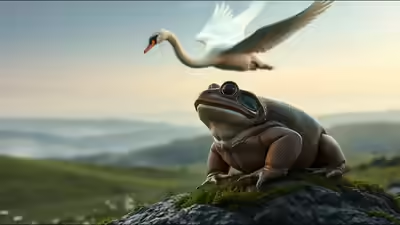
A toad can only dream about eating the swan. It can never happen in reality as it’s a wild desire, an unrealistic dream. It is a famous and old Chinese saying that brings people down to earth, not by clipping their wings, but by reminding them of their capabilities. There is a touch of contempt in the proverb but that is to make this an unforgettable picture of impossible desire to discourage people from confusing fantasy with reality.Chinese proverb of the day: ‘The toad wants to eat the swan’
Swan stands for elegance, toad is at the bottom
In Chinese culture, as in the West, the swan is an emblem of purity, grace, elegance, and nobility. It is a creature of the heavens, capable of effortless flight, associated with high status and untainted beauty. The toad on the other hand represents the absolute bottom of the aesthetic and environmental hierarchy. It lives in the muck, moves with clumsy hops, and is visually unappealing.The proverb does not merely state that the toad admires the swan; it states that the toad wants to eat the swan. Eating implies possession, consumption, and assimilation. Therefore, the proverb targets a specific type of desire, not passive admiration from afar, but an active, audacious pursuit to claim something far superior to oneself.
Origin of the Chinese proverb
While the exact origin of the phrase is rooted in ancient Chinese folklore and colloquial speech, it gained immense literary permanence through its usage in classic Chinese literature, most notably in Cao Xueqin’s 18th-century masterpiece, Dream of the Red Chamber (Honglou Meng). In the novel, characters use the phrase to mock those who attempt to climb into the rigid upper echelons of imperial aristocratic society through marriage or association.Historically, Chinese society was highly stratified, governed by strict Confucian hierarchies that dictated that marriages and partnerships should be formed between families of equal social status and wealth. Within this rigid framework, the proverb functioned as a social corrective and was mostly applicable for romantic relationships. If a poor scholar from a destitute village attempted to court the daughter of a high-ranking minister, people would say, “The toad wants to eat swan meat.“
Killing ambition?
But what is wrong if a toad dreams big? Isn’t the proverb demeaning the toad by asking it to return to its place? As the shackles of society have relaxed and now “marrying out of the league” is not frowned upon as much as it used to be, the proverb comes into play in other spheres of life when people foster delusion. The proverb, in its modern interpretation, is not against ambition. But it is warning against something which is absolutely not possible.Chinese culture has long admired hard work and perseverance. The proverb criticizes desires that are disconnected from reality and unsupported by effort, preparation, or ability.Someone who dreams of becoming a concert pianist while practicing eight hours a day is very different from someone who expects fame without learning the instrument. An entrepreneur who studies the market, develops skills, and accepts setbacks differs greatly from someone who simply expects success to appear. The proverb criticizes entitlement more than aspiration.
Similar proverbs around the world
English speakers sometimes say, “Don’t count your chickens before they hatch,” warning against unrealistic expectations.Another English expression, “Building castles in the air,” refers to impossible dreams disconnected from reality.The Spanish saying “Asking for the moon” describes someone demanding the impossible.French speakers use expressions about wanting more than one deserves, while Russian and Arabic traditions also contain proverbs warning against excessive ambition.Yet the Chinese version stands apart because of its striking imagery of a small toad imagining itself capable of catching a magnificent swan.
Social media and delusion
In the age of social media, the proverb feels surprisingly modern.Online platforms constantly expose people to glamorous lifestyles, luxury goods, celebrity relationships, and overnight success stories. This can create unrealistic expectations about careers, wealth, appearance, and personal relationships. Many people compare themselves with carefully curated images rather than everyday reality. The proverb encourages healthy self-awareness.The Chinese proverb of the toad and the swan is a mirror held up to human desire. It captures the eternal tension between our reality (where we currently stand) and our aspirations (where we wish to be). The proverb survives because it balances a fine line between caution and comedy. It warns us against the dangers of unearned entitlement and blind delusion, reminding us that true growth requires self-awareness. Yet, at the same time, it unintentionally honors the audacity of human hope. It reminds us that no matter how deep in the mud we may find ourselves, it is our nature to look up at the sky and reach for something beautiful.