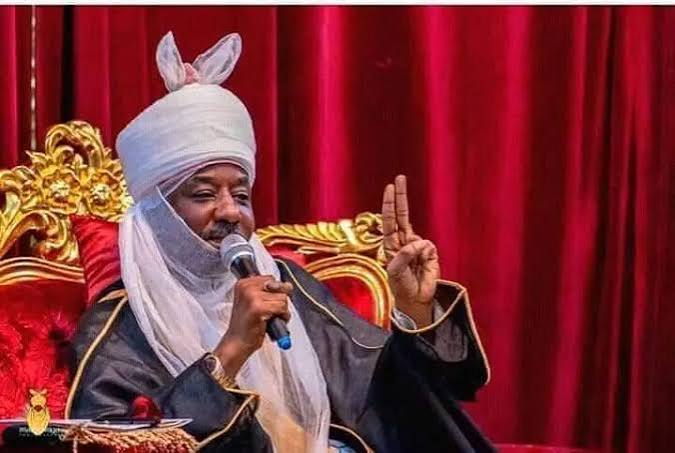
The Emir of Kano, Muhammadu Sanusi II, has criticised the National Assembly for failing to fulfil its constitutional responsibility by allowing successive Federal Governments to breach legal limits on borrowing from the Central Bank of Nigeria (CBN).
Speaking over the weekend on the importance of strengthening democratic institutions and promoting accountability, the former CBN governor accused lawmakers of neglecting their oversight role despite repeated violations of the law governing government borrowing from the apex bank.
Sanusi argued that the legislature’s failure to enforce existing laws contributed significantly to Nigeria’s fiscal challenges, stressing that democratic institutions can only function effectively when they operate independently and hold the executive accountable.
According to the Emir, the relevant legislation clearly restricts the Federal Government from borrowing more than five per cent of the previous year’s revenue from the Central Bank. However, he alleged that this legal provision was repeatedly ignored without any meaningful intervention from the National Assembly.
“The law said you cannot lend more than five per cent of last year’s revenue. That law was broken with impunity. Where was the National Assembly? For eight years, the National Assembly was silent,” he said.
Sanusi maintained that the legislature’s primary responsibility extends beyond passing laws to ensuring that they are faithfully implemented and enforced. He warned that when lawmakers fail to challenge the executive, they undermine the principle of separation of powers.
“The legislature is supposed to make laws and ensure those laws are obeyed. If it cannot stand up to the executive, then it simply becomes an extension of the executive rather than an independent institution,” he stated.
Reflecting on his own experience as Governor of the Central Bank of Nigeria, Sanusi contrasted the scrutiny he faced with what he described as the legislature’s inaction over government borrowing.
“I was summoned before the National Assembly more than 20 times over minor matters relating to the Central Bank. I was questioned, harassed and challenged. Yet, for eight years, when the borrowing law was being violated, the same lawmakers remained silent,” he recalled.
The former CBN governor argued that Nigeria’s economic difficulties could have been mitigated if public institutions had consistently upheld the rule of law and demanded greater accountability from those in power.
He stressed that effective oversight by the legislature is essential to promoting fiscal discipline and safeguarding public finances, adding that stronger democratic institutions remain critical to preventing similar economic challenges in the future.
Sanusi’s remarks come amid ongoing national conversations about fiscal responsibility, institutional independence and the need for stronger checks and balances in Nigeria’s democratic system.