Ex-Minister Uche Nnaji Still Receiving Millions in Salaries Nine Months After Removal From Office

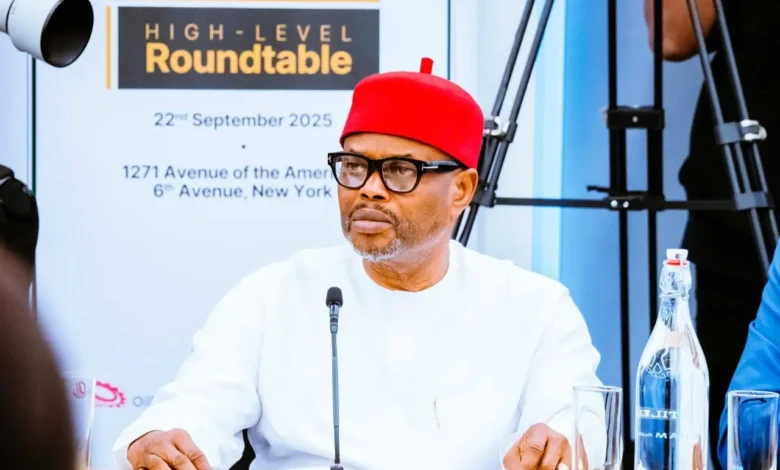
Geoffrey Uchechukwu Nnaji, the disgraced former minister of science and technology now at large amid federal charges, has continued to receive monthly salaries and allowances nine months after leaving office, federal payroll records obtained by Peoples Gazette showed.
Mr Nnaji left office on October 7, 2025, after Peoples Gazette reported he had forged both his National Youth Service Corps (NYSC) certificate and a degree certificate from the University of Nigeria. However, his name has remained on the federal payroll as of June 2026.
Papers from the Integrated Payroll and Personnel Information System (IPPIS) delivered to The Gazette showed that the former minister—under payroll number 561829—has continued to receive N1.1 million in monthly basic salaries alone. Ministry officials said the federal government had paid Mr Nnaji at least N12.8 million in monthly allowances that should have been cut immediately after his ouster by President Bola Tinubu.
Internal messages seen by The Gazette showed ministry officials believed Mr Nnaji had received at least N125 million since October 2025, when he stopped being a minister, with officials fearing up to N300 million had been paid to the minister in illegal benefits over the past nine months.

As of June 15, the minister had been queued to receive his June 2026 salary, which would imminently be paid into his First Bank account, according to people familiar with the payroll infrastructure.
The ceaseless flow of public funds to a politician who no longer holds public office underscores yet again the economic toll of Nigeria’s unwieldy IPPIS infrastructure, which critics say has failed to meaningfully curb opportunistic graft two decades after it was instituted.
In 2022, The Gazette reported how the public payroll system failed to cut payment to Bashir Ahmad, a media aide to President Muhammadu Buhari, several months after he resigned from office to seek the ruling APC’s House of Representatives ticket in Kano.
Nefarious exit
Mr Nnaji was among the first set of ministerial nominees President Bola Tinubu submitted to the Senate in July 2023. Following this, the State Security Service (SSS) conducted a background check, during which it contacted the NYSC to verify the Enugu-born businessman’s credentials.
The Gazette reported that the NYSC alerted the SSS about Mr Nnaji’s falsified academic documents. The SSS concealed the evidence from the Nigerian Senate, leading members of the red chamber to confirm a fraudster as minister in August 2023.
Among the documents Mr Nnaji submitted to lawmakers were his West African Examinations Council (WAEC) certificate, degree from UNN, tax records, and filings with the Code of Conduct Bureau.
His certificate indicated that he enrolled in the youth service on April 16, 1985, and completed it on May 15, 1986—a period of 13 months—contrary to the scheme’s standard one-year duration since its inception in 1973. NYSC officials also told this outlet that they could not find a copy in their possession that carried the duration stated on Mr Nnaji’s certificate.
According to the NYSC certificate he presented, Mr Nnaji began national service before graduating from UNN in July 1985, marking another indication of its fabrication. He later admitted that UNN never issued him a certificate.
A flurry of court cases followed The Gazette’s story, forcing the politician to tender his resignation, claiming, without evidence, that he had been the target of “blackmail” by political rivals in his home state of Enugu.
Following his removal from office, Mr Nnaji disappeared from public life, and the anti-graft office, Independent Corrupt Practices and Other Related Offences Commission (ICPC), launched a criminal inquiry.
He subsequently went underground, and a federal court recently issued a warrant for his arrest.
Drawing millions out of office
Mr Nnaji did not return a request for comment on why he continued to receive monthly salaries and allowances long after leaving office, and whether or not he planned to return the illegal benefits.
He has repeatedly denied corruption allegations in previous statements about his conduct in office, and often reprimands his political detractors for being behind efforts to defame him before Nigerians.
Federal sources told The Gazette that the former minister remains on the payroll because the official responsible for removing him from the system failed to take the necessary action. However, it remains unclear whether it was deliberate or an administrative oversight.
The IPPIS continued processing the former minister’s payments even after his banking information should have been cleared from the system, officials from the Federal Ministry of Innovation, Science, and Technology said.
“He was not removed, and we don’t know if it was deliberate corruption or an oversight on the part of our human resources desk,” a ministry official said under anonymity to comment on the matter.
“We’re still calculating how much he has been getting every month because of this mistake,” the official added. “But we have found N125 million so far.”
“We expect that he would have received more than N300 million over the past nine months,” the official noted, adding that only a negligible miscellany of allowances had been cut because he was no longer active.
A spokesman for the ministry did not immediately return a request seeking comments.
Among the most notable public officials is Mr Ahmad, who resigned on May 11, 2022, to contest the House of Representatives ticket.
IPPIS records indicated that Mr Ahmad continued to receive salaries for May, June, and July 2022, earning a monthly net pay of N876,738.37 after statutory deductions.
“I had returned the salaries I received during the period I wasn’t in the office,” Mr Ahmad said in a message to The Gazette at the time. He, however, declined to provide proof that the payment had been refunded to the federal treasury.
A review of over a dozen officials who left public service following the expiration of Mr Buhari’s tenure in May 2023 showed they were promptly cut from the payroll system.
Similarly, Betta Edu was removed from the IPPIS system after being suspended from office on corruption charges in January 2024.
IPPIS
The IPPIS was instituted by President Olusegun Obasanjo in 2006 to improve the effectiveness and efficiency of payroll administration, with the former Nigerian leader expressing hope that the system would help address the menace of ‘ghost working’. It was first deployed in April 2007 with support from a $5 million loan from the World Bank.
Initially managed by the Bureau of Public Service Reforms (BPSR), the platform was transferred to the Office of the Accountant-General of the Federation (OAGF) in 2008.
It was designed to harmonise personnel records across ministries, departments and agencies, streamline salary payments, eliminate ghost workers, and manage statutory deductions for taxes, pensions, and other third-party payments.
The IPPIS initially operated on the Oracle database for several years until the Nigerian government deemed it too expensive and began transitioning to a local software provider, Softsuite, with naira operating costs in 2018.
A spokesman for SoftSuite, based in Lagos, did not immediately return a request seeking comments on Monday.
Since its implementation, the platform has been credited with eliminating thousands of ghost workers and saving the government trillions of naira. In 2019, former accountant-general Ahmed Idris said the government saved N273.81 billion between 2017 and 2018 through the implementation of IPPIS.
According to a 2022 report on the BPSR’s website, the government had saved N10 trillion, weeded out 70,000 ghost workers from its payroll, and reduced federal workers from 800,000 to 720,000, saving the government an additional N220 billion.
Despite its benefits, the IPPIS faces challenges ranging from delayed salaries to remittances to third-party platforms.
Last month, accountant-general Shamseldeen Ogunjimi directed stakeholders to review the implementation of IPPIS to improve efficiency, transparency, and accountability in payroll administration.
In federal MDAs, human resources units are responsible for maintaining personnel records, processing payroll variations and updating employee information, including notifying the OAGF when staffers leave office. The OAGF then stops payment on the IPPIS profile.
After public officers’ dismissal or resignation, MDAs’ human resources departments are expected to notify the Federal Civil Service Commission and initiate an “exit command” on the IPPIS platform to deactivate their biometrics, thereby stopping salary payments.
However, in Mr Nnaji’s case, payments have continued because his biometrics and banking details have not yet been removed from the platform.
All federal employees must be registered on the IPPIS database before payments can be made. Whereas there is no specific date for updating payroll data, employees may be directed to do so as needed to verify active workers.
Mr Nnaji’s continued appearance on the federal payroll highlights lapses in the digital platform that processes salaries for workers in ministries, departments, and agencies.
The accountant-general of the federation did not respond to requests for comment on whether he was aware that Mr Nnaji remained on the government’s payroll and the measures being taken to prevent similar occurrences in the future.
Accountability
Successive presidential administrations have faced suspicions of corruption among everyday Nigerians, but the pipelines are often through direct bribery and contract racketeering. Although the IPPIS has not entirely eliminated ghost workers from the federal payroll system, it is widely believed to have curbed excesses, especially compared with the years before its MDA-wide implementation.
Nonetheless, it is crucial for the Tinubu administration to hold accountable the officials who allowed Mr Nnaji to linger on the payroll for so long after leaving office and while being on the run from the law, said anti-corruption campaigner Chidi Nwachukwu.
“The technology behind IPPIS is not supposed to work in most cases,” Mr Nwachukwu said. “It’s expected to work in all cases.”
Mr Nwachukwu said billions are being lost every year to payroll fraud, and a federal audit might be necessary to reconcile what the IPPIS pays out in a given year against statutory beneficiaries.
“We need to know, probably through a credible audit, what the system paid out by matching it against what the federal personnel count is within the period under review,” he said.
A spokesman for the president said the matter would be “looked into”, but did not immediately say what options are being considered against Mr Nnaji and the officials responsible for his illicit cornering of unearned public funds.