Vilnius is beautiful in the old European sense of the word: narrow cobbled lanes polished by centuries of footsteps, the aroma of fresh coffee drifting through the cold northern air, little shops with display windows that seem to ask you to linger a while longer, lively pedestrian streets lined with markets and boutiques, benches scattered along hilltop paths overlooking the river, museums in improbable abundance, lookout points where the city suddenly unfolds in church towers and red rooftops. It is the sort of place where even silence appears carefully curated.
But to the Jewish traveler, Vilna (Vilnius) speaks in another language altogether. A language more intimate, almost familial – for this city left an immense imprint on Jewish civilization, not merely across the last three centuries of time, but across the geography of the Jewish world itself. There was a reason it came to be called the “Jerusalem of Lita.”
The word “Litvak” long ago ceased to describe only a place on the map. It became a temperament, almost a theology of character. Not geography, but a way of thinking. A Judaism of intellect and restraint, of disciplined thought and quiet endurance.
Here, in Vilna, that particular language of Torah scholarship was refined into something almost architectural in its precision. At its center stood the Vilna Gaon, an almost inconceivable figure. He mastered not only the breadth of Jewish learning but also mathematics, astronomy, and linguistics. He held no official position, sought no title, and yet became an authority whose influence stretched far beyond the city’s borders. Even non-Jews referred to him simply as “the Gaon,” “the genius,” in Hebrew.
His house once stood on Žydu 5 (Jewish Street 5). The original house did not survive, but a modest marker and a sculpted head were imagined by a local artist.
On the wall of the house adjoining the home of the Vilna Gaon, a sign hangs that reads: “The Vilna Gaon, Elijah, lived in the house that once stood here.” Today, the street leading there is called Gaono Street, as if the city itself refuses to forget.
The Great Synagogue
About 100 meters opposite the home of the Vilna Gaon stood “the Shulhof,” a large courtyard once filled with the Great Synagogue, about a dozen smaller synagogues (shtiblech), and the Gaon’s study hall. The religious and cultural heart of Jewish Vilna.
The Great Synagogue, built in the 17th century in Renaissance-Baroque style, was the city’s most impressive public building, with thousands of seats. Due to a local law forbidding buildings taller than churches, its Jewish architect cleverly lowered the floor two meters below ground level, making the interior taller while the exterior remained modest. The holy ark held 18 Torah scrolls, and some of its original elements are now displayed in the Museum of Tolerance in Jerusalem.
Though damaged by wars, fires, and even the Nazis, the synagogue did not survive Soviet rule, which demolished it in 1956. A high school stands on the site today.
The Vilna Gaon was a fierce opponent of the burgeoning movement of Hassidism. His resistance was rooted in his supreme devotion to rigorous Torah study. To him, the hassidic emphasis on serving God through emotional fervor and joy appeared as “bitul Torah,” a wasting of Torah-study time.
Furthermore, the Gaon lived in the shadow of the immense wreckage left behind by the Sabbatean movement. He feared that the hassidim might come to view their rebbes as false messiahs, much like the followers of Sabbatai Zevi. Consequently, he issued a formal excommunication against the movement. Today, however, we know that Hassidism did not lead to assimilation; on the contrary, it became a powerful force for Jewish preservation.
From Vilna, an intellectual tradition spread outward. The Gaon’s students established Volozhin Yeshiva, the prototype for the modern yeshiva world. The major and most prominent yeshivot in Israel nowadays, such as Ponevezh, Mir, and Hebron, continue the Lithuanian tradition. That model would also shape institutions in America, places like Beth Medrash Gavoha (Lakewood), Yeshiva Rabbi Chaim Berlin (Brooklyn), Yeshiva Torah Vadaath (Brooklyn), Yeshiva Ner Israel (Baltimore), the Chofetz Chaim Yeshivas network (across the US), as well as Telshe Yeshiva (Cleveland, where the same intensity of study continues, far from the forests and rivers of Lithuania.
Vilna Gaon – views on the Holy Land
The Vilna Gaon held profoundly proto-Zionist views and attempted to journey to the Land of Israel in 1782. Misfortunes and difficulties along the way forced him to turn back before reaching his destination.
Inspired by his example, many of his disciples began immigrating to the Holy Land from 1808 onward, in the historic movement known as the “Aliyah of the Disciples of the Vilna Gaon.” They first settled in Safed. From 1816, some of them gradually moved to Jerusalem, helping lay the foundations for the renewed Jewish presence in the city long before political Zionism would acquire its modern vocabulary.
But Vilna is not only about ideas. It is also about stones. There are many more Jewish heritage sites in Vilna.
The Shas Vilna edition of the Talmud was born in the printing house of the Widow Romm. Its graphic layout, the central text framed by commentary on either side, became so standard that it now feels inevitable, as though the Talmud had always looked this way. The press building still stands today at 4 Dvasiov St. Studying the Daf Yomi in front of this printing house is the most moving experience for any religious Jew. I had the strange sensation that the ink was still drying, that the act of study is part of an unbroken present. You’d try it too.
The Choral Synagogue, its pale façade striped in soft browns, crowned by a blue dome that seems to hold a piece of sky. Inside, the air carries the faint scent of old wood and time. Once, there were more than a hundred synagogues in Vilna. Today, only a handful remain, each one like a survivor who speaks softly but remembers everything.
Across the street lies the former ghetto. Around 30,000 Jews were confined here in 1941, and within a few years, most were murdered in the forests of Ponary. The streets are quiet now. Small plaques mark where gates once stood, where schools operated, where resistance leaflets were written. On a few shopfronts, one can still see faded Hebrew signs that have survived from before the Holocaust, like fragile echoes from another century. But what lingers most is absence. No children’s voices, no life pressing forward.
Another Jewish tourist site is the building of the Chief Rabbinate (corner of Ignoto and Benediktinu streets). Theodor Herzl visited Vilna in 1903 and met here with the Jewish community leaders. From this balcony, he addressed thousands of Jews gathered on the street below.
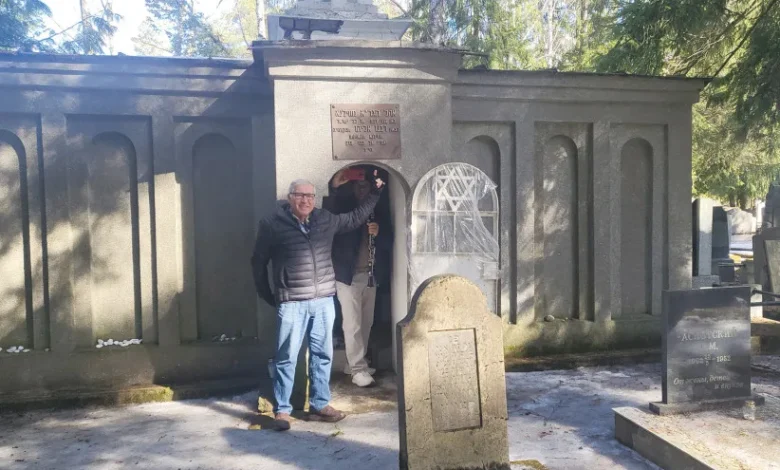
The three Jewish cemeteries of Vilnius tell their own layered story. When the Gaon passed away in 1797, he was buried in the Shnipishok Jewish cemetery. Shnipishok was a Jewish town, now a suburb within the expanded city. During Soviet rule, most of the cemetery was destroyed to build the “Soviet Sports Palace.” After a global outcry, in 1951, the authorities decided to move about a dozen graves of prominent Jews to the New Jewish Cemetery, with the Gaon and his family at the top of the list.
A canopy (ohel) was built over the Gaon’s new grave, becoming Vilna’s main Jewish tourist attraction. Almost every Jewish visitor comes to pray and leave a “kvitel” (a small note with a personal wish). Even Prime Minister Benjamin Netanyahu, a descendant of the Gaon, visited the canopy during his official visit to Lithuania in 2018.
For the Jewish traveler, Vilna is not merely a point upon a map. Vilna offers something deeper, almost invisible to the passing glance. Here, stones are never just stones, but layers of time, of silenced voices and others that have found their way back into the light.
And along these narrow streets, one senses that Jewish sociology has never truly departed. The old disputes between the Lithuanian scholars and the hassidic world, once carried through modest study halls, remind us how argument itself is woven into the fabric of Jewish life. Even now, in a wholly different age, the public divide between pro-Bibi and anti-Bibi camps may seem new, but the Jewish people have always had such disagreements, and likely always will. The issues may change, but the disputes remain.
There are moments in this city when you find yourself wondering which is stronger – what was built, or what was erased? Perhaps it is the erasure itself that shapes memory.
Perhaps that is the deeper meaning of Vilna. Not only a city of the past, but a place where the past continues to ask questions. What remains of a person after they are gone? What remains of a culture after it is destroyed? And perhaps, like a page of Talmud, there is no single answer here, but an ongoing conversation.
Vilnius invites you not only to see, but to listen. Not only to travel, but to remember.
The author is the editor of the blog jewishtraveler.co.il