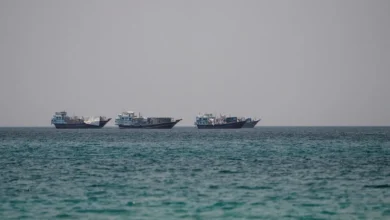
The US shot down Iranian drones near the Strait of Hormuz as talks continued for an interim peace deal to reopen the strategic waterway, adding to uncertainty over when an agreement can be reached.
US Central Command said it downed multiple unmanned aircraft targeting commercial ships in the area, only hours after a senior Trump administration official said on June 12 there was an 80 per cent or 85 per cent chance Washington and Tehran would sign the pact soon.
Iran’s Foreign Minister Abbas Araghchi echoed those expectations in a speech carried by state television on June 12, adding the signing could take place in the coming days.
US President Donald Trump has vowed dozens of times that an agreement to end the war that began in February is near, only for none to materialise so far.
The primary US objectives are to reopen Hormuz strait to maritime traffic and curb Iran’s nuclear programme.
Iran insists on retaining a degree of control over the waterway and gaining immediate access to its frozen funds, while negotiations over the Islamic Republic’s uranium enrichment would take place after the interim deal is signed.
The US expects the deal will ensure Iran does not have a nuclear weapons programme but would let it maintain a civilian nuclear energy programme, the senior American official said.
It would also ensure enriched nuclear material is removed from the country and end both sides’ blockade of the Strait of Hormuz.
If all terms are met, the US would ease sanctions on Iran and allow it to reintegrate into the global economy, according to the official.
Some Iranian hardliners still want to kill any breakthrough, the official said.
Araghchi said Iran’s sovereignty over the strait would be maintained under the proposed deal, adding the regime governing Hormuz would differ from the past, when Tehran provided management services free of charge.
“We are closer to an understanding than ever before. This means it might happen in the next one or two days, or it might happen within the next few days,” Araghchi said.
Iran’s Foreign Ministry said Tehran was still reviewing the draft. The terms of the accord still need to be approved by Iranian Supreme Leader Mojtaba Khamenei, according to a European official familiar with the matter.
Bringing a conclusive end to the conflict, now in its fourth month, has thrust Trump into a complicated political bind: He wants to present the deal as a win to national security hawks in his own party as well as to an American public that has increasingly turned against the war he started with a joint US-Israeli bombardment of the Islamic Republic on Feb 28.
The war has killed thousands of people across the region, mainly in Iran and Lebanon.
A central element of Trump’s emerging Iran deal is a step-by-step approach that would see the Strait of Hormuz reopened followed by Tehran getting economic rewards each time it meets US demands.
That sequencing formalises a cautious approach designed to prevent the White House from getting caught out as it tries to end the war. But it also means there will be many opportunities for the deal to fall apart.
“Any deal that kicks the can down the road on the most critical issues and is conditions-based would put the US and Iran exactly where they’ve been: a fragile ceasefire in name only that is routinely tested and prone to violence,” said Becca Wasser, defence lead for Bloomberg Economics.
A person familiar with the deliberations, who asked not to be named while discussing sensitive matters, said the memorandum would be open to interpretation in certain areas, including what the reopening of Hormuz would mean in practice.
Another diplomat familiar with the talks said the US and its allies would aim to ensure normal levels of shipments through the strait within about a month of an agreement being signed.
That may be complicated by the high likelihood of Iran having placed mines in the strait, which the UK and France are preparing to help clear.
Roughly 140 ships passed through the narrow choke point each day before the conflict erupted. The number of vessels has crept up in recent weeks, but is still far below pre-conflict levels.
Despite continuing uncertainty, energy prices continued to fall on June 12 following Trump’s announcement a day earlier that he had cancelled plans for new strikes on Iran.
Brent futures fell as much as 5.1 per cent to trade at the lowest level since the early days of the war, while European gas slumped as much as 8.4 per cent. While the global benchmark is still up almost 50 per cent in 2026, it has fallen from a high of US$125 in late April.
Another potential sticking point is Israel, which is not part of the negotiations for the interim deal. Prime Minister Benjamin Netanyahu has indicated he’d prefer more strikes to further degrade Iran’s military.
Israel’s minimum expectation is now that an end-of-war accord ensures highly enriched uranium is removed from Iran, according to a person familiar with the matter.
Araghchi said Israel was an “enemy” of the proposed deal with the US and that it was seeking to disrupt it.
Until Iran responds again, it will be hard to determine whether the latest manoeuvring is a fresh step toward a longer-term peace or just another short-lived promise.
The senior administration official suggested that this time was different.
US diplomatic efforts have been an all-hands-on-deck process over the past 24 hours involving officials including Secretary of State Marco Rubio, Defense Secretary Pete Hegseth, Trump’s son-in-law Jared Kushner and White House Chief of Staff Susie Wiles, the senior US official said. BLOOMBERG