The U.S.-Israeli war against Iran over recent months has reshaped several dimensions of the conflict. Alongside the economic pressure Iran exerted by disrupting activity in the Strait of Hormuz, the nuclear file remains equally consequential. Weeks ago, Iranian media outlets close to the Revolutionary Guard Corps, along with statements attributed to military sources, suggested that Tehran still possesses advanced weapons it has yet to deploy. Those signals raise a broader question about the nature and limits of Iranian deterrence, and whether the nuclear issue has become part of that undeclared deterrence strategy. The debate today is no longer centered on whether Iran possesses the technical capacity to develop nuclear weapons. Rather, it focuses on whether Tehran has made the political decision to acquire a nuclear deterrent. On March 25, the Trump administration reportedly presented Iran with a peace proposal that included far-reaching restrictions on its nuclear program. The proposal called for the dismantlement of all nuclear facilities, the transfer of all nuclear materials and equipment to the International Atomic Energy Agency (IAEA), and a permanent halt to uranium enrichment. Iran responded by reiterating its readiness to provide all necessary guarantees that it would not pursue nuclear weapons, while insisting on its right to develop and use nuclear technology for peaceful purposes, a position consistent with the one it adopted under the 2015 nuclear agreement. Yet the war marked a new chapter in the cycle of tension and mistrust that has long defined Iranian-American relations. It followed earlier turning points that deepened Tehran’s skepticism toward Washington, most notably the U.S. withdrawal from the nuclear deal in 2018 and the attack on the Natanz nuclear facility in 2021, which Iran viewed as a violation of its national sovereignty.
The roots of Iran’s nuclear program stretch back to the 1950s under the Shah. During the 1970s, the United States played a leading role in supporting the development of Iran’s nuclear infrastructure, at a time when Tehran was one of Washington’s closest regional allies. That position shifted dramatically after the 1979 Islamic Revolution. The United States became one of the strongest advocates for dismantling Iran’s nuclear program, viewing it as a threat to regional stability. Warnings about Iran’s nuclear ambitions soon became a recurring feature of international politics. In 1992, Benjamin Netanyahu claimed that Iran was nearing the capability to produce a nuclear weapon. Three years later, President Bill Clinton accused Tehran of seeking to build an atomic bomb. As allegations mounted over secret uranium-enrichment facilities and Western sanctions were imposed in 2002, a decree issued the following year by Iran’s Supreme Leader, Ali Khamenei, reaffirmed that Iran had no intention of acquiring nuclear weapons. That position went on to become a central pillar of official Iranian policy. Khamenei reinforced this stance in 2012, declaring that nuclear weapons were religiously forbidden and that Iran did not regard them as a source of strength. Instead, Tehran consistently framed its nuclear ambitions as part of a civilian program aimed at securing peaceful nuclear technology. That position was reflected in Iran’s decision to enter negotiations with the United States and other world powers, ultimately leading to the 2015 nuclear agreement under President Barack Obama. Under the deal, Iran accepted strict limits on uranium enrichment and extensive international monitoring of its nuclear activities. After President Donald Trump unilaterally withdrew from the agreement in 2018 and reimposed sanctions, Iran expanded its nuclear program. Yet even as its capabilities grew, Tehran stopped short of publicly declaring a political decision to develop a nuclear weapon.
Before 2010, Iran’s uranium enrichment levels remained at around 3.5 percent. That changed after the collapse of the 2009 Tehran Research Reactor fuel-swap deal, which faltered amid deep mutual mistrust between Iran and the West. The following year brought the discovery of the Stuxnet cyberattack, which targeted centrifuges at the Natanz nuclear facility, as well as the beginning of a wave of assassinations directed at Iranian nuclear scientists. Against this backdrop, Tehran announced that it would begin enriching uranium to 20 percent, arguing that the move was necessary to produce fuel for the Tehran Research Reactor.

READ: Trump says he does not need deal with Iran to get enriched uranium
Following the 2015 nuclear agreement, Iran returned to compliance with a 3.67 percent enrichment limit. That restraint began to unravel after the United States withdrew from the deal and reimposed sanctions, prompting Tehran to raise enrichment levels to 4.5 percent. A more significant shift came in early 2021, when Iran resumed enrichment at 20 percent. The move followed a year that marked a major escalation in the U.S.-Israeli confrontation with Iran. In addition to the reimposition of sweeping U.S. sanctions, Washington assassinated Qassem Soleimani, commander of the Islamic Revolutionary Guard Corps’ Quds Force, in January 2020. Tehran viewed the killing as a direct attack on its senior military leadership and subsequently announced that it would no longer observe the nuclear deal’s restrictions on centrifuge numbers and enrichment levels. That same year, an explosion struck the Natanz nuclear facility, an incident Iran blamed on Israel. Later in 2020, Mohsen Fakhrizadeh, one of the figures most closely associated with Iran’s nuclear program, was assassinated. After another attack targeted Natanz in 2021, Iran raised uranium enrichment to 60 percent, marking a qualitative leap in the development of its nuclear program.
The year 2021 marked a critical turning point, not only in the technical trajectory of Iran’s nuclear program, but also in the tone of Iranian political discourse surrounding it. Former Intelligence Minister Mahmoud Alavi suggested that sustained Western pressure could ultimately push Iran toward developing a nuclear weapon. His remarks opened the door to a broader debate within the Iranian establishment.
In 2024, Kamal Kharrazi, an adviser to Supreme Leader Ali Khamenei and head of the Strategic Council on Foreign Relations, argued that continued threats against Iran could compel Tehran to reconsider its nuclear doctrine. The same year saw growing calls from conservative lawmakers to reassess that doctrine and consider nuclear weapons as a defensive deterrent.
Similar arguments were echoed by media outlets closely aligned with the Revolutionary Guard Corps. While Iranian officials have continued throughout this year to deny any intention of pursuing nuclear arms, such an outcome no longer appears beyond the realm of possibility. Earlier statements by senior officials, rapid advances in nuclear technology, and a deepening erosion of trust in the United States have all contributed to a shifting strategic landscape.
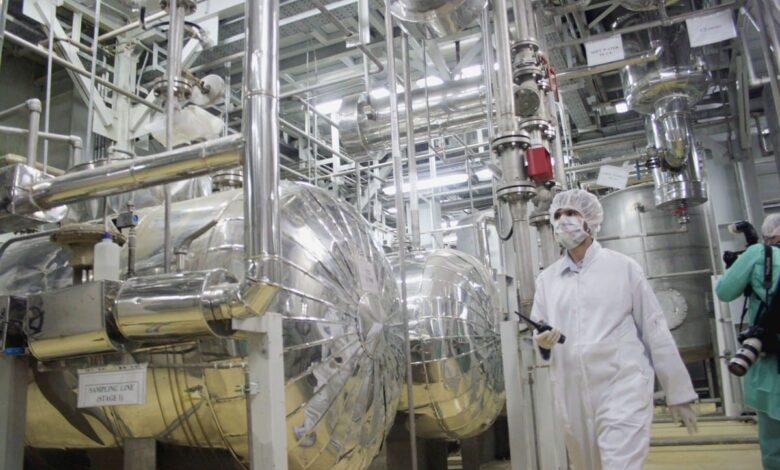
Iran is widely regarded as a nuclear threshold state. At the heart of that assessment is its stockpile of uranium enriched to 60 percent purity, far above the 3 to 5 percent typically required for civilian nuclear purposes. Before the recent attacks, Iran possessed an estimated 440.9 kilograms of this material, according to the International Atomic Energy Agency (IAEA). The extent to which that stockpile may have been damaged remains unclear, as does the scale of any losses. Beyond enriched uranium, Iran has accumulated a substantial body of nuclear expertise, developed and refined over the past two decades. That scientific capacity has been matched by a broad nuclear infrastructure, including advanced centrifuge technology and production facilities dispersed across the country, some of them operating in secrecy. Iran also runs a number of research and power reactors, including the Russian-operated Bushehr Nuclear Power Plant. Additional centrifuges are believed to be stored in underground facilities. The full impact of the recent strikes on these capabilities has yet to be independently verified, largely because much of Iran’s nuclear infrastructure remains concealed from public view. Following the ceasefire, President Donald Trump remarked that Iran’s enriched uranium was “buried deep underground” and would be difficult for anyone to access. Iran also possesses an extensive ballistic missile program and continues to invest in its development. Such missiles can serve as delivery systems for nuclear warheads, making them a critical component of any potential future nuclear deterrent.
In an interview with Al Jazeera, former IAEA chief inspector Yousry Abu Shady said Iran had moved its highly enriched nuclear material to secure underground locations before the attacks began, and that the fortified facilities beneath the surface were not fully destroyed.
According to Abu Shady, only a small portion of Iran’s enriched uranium is believed to have been damaged, while the whereabouts of the remainder remain known only to Iranian authorities. The U.S.-based Council on Foreign Relations (CFR) maintains that Iran does not currently possess a nuclear weapon. However, it acknowledges that Tehran has acquired the expertise, infrastructure, and technical foundation that could enable it to build one within a relatively short period if a political decision were made. The same conclusion has been echoed by the Institute for Science and International Security (ISIS), which argues that Iran possesses “weaponization-related capabilities” that could support a future nuclear weapons program. Abu Shady has also argued that 42 kilograms of uranium enriched to 60 percent would be sufficient to produce a rudimentary nuclear device. Given that Iran possesses more than 440 kilograms of uranium enriched to that level, the stockpile could theoretically provide enough material for roughly ten low-yield devices. To produce more effective nuclear weapons, however, enrichment would need to reach around 90 percent purity, a threshold that remains technically achievable for Iran. By enriching uranium to 60 percent, Iran has already completed the most difficult phase of the enrichment process. As enrichment levels increase, progressively less additional work is required to reach weapons-grade material. Higher enrichment also allows the same nuclear effect to be achieved with smaller quantities of fissile material. For Iran, the final step from 60 percent to weapons-grade enrichment could be measured in weeks rather than months. Yet producing fissile material is only one part of the equation. The U.S.-based Center for Strategic and International Studies (CSIS) notes that the successful weaponization of a nuclear device depends on whether a warhead can be reduced in size, weight, and configuration to fit a missile delivery system. Iran possesses a growing arsenal of medium-range ballistic missiles and continues to invest heavily in missile development, though the extent of that progress remains unclear. CSIS assesses that if Iran succeeds in miniaturizing a nuclear warhead, its missile force could provide a viable nuclear delivery capability. Nuclear testing has traditionally served as one of the clearest indicators that a state has decided to become a nuclear weapons power, as North Korea did before it declared itself nuclear-armed. No such test has been observed in Iran. Yet the absence of a test is not definitive proof that a state lacks a nuclear weapon. Under certain security conditions, a country may choose to develop a nuclear capability without conducting a public test. The central question therefore remains: after the war, has Iran made the political decision to become a nuclear-armed state?
READ: Iranian FM: US bases are a source of instability in the region
The war may leave Iran more determined than ever to acquire a nuclear deterrent capable of preventing future conflicts, just as years of sanctions, deepening mistrust of Washington, and repeated Israeli military pressure helped shape Tehran’s decision to steadily increase uranium enrichment. To understand that possibility, however, it is useful to place recent developments within a broader regional context. Any discussion of Iran’s nuclear ambitions inevitably extends beyond Iran itself. It touches the security calculations of neighboring states and the wider balance of power in the Middle East. For that reason, Iran’s nuclear trajectory cannot be examined in isolation from Israel’s nuclear arsenal. Israel is widely understood to possess nuclear weapons, yet its nuclear capabilities remain largely shielded from international scrutiny and public debate. At the same time, Israel continues to occupy Palestinian territories and also occupies Syrian and Lebanese land. It has repeatedly carried out military operations beyond its borders, targeting neighboring countries such as Syria and Lebanon, as well as more distant regional actors including Iran and Iraq. These actions have included targeted assassinations, violations of the sovereignty of independent states, and conduct contrary to established international norms and legal principles. Israel remains the only nuclear-armed state in the Middle East. International estimates place its arsenal at between 80 and 200 nuclear warheads.
Yet unlike other states facing scrutiny over their nuclear activities, Israel continues to develop and modernize its capabilities without meaningful international oversight. From this perspective, Israel’s nuclear arsenal constitutes the region’s most significant strategic challenge, and potentially one with implications far beyond the Middle East.
This raises a broader question: should the region’s nuclear debate focus exclusively on Iran? The issue of military nuclear capability affects all states in the region, not Iran alone. Gulf countries, Egypt, and Turkey all have a stake in shaping the future nuclear order of the Middle East. Any serious effort to address nuclear weapons in the region must therefore begin with Israel’s existing nuclear arsenal before turning to a country that remains, at least for now, on the nuclear threshold. Ultimately, establishing a stable regional nuclear order requires addressing the Middle East’s nuclear realities as a whole. Within that framework, Israel’s nuclear program occupies a central place in the discussion.
The recent war may not have delayed Iran’s nuclear program as much as it transformed the political environment surrounding it. The key question is no longer whether Iran has the technical ability to build a nuclear weapon. Rather, it is whether Tehran has come to view such a capability as a strategic necessity, particularly in a region where, from its perspective, a nuclear-armed adversary can use force with little fear of deterrence.
OPINION: Beyond unipolarity and the end of strategic certainty: Lessons imposed by the war on Iran
The views expressed in this article belong to the author and do not necessarily reflect the editorial policy of Middle East Monitor.