For decades, land administration in many parts of Nigeria revolved around stacks of paper files, cumbersome procedures and prolonged delays in processing land documents. For landowners, developers and investors, accessing records or securing statutory land documents often meant navigating a slow manual system that left room for inefficiency, uncertainty and avoidable bureaucracy.
Yobe State was no different. As the state witnessed rapid urban growth, expanding housing projects and increasing demand for land for residential, commercial and public purposes, the limitations of the manual system became even more pronounced, making reform not just desirable but necessary.


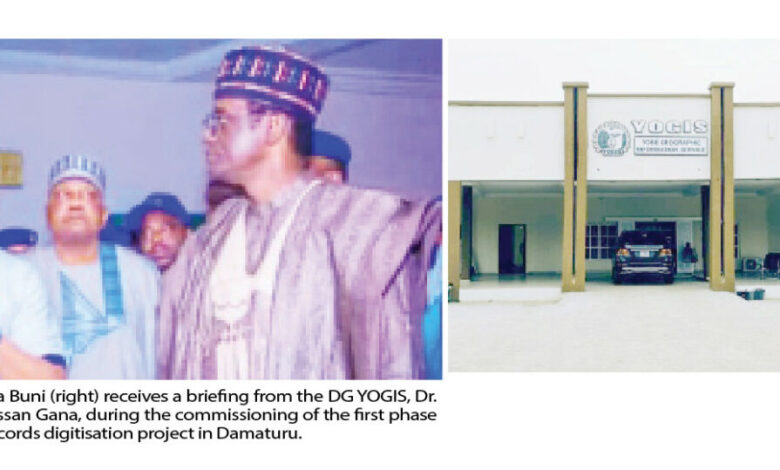
Recognising that effective land administration is the bedrock of orderly development, Governor Mai Mala Buni took a decisive step by establishing the Yobe State Geographic Information System (YOGIS).
The agency was designed to serve as the state’s digital gateway to land administration, bringing together technology, planning and institutional reforms to simplify land management while supporting economic growth.
The establishment of YOGIS reflected a broader governance philosophy that development goes beyond constructing roads, schools and hospitals, but also requires strong institutions capable of providing efficient public services, protecting public records and creating an enabling environment for investment.
From the outset, the agency was entrusted with modernising land administration through digital innovation, improved surveying, accurate mapping and transparent record management.
Under the leadership of its Director-General, Dr. Abdullahi Hassan Gana, and his management team, YOGIS has steadily evolved into one of the most impactful institutions created by the Buni administration.
The first challenge confronting the agency was obvious. Thousands of land records existed only in paper form, occupying office shelves and filing cabinets, while retrieving a single file often required lengthy manual searches that delayed service delivery.
Rather than improving the old system, YOGIS set out to replace it.
Today, more than 80,000 land files have been scanned and digitised, creating a secure electronic database that has fundamentally transformed the management of land records across the state. The reform has not only improved the speed of document retrieval but has also reduced the risks associated with misplaced, damaged or duplicated files.
The digitisation exercise has equally strengthened transparency in land administration, with records now electronically managed, making land transactions faster, more reliable and less susceptible to the bottlenecks that characterised the manual system.
Technology, however, is only as effective as the people operating it.
To sustain the reforms, YOGIS invested significantly in human capital development, with more than 100 members of staff trained in digitisation, Geographic Information Systems (GIS), Land Information Systems (LIS) and other modern land administration processes.
The investment has equipped the agency with the technical expertise required to manage an increasingly sophisticated digital land administration system.
While digitising existing records remained a priority, the government also recognised the need to generate credible data for future planning.
That informed the enumeration of approximately 147,000 houses across Damaturu, Bade, Nguru, Potiskum and Geidam Local Government Areas, creating one of the most comprehensive property databases in the state’s history.
The exercise has strengthened planning, property identification and land administration while providing the government with reliable data for future development initiatives.
As the reforms gathered momentum, they also attracted international recognition.
Through the successful implementation of the Disbursement Linked Indicator (DLI) 11.3, Yobe State secured a $2.5 million World Bank grant, validating the progress made in strengthening institutional capacity and modernising land administration.
The achievement demonstrated that investments in governance reforms can attract the confidence of development partners while strengthening institutional capacity.