0
LAGOS – The planned listing of Dangote Petroleum Refinery and Petrochemicals on the Nigerian capital market is shaping up to become one of the most consequential financial events in Africa’s history, placing the Nigerian Exchange Group (NGX) at the centre of what could redefine the continent’s investment landscape.
With an estimated valuation of between $40 billion and $50 billion, the refinery’s anticipated initial public offering (IPO) is expected to become Africa’s largest-ever public share sale, potentially raising as much as $5 billion from investors across Nigeria and the wider African continent.
The sheer size of the transaction is already generating intense excitement among investors, regulators, pension fund managers, market operators, and foreign institutional investors, many of whom see the proposed listing as a defining moment for Nigeria’s capital market evolution.

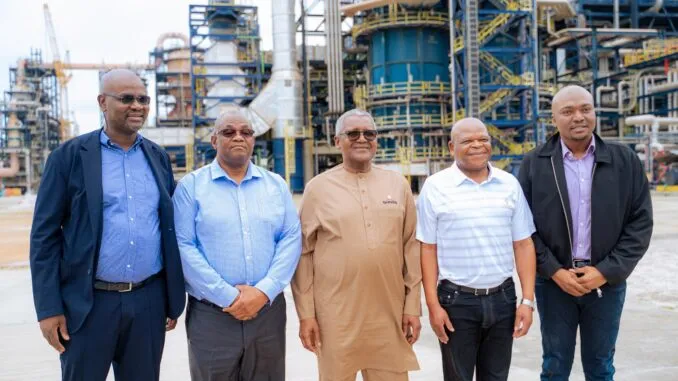
At the same time, the transaction is expected to become the biggest stress test yet for the Nigerian Exchange’s liquidity depth, trading infrastructure, settlement systems, regulatory framework, and overall ability to manage mega-cap listings comparable to those seen in larger emerging markets.
For Aliko Dangote, Africa’s richest businessman, the refinery IPO represents more than a fundraising exercise. It is part of a broader ambition to deepen African industrialisation, democratise ownership of strategic infrastructure, and position the Dangote Group as a dominant pan-African industrial conglomerate.
Located in the Lekki Free Trade Zone in Lagos, Dangote Refinery is regarded as the world’s largest single-train refinery, with installed capacity of 650,000 barrels per day.
Since ramping up operations last year, the facility has significantly reduced Nigeria’s dependence on imported petroleum products while expanding exports of refined fuel to African and international markets.
The refinery has already altered the structure of Nigeria’s downstream oil market by reducing pressure on foreign exchange demand previously used for fuel imports.
Analysts say its growing influence on regional energy supply chains is one of the major reasons investor appetite for the planned IPO is expected to be exceptionally strong.
Dangote has indicated that between five and 10 percent of the refinery’s equity could be floated during the initial phase of the offering. Market projections suggest the transaction could instantly create one of the most valuable publicly traded companies ever listed in Africa.
The businessman has also hinted that shareholders may benefit from dollar-linked dividends because a substantial portion of the refinery’s revenues is expected to come from exports denominated in foreign currency.
For the NGX, however, the proposed listing is both an opportunity and a challenge.
Several market analysts argue that the exchange is significantly more prepared today for a mega-listing of this scale than it would have been a decade ago.
Following its demutualisation and transformation into a publicly quoted exchange group, the NGX has undergone extensive structural reforms aimed at improving market transparency, operational efficiency, and institutional participation.
The Exchange has modernised its trading technology, strengthened disclosure requirements, improved market surveillance systems, and enhanced post-trade clearing infrastructure through reforms at the Central Securities Clearing System (CSCS).
Nigeria’s recent banking recapitalisation drive has also injected fresh liquidity into the financial system, increasing institutional investor participation in equities and fixed-income instruments.
These reforms have contributed to a sharp rise in market capitalisation on the NGX, which has now crossed N160 trillion.
Analysts believe the listing of Dangote Refinery alone could potentially push total market capitalisation beyond the N200 trillion threshold.
Such a development would significantly elevate the global visibility of the Nigerian capital market and potentially strengthen Lagos’ ambition of becoming a major financial hub for emerging Africa.
The Exchange has also been actively engaging regional stakeholders in anticipation of the transaction.
Executives from several African stock exchanges, including the Nairobi Securities Exchange, have reportedly held discussions with Dangote Group and NGX officials regarding possible cross-border participation structures for the IPO.
The move reflects growing recognition that the refinery is not merely a Nigerian industrial project but a strategic African infrastructure asset with continent-wide significance.
Market operators believe a successful multi-exchange participation framework could accelerate financial integration across African capital markets under the African Continental Free Trade Area (AfCFTA).
The appointment of leading issuing houses has further strengthened confidence in the transaction’s credibility and preparedness.
Dangote Group is understood to have engaged Stanbic IBTC Capital, Vetiva Capital Management, and First Capital to structure the offering, coordinate regulatory approvals, and manage both domestic and international investor participation.
Institutional demand for the IPO is also expected to receive significant support from Nigeria’s pension industry after the National Pension Commission (PenCom) granted a special waiver allowing pension fund administrators to invest in the refinery offering despite the company not fully meeting conventional profitability and dividend track-record requirements.
The decision was described as a one-off regulatory measure reflecting the strategic importance of the refinery to Nigeria’s economy.
Analysts say the waiver could unlock trillions of naira in long-term domestic institutional capital for the transaction, helping to stabilise the offer and reduce dependence on volatile foreign portfolio flows.
Yet despite the growing optimism surrounding the planned listing, questions remain over whether the Nigerian capital market possesses sufficient depth to comfortably absorb an IPO of such unprecedented scale.
One major concern is liquidity concentration.
At a projected valuation of up to $50 billion, Dangote Refinery could quickly become one of the dominant stocks on the NGX, potentially distorting market weightings and concentrating investor funds around a single entity.
Some analysts warn that excessive demand for the IPO could temporarily divert liquidity away from other listed companies, especially medium-cap and small-cap equities.
Others believe the listing could fundamentally reshape the composition of Nigerian equity indices by increasing the dominance of industrial and energy-related stocks.
Foreign investor participation also remains a critical factor.
Although recent reforms introduced by the Central Bank of Nigeria have improved transparency in the foreign exchange market, some offshore investors remain cautious because of previous experiences involving FX illiquidity, currency volatility, and delays in capital repatriation.
Analysts note that sustained exchange rate stability and policy consistency will be essential to attracting strong foreign institutional participation in the offer.
Operational readiness is another area under close scrutiny.
Given the refinery’s strategic importance and strong retail investor interest, market operators expect the IPO could be heavily oversubscribed.
Such a scenario would place enormous pressure on the NGX’s digital infrastructure, allotment systems, and settlement mechanisms.
The Exchange’s ongoing migration toward a T+1 settlement cycle is therefore viewed as strategically important ahead of the transaction because it is expected to improve market efficiency, accelerate trade settlement, and reduce counterparty risks.