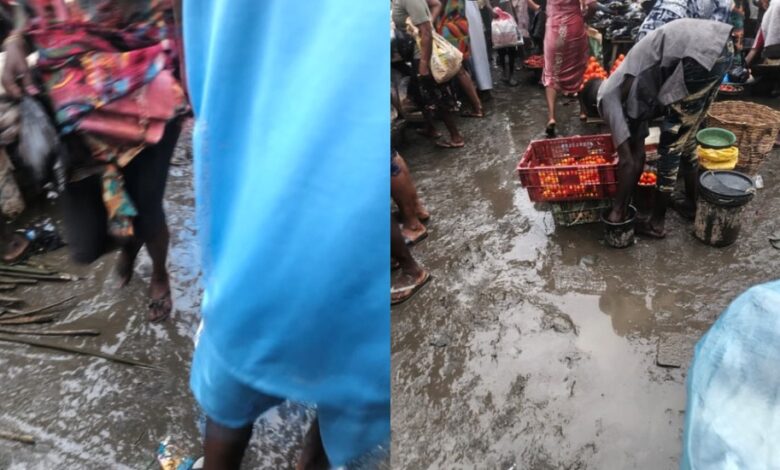
However, beneath its bustling commercial activity lies a disturbing reality: every rainfall exposes the poor environmental condition of the market.
A visit by THE WHISTLER correspondent to the market revealed how quickly the grounds turn muddy during rainfall. Despite the difficult conditions, traders continued displaying both perishable and non-perishable food items for sale in the filthy environment.
While some traders make efforts to sweep portions of the market, a significant section still requires proper infrastructure such as better interlocking stones or concrete flooring to prevent persistent mud during rains.
“My brother, why did you come here with those fine shoes? Don’t you know people don’t wear good shoes to this market?” a trader remarked to our correspondent, expressing concern over his mud-soaked footwear.

In September 2023, the Lagos State Government sealed the market for noncompliance with environmental protection laws. The market was also shut down again by officials of the Lagos State Waste Management Authority (LAWMA), alongside the Lagos State Environmental Sanitation Corps (LAGESC), about 10 months after an earlier closure over similar environmental infractions.
Announcing the closure on X at the time, the Lagos State Commissioner for Environment and Water Resources, Tokunbo Wahab, said the action followed repeated complaints from members of the public.
According to him, the market had become “notorious for very poor sanitary conditions” and persistent failure to comply with waste management regulations.
“This action is taken to protect members of the public from food-borne and water-borne diseases like cholera, thypoid, dysentery,” Wahab said.
He urged members of the public to report any similar cases of poor sanitation in markets and business outlets across the state.
Speaking on the implications of poor market sanitation, a public health expert and Chief Executive Officer of EpidAlert, Dr Lawal Bakare, said market sanitation is primarily an environmental issue, although it has significant public health consequences.
He noted that environmental health officers at the local government level have important responsibilities in monitoring sanitation standards and enforcing existing regulations.
According to him, the poor condition of many markets reflects weaknesses in regulatory enforcement, adding that agencies responsible for environmental management, public health and market regulation must work together to improve conditions.
Bakare also noted that markets generate substantial revenue for governments through various levies and fees, making investment in cleaner and better-organised market environments a necessity rather than an option.
Improving market infrastructure, he said, would not only protect public health but also enhance economic activity.
He further stressed that consumers have a role to play, arguing that purchasing decisions can influence the behaviour of traders.
“Consumers should stop encouraging those things,” he told THE WHISTLER.
“You can control the behaviour of the seller by making sure that you don’t buy.”
According to the World Health Organization (WHO), an estimated 866 million people—nearly 1 in 9 globally—fall ill each year after consuming contaminated food, while about 1.52 million die annually as a result.
The economic burden is also significant, with around US$310bn lost every year in productivity and medical costs linked to unsafe food worldwide. Children under five are particularly vulnerable, accounting for 29 per cent of the global health burden of foodborne diseases, with approximately 143,000 deaths recorded in 2021 alone.
Beyond health impacts, WHO says foodborne diseases slow socioeconomic development by placing pressure on healthcare systems and undermining national economies, tourism, and international trade.
What do you think about this?
Drop your opinion in the comment section.
FOLLOW US & Share this with someone who needs to see this.