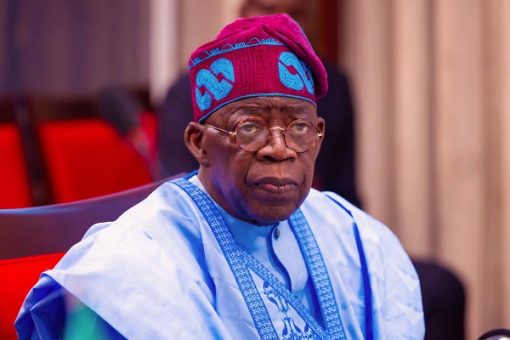
President Bola Ahmed Tinubu has reaffirmed his administration’s commitment to deepening collaboration with traditional institutions and leaders across the Northern part of the country.
The president said such collaboration aims to serve as a key strategy for addressing insecurity, promoting national cohesion, and driving sustainable development in Nigeria.
Tinubu said this while speaking at the eighth Executive Committee Meeting of the Northern Traditional Rulers’ Council (NTRC) on Monday in Dutse, Jigawa State.
Represented by the Minister of Information and National Orientation, Mohammed Idris, the president delivered the message to traditional rulers and stakeholders from across Northern Nigeria.


“The administration of President Bola Ahmed Tinubu fully recognises the strategic role of traditional institutions and remains committed to deepening engagement with traditional rulers in advancing peace, security, national cohesion, and development,” Idris said.
The Minister commended the NTRC, chaired by the Sultan of Sokoto, His Eminence Alhaji Muhammad Sa’ad Abubakar, for its ongoing contributions to peace and unity in the region.
Addressing the meeting’s theme, “Peace, Unity and Development of the North,” Idris stressed that peace forms the bedrock of any meaningful progress.
“Without peace, development becomes difficult; without unity, progress cannot be sustained,” he stated.
Idris highlighted the critical position of traditional rulers as custodians of culture, mediators in conflicts, and trusted bridges between government and communities.
He noted their proximity to the grassroots and moral authority makes them indispensable in peacebuilding and mobilisation.
On security, the Minister acknowledged persistent challenges but pointed to gains made through strengthened military operations, intelligence gathering, and inter-agency coordination.
He emphasised that military efforts must be complemented by addressing socio-economic drivers of insecurity such as poverty, unemployment, and exclusion.
To this end, the government has rolled out initiatives in agriculture, livestock development, solid minerals, infrastructure, and support for small businesses.
Idris described the creation of the Federal Ministry of Livestock Development as a landmark move to modernise the sector, reduce resource-based conflicts, and unlock economic potential.
He also spotlighted the administration’s four Legacy Highway Projects, including the Lagos-Calabar Coastal Highway and Sokoto-Badagry Super Highway, as transformative investments aimed at improving connectivity, creating jobs, and fostering national integration.
Additionally, programmes such as the Nigerian Education Loan Fund (NELFUND) and the Nigerian Consumer Credit Corporation (CREDICORP) are designed to expand opportunities for citizens, particularly the youth.
Idris urged traditional rulers to play a leading role in public enlightenment and countering misinformation, noting their high level of trust within communities.
The meeting concluded with expectations of practical recommendations to strengthen peace and accelerate development in the North.
Idris also extended the Federal Government’s condolences over the death of retired Major General Rabe Abubakar of Katsina State, describing the loss as a painful reminder of the need to intensify efforts against insecurity.