On June 11, 2026, when operatives of the Federal Capital Territory (FCT) Police Command stormed a suspected bandits’ hideout on the outskirts of Abuja, they expected to find armed criminals, weapons, and perhaps kidnapped victims. What they did not expect, however, was to find a heavily pregnant woman among them. The woman, who reportedly worked as a cook for the kidnappers and their captives, had defied all odds to take on the role. EJIKE EJIKE reports.
The arrest of Hauwa Shafiu and four other suspects has once again exposed an uncomfortable reality about modern criminal enterprises in Nigeria, kidnapping gangs are no longer merely groups of armed men hiding in forests. Increasingly, they depend on sophisticated support networks comprising informants, logistics providers, financiers, transporters, and community collaborators who help sustain their operations.

The development underscores the evolving nature of organised crime and the challenges security agencies face in dismantling not only the gunmen but also the networks that enable them to thrive.
For security experts, the development highlights an evolving security landscape in which criminality is sustained not only by weapons and violence but also by well-coordinated supply chains, logistics networks, and local collaborators who enable such operations to flourish.
According to the FCT commissioner of Police, Ahmed Sanusi, preliminary investigations revealed that the suspects had established a base in a community near the boundary of the Federal Capital Territory.
Their location was strategic close enough to monitor movements in and around Abuja, yet sufficiently concealed to avoid immediate detection by security agencies.
Police investigators believe the criminal network used the community as an operational base for gathering intelligence, coordinating attacks, and providing logistical support to kidnappers operating in surrounding areas.
Among those arrested was Shafiu, whom police described as a logistics supplier and cook for the gang.
CP Sanusi alleged that her role involved preparing meals and providing support services for both kidnappers and their captives.
Security experts, Iyke Odife said “the arrest and subsequent revelations highlights an often-overlooked aspect of organised crime.
Every kidnapping operation requires more than armed men. Hostages must be fed. Criminal camps require supplies. Communication channels must be maintained. Ransom proceeds must be collected and distributed.
Without these support structures, many criminal operations would struggle to survive.”
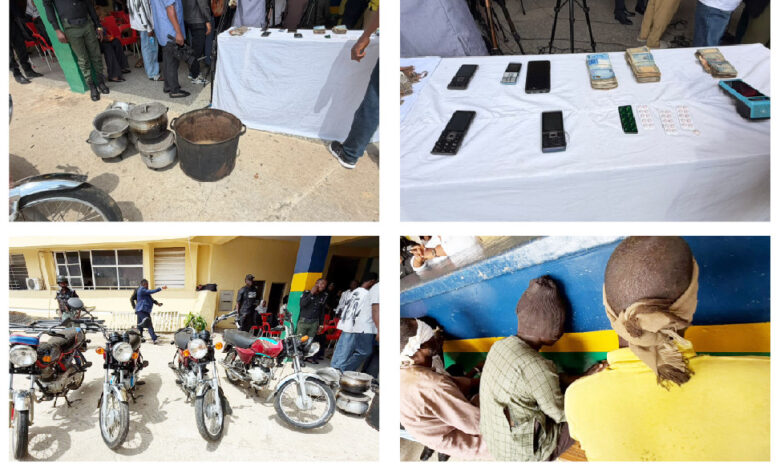
FCT police spokesperson, SP Josephine Adeh further stated that “the items recovered from the suspects paint a revealing picture of how sophisticated the group is. They include motorcycles, mobile phones, a Point of Sale (POS) machine, cooking utensils, tramadol tablets and cash believed to be linked to kidnapping activities.
“To many observers, the cooking utensils appeared ordinary.
To investigators, they represented something far more significant: evidence of a functioning support network.
The presence of a POS machine also illustrates how kidnapping operations increasingly exploit modern financial tools to move money and manage transactions.
Meanwhile, the recovered tramadol tablets point to another disturbing trend.”
LEADERSHIP Weekend recalls that security agencies have repeatedly warned about the growing relationship between drug abuse and violent crime. The alleged supply of narcotics to criminal gangs helps sustain operations by enhancing endurance, reducing inhibitions and creating dependency among gang members.
NDLEA chairman/chief executive officer, Brig. Gen. Mohamed Marwa (rtd), has consistently maintained that drug abuse and illicit trafficking are major drivers of crime and insecurity, noting that many criminal activities, including kidnapping, banditry, terrorism and cult violence, are either committed under the influence of drugs or financed through proceeds from the illicit drug trade.
According to him, “There is a strong and undeniable link between drug abuse, illicit drug trafficking and criminality. Drug use fuels violent crimes, banditry, kidnapping, terrorism, cultism and other forms of insecurity, while proceeds from drug trafficking often finance criminal networks. This is why the fight against illicit drugs is not only a public health intervention but also a critical component of national security and crime prevention.”