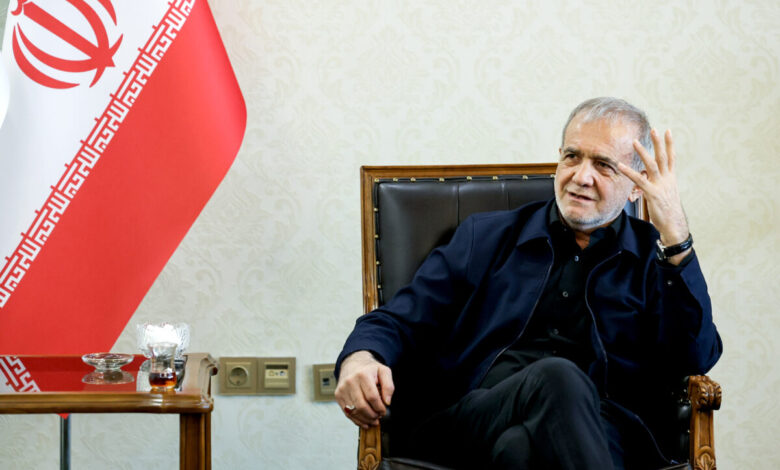
Iranian President Masoud Pezeshkian said Wednesday that Iran must move beyond the current “no war, no peace” situation, as efforts continue to revive negotiations with the United States amid heightened regional tensions, Anadolu reports.
“We must move beyond the state of neither war nor peace,” Pezeshkian said during an event in Tehran, as cited by the state news agency IRNA.
“War is certainly not in the country’s interest, but if they seek to violate our dignity, our land and our territory, we will not surrender,” he added.

The Iranian president said managing the country during war and crises “was difficult” and stressed the need for unity and cooperation among all segments of society to overcome challenges facing Iran.
“We must move forward with dignity in a way that saves the future of our country from crises and storms,” he said.
Pezeshkian said Iran “will not be forced into submission through military pressure or threats.”
“The enemy will only see our surrender in its dreams,” he said, adding that Iran would not be compelled to yield through threats or military action.
Referring to recent US and Israeli attacks, Pezeshkian described the killing of Iranian commanders as “unacceptable.”
He also accused Iran’s adversaries of attempting to sow divisions within the country and mobilize regional states against Tehran.
READ: Iran says repeated US ceasefire violations harming diplomatic process
“One of the enemy’s policies was to mobilize Arab and Muslim countries against Iran,” he said, adding that ongoing regional diplomacy was helping counter that effort.
Pezeshkian also highlighted the economic challenges facing Iran, saying sanctions and restrictions on trade routes had placed the country under severe pressure.
“We are under sanctions, our routes have been blocked, and we face a difficult test ahead,” he said. “Running the country under these conditions is not easy, especially with existing imbalances and economic difficulties.”
The remarks came after overnight exchanges between Iranian and US forces, underscoring the fragility of diplomatic efforts and ceasefire arrangements in the region.
The US Central Command (CENTCOM) said Wednesday US fighter jets struck Iranian air defense systems and radar sites near the Strait of Hormuz in response to the downing of a US Army Apache helicopter.
Iran’s Islamic Revolutionary Guard Corps (IRGC), for its part, said it launched retaliatory attacks on 21 American military targets at US air and naval bases across the region.
Regional tensions have remained high since late February, when Israeli and US strikes on Iran triggered a broader cycle of military escalation, retaliatory attacks and diplomatic confrontations.
The latest incident followed several days of fluctuating tensions in the region, during which Israel and Iran traded military strikes before pulling back amid efforts to revive diplomacy between Tehran and Washington.
READ: Iran says it targeted US bases in Bahrain, Jordan and Kuwait, warns of stronger response