New posts
13:28
Armed Clashes In Kurdish Cities Leave Several Dead
According to reports from Iran, there have been armed clashes around the northwestern cities of Sardasht and Piranshahr on July 1 between groups opposing the Islamic republic and the Islamic Revolutionary Guards Corps (IRGC).
Both cities have a dominant Kurdish majority.

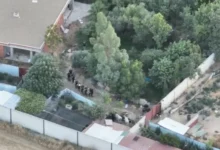
Two human rights organizations, Hana and Hengaw, which cover the Kurdish regions of Iran, reported that several people were killed in the clashes. According to Hana, the IRGC used heavy weaponry and the clashes took place near residential areas full of civilians.
News outlets close to the Kurdistan Democratic Party of Iran (KDPI) reported that on the evening of July 1, five members of the party were killed during an armed clash with the IRGC near the village of Qazqapan, close to Piranshahr.
The KDPI, one of the oldest and largest Iranian Kurdish opposition groups, has engaged in armed struggle against the Iranian regime, which has designated the party as a terrorist organization and banned it. The party operates out of Iraq.
The Fars news agency, which is close to the IRGC, reported that six members of the KDPI were killed in the clashes, although gave no further details.
The Saberin News Telegram channel, which is close to Iranian security apparatus, also confirmed the clashes, claiming that 11 members of the Kurdish opposition were killed in two separate clashes.
RFE/RL has not been able to independently verify the details of these reports.
Earlier on the evening of July 1, the KDPI said that one of the group’s camps in the Iraqi Kurdistan region had been attacked by drones.
There were other clashes earlier in the week. Iranian media reported that two members of the IRGC were killed in a shooting outside their homes in the city of Paveh in the Kermanshah Province, a predominantly Kurdish region, on the evening of June 29.
Share
Copy link
Facebook
X (Twitter)
LinkedIn
Email
Share
07:58
Qatari Foreign Ministry Says ‘Positive Progress’ In Doha Talks
Majed al-Ansari, spokesman for the Qatari Foreign Ministry, has said that US and Iranian negotiators made “positive progress…on issues related to the Islamabad Memorandum of Understanding” in talks on July 1.
With Qatari and Pakistani mediation, Iranian and US negotiators have been holding indirect, technical talks in the Qatari capital, Doha.
Writing on X,al-Ansari also said that “The parties agreed to continue discussions over the coming period, with the next meeting to be scheduled at the earliest possible time following the funeral processions of the former Iranian Supreme Leader.”
From July 4-9, several Iranian cities will hold processions and funeral ceremonies for the late Supreme Leader Ayatollah Ali Khamenei, who was killed in a US-Israeli strike on February 28.
His body will lie in state in Tehran and the former leader will be buried in the Imam Reza Shrine in the city of Mashhad.
Share
Copy link
Facebook
X (Twitter)
LinkedIn
Email
Share
23:25
1.7.2026
Tehran Rejects US Assertions About IAEA Access To All Iranian Nuclear Sites
Iranian parliament speaker and chief negotiator Mohammad Bagher Qalibaf.
Iranian parliament speaker and chief negotiator Mohammad Qalibaf has dismissed reports of expanded nuclear inspections concessions as “lies,” asserting that International Atomic Energy Agency (IAEA) inspectors will not be granted access to damaged nuclear facilities despite the push from US President Donald Trump administration.
Speaking on state television on July 1, Qalibaf emphasized that under the existing laws ratified by Iranian parliament and the Supreme National Security Council, inspectors are strictly barred from accessing any bombed or damaged sites “under any circumstances.” He specified that access remains tightly restricted to just two locations: the Bushehr nuclear power plant and the Tehran research reactor.
By labeling contrary reports as falsehoods, Qalibaf signaled a rigid baseline for upcoming talks with US, underscoring that Tehran will offer “no concessions” beyond its current domestic legal framework, effectively blocking any broader oversight demands from Washington.
Share
Copy link
Facebook
X (Twitter)
LinkedIn
Email
Share
20:34
1.7.2026
Iran Deputy FM: Part Of Frozen Assets To Be Used To Buy Goods For Tehran
Irans Deputy Foreign Minister Kazem Qaribabadi said part of the $6 billion in frozen Iranian assets held in Qatar will be made available to Tehran in the form of goods.
Qaribabadi, speaking to the official IRNA news agency, said the decision was made during talks in the Qatari capital, Doha, on July 1.
He said during a meeting with officials from the Qatari Central Bank it was decided that based on the declared needs of our country, the necessary goods would be purchased and made available to Iran.
He did not provide further details and there has been no US confirmation of Qaribabadi’s claim.
Qaribabadi headed an Iranian delegation to Qatar, where he said indirect technical talks were also held with US officials.
The release of billions in frozen Iranian assets held abroad is part of the memorandum of understanding (MOU) signed by Tehran and Washington on June 17 aimed at ending months of war.
US President Donald Trump said on June 23 that any unlocked Iranian funds would be used to purchase American corn, soybeans, and wheat. The money, he said, would be held “in escrow, controlled by” Washington and spent “exclusively” on American food and medical supplies.
But Iranian Central Bank Governor Abdolnasser Hemmati swiftly denied there was such an obligation. He added that if American prices and quality proved more competitive than other suppliers, there is no obstacle to purchasing from that country.
Share
Copy link
Facebook
X (Twitter)
LinkedIn
Email
Share
19:55
1.7.2026
Strait Of Hormuz Still A Warlike Operations Area
International shipping unions and employers said they have continued to designate the Strait of Hormuz, a key artery for global oil and gas supplies, a warlike operations area.
This decision recognises the continuing and significant risk to life and the rapidly evolving situation in the area, the International Transport Workers Federation (ITF) and the Joint Negotiating Group (JNG) said in a jointstatement.
Iran effectively closed the strategic waterway after the United States and Israel launched a war against the Islamic republic on February 28. Traffic in the strait surged after Tehran and Washington signed an interim peace deal on June 17. But two separate attacks on vessels last week led to a sharp drop in traffic.
Iran fired on commercial vessels in the strait on June 27, leading US forces to strike Iranian coastal radar and military sites in an effort to protect shipping.
At least 14 seafarers have been killed and more than 40 vessels attacked during the conflict.
Share
Copy link
Facebook
X (Twitter)
LinkedIn
Email
Share
19:45
1.7.2026
Vance: Doha Talks ‘Going Well’
US Vice President JD Vance has said that talks in Doha between US and Iranian officials “are going well,” even though it was still “pretty early.”
When asked about the indirect technical talks in the Qatari capital, Vance said obviously, we’re worried about the nuclear issue, we’re going to start talking about that.
“If they try to rebuild that nuclear program, if they refuse to let inspections in…if they…resume shooting at commercial vessels, which they have stopped for a few days, obviously the president still has a lot of options on the table, Vance added when speaking to reporters at a US Navy air station in Virginia Beach, Virginia.
Earlier, US President Donald Trump said “very good meetings” were held in Doha , where Qatar and Pakistan are serving as mediators.
When asked about different factions within the Iranian government, the vice-president said “you’ve got people who actually recognize the last 47 years of their government has been a mistake, and that they need to change their relationship with the United States, with Europe, with the Gulf Arab countries. And then you’ve got a few people who are still kind of attached to the old ways. We think we see a lot of momentum for the people who are trying to turn over a new leaf.
SEE ALSO:
Is The Deal With Washington Fracturing Irans Elite Consensus?
On June 30, Vance said Washington expected “real concessions” from Tehran, saying that it would judge Iran by its actions rather than its rhetoric.
Share
Copy link
Facebook
X (Twitter)
LinkedIn
Email
Share
14:08
1.7.2026
Hormuz Traffic Holds Despite Security And Route Tensions
Kpler, a commodities intelligence company, reported 34 verified vessel crossings on June 30 in the Strait of Hormuz.
The data indicated a broad mix of commercial, energy-linked, and support traffic, while route visibility remained fragmented across Iranian and Omani routes.
“That pattern points to continued operational continuity, but not a settled return to normal routing,” Kpler said in apost on Xon July 1.
Meanwhile, the International Maritime Organization has listed 49 confirmed incidents in the Strait of Hormuz and the Middle East as of June 30.
The memorandum of understanding (MOU) signed by US President Donald Trump and his Iranian counterpart, Masud Pezeshkian, on June 17 states that Iran will make its “best efforts” to ensure toll-free passage through the strait for “60 days only,” pending a final agreement being reached.
Since it was signed, Iranian officials have repeatedly stated that Iran will charge “service fees” for vessels to pass through.
Efforts to assert Iranian control of the strait have continued, with the Islamic Revolutionary Guards Corps saying vessels may only pass through Iranian waters, not the southern route through Omani waters that Washington has encouraged shipping to use.
Share
Copy link
Facebook
X (Twitter)
LinkedIn
Email
Share
13:39
1.7.2026
Iranian Negotiator Says Working Groups Formed In Doha
Iranian Deputy Foreign Minister Kazem Gharibabadi, who took part in today’s indirect talks in Doha with US officials, announced that working groups have been formed to follow up on the implementation of the memorandum of understanding (MOU) and to negotiate a final agreement, but talks in this format have not yet begun.
Gharibabadi told reporters on July 1 after meeting with Qatar’s prime minister that consultations are continuing to determine the time and place for the start of negotiations through mediators, and that these talks will begin if the necessary conditions are met.
According to ISNA news agency, after this meeting, a trilateral meeting of senior negotiators from Iran, Qatar, and Pakistan was held to review the implementation process of the MOU.
Iranian officials had previously emphasized that technical talks on the MOU in Doha would be held indirectly, with the mediation of Qatar and Pakistan, and that no meeting between senior Iranian and American officials was planned at this stage.
Share
Copy link
Facebook
X (Twitter)
LinkedIn
Email
Share
10:57
1.7.2026
US, Iran Indirect Talks Under Way In Doha
Indirect technical talks between Washington and Tehran are under way in Doha, with Qatar and Pakistan serving as mediators, a source with direct knowledge of the discussions told Reuters on July 1.
US envoy Steve Witkoff and Trump’s son-in-law Jared Kushner are not attending the talks themselves, the source said. The pair met with Qatar’s prime minister and Qatari Foreign Minister Sheikh Mohammed bin Abdulrahman Al-Thani on June 30 to lay the groundwork for the technical talks.
“The meeting discussed developments in the ongoing talks between the United States and the Islamic Republic of Iran within the framework of the memorandum of understanding (MoU) between the two parties,” Qatar’s Foreign Ministry said in apost on X.
The trio also addressed the latest regional developments, particularly cease-fire in Lebanon.
Earlier, Iran said it would meet with Qatari mediators on July 1, adding that Iranian officials were set to travel to Doha.
Meanwhile, Qatar’s Foreign Ministry said that no high-level meetings between US and Iranian officials are scheduled in Doha in the coming days.
“To the best of my knowledge, there are no direct meetings scheduled between the two parties in the coming days,” Qatari Foreign Ministry spokesman Majed Al Ansari told reporters on June 30.
SEE ALSO:
Qatar Says No High-Level US-Iran Talks Scheduled In Doha Despite Trump Claim
Share
Copy link
Facebook
X (Twitter)
LinkedIn
Email
Share
10:14
1.7.2026
Iran Exported 50 Million Barrels Of Oil In Past Two Weeks, Says Monitor
Vessels in the Strait of Hormuz near the beach of Bandar Abbas, Iran, on June 30
Tanker Trackers, a company that tracks and monitors oil tankers, has released new information indicating that Iran has exported 50 million barrels of crude oil in the past two weeks since the United States lifted its naval blockade of Iranian ports.
Based on this figure, Iran exported 1.66 million barrels per day of oil in June, the company said.Tanker Trackerssays exports from most other countries in the region are still nowhere near pre-war levels.
Mohammad Baqer Qalibaf, speaker of Iran’s parliament and head of the country’s negotiating team, also said in a TV interview on June 30 that “since the end of the US naval blockade, we have exported more than 40 million barrels of oil.”
In this interview, Qalibaf also called the US naval blockade of Iranian ports, which began after the cease-fire in April, “the most severe type of war,” which, he said, had besieged “the people and the people’s bread.”
In this regard, US Treasury Secretary Scott Bessent said on June 29 that despite the lifting of sanctions on Iranian oil by the United States, no country except China has purchased Iranian oil at a discount, and other countries have not yet started purchasing Iranian oil due to concerns about the return of US sanctions.
Share
Copy link
Facebook
X (Twitter)
LinkedIn
Email
Share
Load more