History has not been kind to Iraqis. For more than two decades, they have lived without a single contemporary symbol capable of restoring even a fragment of their shattered national dignity. And so, they turn backwards. They return to a sentimental museum of figures who once embodied a different Iraq: al‑Rasafi, al‑Sayyab, Nazem al‑Ghazali, Yusuf al‑Ani, Salim al‑Basri, Ali al‑Wardi… and, in the present, Kadim Al Sahir—perhaps the last remaining “consolation prize” in a landscape disfigured by sectarian politics, corruption, and cultural decay.
These names are not mere cultural icons. They are compensatory symbols, emotional substitutes for a present that offers little to believe in. Iraqis who cannot find a state that respects them, a political system that represents them, or institutions that give them a sense of belonging, search instead for an Iraq that once existed: an Iraq of poetry rather than militias, of song rather than sectarian sermons, of scholarship rather than ignorance.
Each of these figures becomes a kind of moral medal, pinned to the chest of a citizen trying to convince himself that his country once deserved to be called a country.
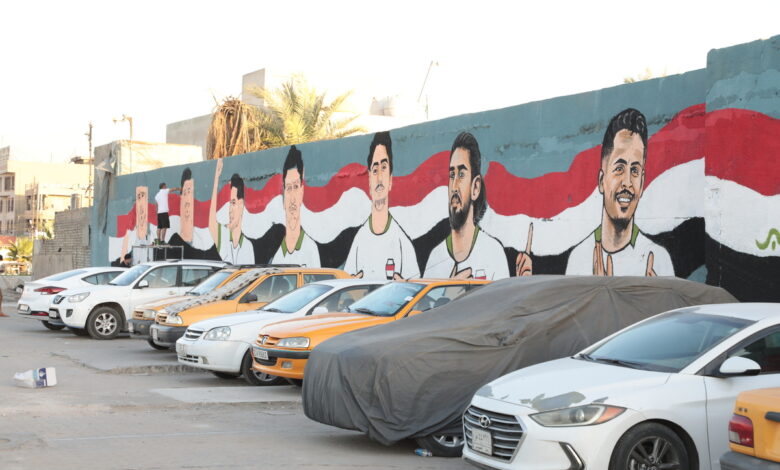
In this context, the Iraqi national football team emerges as the newest—and perhaps most fragile—consolation prize. A team that reached the World Cup after a grueling qualification campaign, hindered at every step by the same corruption and infighting that plague every Iraqi institution since 2003. And yet, Iraqis project onto this team a hope that it might become the one thing capable of uniting them, even briefly, as a people rather than as rival sects.
This is where the idea becomes both powerful and dangerous.
Iraqis are not asking their team for football. They are asking it for what the state has failed to deliver: dignity, unity, a respectable image before the world, and the fleeting reassurance that Iraq can still be something other than ruin.
This is not sport. This is a desperate attempt to manufacture a national consolation prize on a football pitch. But can eleven players carry such a symbolic burden? Is it fair to expect a team to repair what dozens of parties, hundreds of militias, and thousands of corrupt officials have destroyed?
READ: Iraqi football player questioned for 7 hours after arriving in US: Reports
A video circulated recently—posted by a sectarian activist hiding behind a pseudonym—showed Iraqi fans in the 1980s chanting “Iraq, Iraq” in unison at Baghdad’s People’s Stadium. There was no “fake Iraq,” no sectarian slogans, no sense that cheering for the national team could betray one’s identity. Football was simply Iraqi. As it is everywhere else in the world: the national team represents the nation, not a faction.
Today, part of the fan culture has been hijacked. Sectarian clerics exploit the ignorance of crowds, turning matches into crude displays of identity politics. They chant for the sect, not the country, and then speak shamelessly of “the national team.”
How can an Iraqi feel represented by a team whose supporters sometimes violate his sense of national, ethical, and even civilizational belonging?
There was a harsher time. In 2004, as American tanks crushed the streets of Iraqi cities, coach Adnan Hamad led the Olympic team in Athens. He insisted on one sentence: “We play for Iraq alone.”
It was not a slogan. It was an ethical stance in a moment when Iraq’s image was being shaped by war footage, not by sport. In his book Occupied Pitches, Hamad writes about football as if it were the last remaining piece of the nation worth defending. He understood that the team was a counter‑identity to the fake Iraq manufactured by sectarian parties and militia leaders.
He refused to become a sectarian coach—and was punished for it. The political class later barred him from returning because he would not bow to the logic of the factions. He held to one idea: football is not a game; it is the last space where Iraqis can still imagine themselves as one people. The tragedy is that the Iraq which needed him most was the Iraq that shut the door in his face.
And so we return to the question of the consolation prize.
Iraqis do not follow their team merely out of love for football. They follow it because they seek symbolic compensation for everything they have lost: a state, safety, trust, a future. They want to tell themselves: “At least we have a national team.”
Just as they say: “At least we have al‑Sayyab, al‑Ghazali, al‑Sahir…” It is the same sentence in different forms: We do not have a country, but we have reminders that we once deserved one.
But football, however magical, cannot replace politics. It cannot rebuild a broken society. It cannot give an entire people what reality has denied them.
READ: Palestinian Football Association president criticizes US over delayed visa for World Cup events
It can offer a moment of joy, a beautiful illusion of unity, a brief escape from the weight of daily life. But it ends with the referee’s whistle, and the next morning the country remains unchanged.
Around the world, national teams are mirrors of their nations. Analysts read their performances as clues to the inner workings of society. When it comes to deep national identity, the press does not hesitate to speak plainly.
British media, for example, openly describe the England team as a more authentic expression of the country than its politicians—whom The Guardian once compared to “rats fighting inside a sack.”
In Iraq, the picture is harsher. We search for a consolation prize in football while the real prize we need is not a goal scored against an opponent, but a state scored against history. We want a team that wins, but we do not yet have a country that wins.
And so the question becomes unavoidable: Is it enough to pin our hopes on a team while leaving the nation itself without hope? Is it enough to celebrate a new consolation prize while the grand prize—a dignified, just, non‑sectarian Iraq—remains out of reach?
The answer, painfully, is clear: No football team can compensate for a lost homeland. No consolation prize can satisfy a people who have lost everything. And yet, the Iraqi will sit before the screen, cheering, grieving, celebrating, crying—because he no longer has the luxury of abandoning even the last consolation prize he has left.
OPINION: The World Cup in the age of Trumpian transaction
The views expressed in this article belong to the author and do not necessarily reflect the editorial policy of Middle East Monitor.