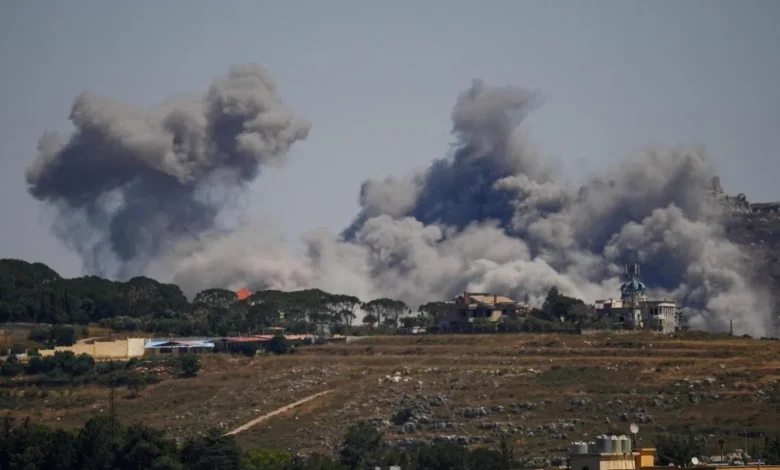
LONDON – A ceasefire agreement between Israel and Lebanon appears to have collapsed hours after it was signed on June 4.
In a joint statement released in Washington at the end of US-sponsored talks, Israeli and Lebanese government negotiators pledged to refrain from further clashes provided the Iranian-backed Hezbollah militia based on Lebanese territory stops its attacks on Israel.
The agreement was swiftly hailed as a win for US diplomacy. And at least in public, Lebanese officials continue to claim that the deal remains valid; “implementation could begin within 24 hours,” Lebanese President Joseph Aoun said.
But Hezbollah has continued to fire drones and missiles at Israel, and the Israeli military announced that it had no intention of withdrawing from occupied Lebanese territory.

The latest agreement therefore seems unlikely to provide a durable framework for stability between Israel and Lebanon. And no such stability is feasible until the broader military confrontation between the US and Iran ends.
Israel’s fight with Hezbollah has always been a proxy war for the Jewish state’s showdown with Iran; without Iranian funding and weapon supplies, the militia would have ceased to exist.
But until recently, both Hezbollah and Iran maintained the fiction that, although they shared the same vision of a Middle East without Israel, they had different objectives and strategies. Hezbollah was particularly keen to be seen as a force defending Lebanon, rather than as simply an Iranian militia.
Israel assassinated most of Hezbollah’s leaders in a surprise offensive launched in September 2024, which, according to Israeli claims, decimated the Lebanese-based militia.
And although this was not evident at that time, the Israeli offensive against Hezbollah acted as a prelude to Israel’s subsequent bombing campaigns on Iran, launched in June 2025 and February this year, in conjunction with the United States.
But Hezbollah is not the spent force the Israelis believed it to be. And instead of knocking out Iran, the war which US President Donald Trump and Israeli Prime Minister Benjamin Netanyahu launched against Iran in February has transformed Hezbollah into an even more valuable proxy for the Iranians.
The result is that Hezbollah is now openly coordinating its actions with Iran. No sooner was a ceasefire concluded between the US and Iran on April 8, 2026, and Hezbollah started bombarding Israeli cities. The Iranians are now insisting that any permanent deal with the US to open the Strait of Hormuz to international navigation and restore the flows of oil from the Gulf must also include a ceasefire in Lebanon.
All these developments are bad news for Netanyahu, who must face general elections in Israel at some point over the next four months.
Hezbollah’s resurgence is embarrassing for the Israeli leader. And the fact that the US is willing to consider a deal with Iran which explicitly ties Hezbollah is Israel’s worst political nightmare.
As if to rub further salt into Israel’s political wounds, Iranian Foreign Minister Abbas Araghchi emphasised on June 1 that any ceasefire agreement with the US also covers Lebanon. “A violation on one front is considered a violation of the ceasefire on all fronts,” Araghchi said.
The idea that Iran could emerge from the current fighting not only with its clerical regime intact but also with its influence throughout the Middle East boosted even further is intolerable to Netanyahu.
That’s why the Israeli prime minister is eager to continue pushing his troops into Lebanon, in the hope of destroying as many Hezbollah installations as possible. Israeli soldiers have now occupied the centuries-old Crusader fortress of Beaufort, located about 60 kms from Beirut, the Lebanese capital.
Netanyahu described this as a “decisive turning point”: “We have broken through the barrier of fear. We are taking the initiative and are active on all fronts,” he claimed.
The snag for Netanyahu is that Trump is desperate to conclude the showdown with Iran and is therefore increasingly irritated by Netanyahu’s machinations. According to a report by the US-based news portal Axios, relations between the US and Israeli leaders are so testy that during a recent phone call, Trump accused the Israeli Prime Minister of being “totally crazy” for continuing the offensive in Lebanon.
Under intense US pressure, Israel has agreed not to resume its bombings of Beirut. But the Israeli ground offensive inside Lebanon is continuing unabated, and the Lebanese capital may well come under Israeli fire again very soon.
US diplomats are now trying a different tack: direct talks between Israel and the Lebanese leaders. Lebanon’s multi-faith government and its Christian leader Aoun are appalled by how Hezbollah dragged their country into another war with Israel. They have therefore agreed to direct talks with Israel, in the hope that this would provide some way out of the crisis.
In theory, the deal concluded between Israeli and Lebanese negotiators in Washington on June 4 amounts to significant progress. The Lebanese have agreed to create so-called “security zones” inside Lebanon’s territory, from which “Hezbollah will be banned and where the Lebanese Armed Forces will take exclusive control of the territory,” as the document claims.
This should create a physical separation between Israel and Hezbollah and allow Israel to withdraw its troops from Lebanon. And it could restore some stability to Lebanon without tying the country’s fate too closely to the ongoing Gulf confrontation with Iran, just as Israel always wanted.
The snag is that neither the Iranians nor their Hezbollah proxy have any interest in going along with this scheme. Although Aoun is a former army general and therefore has greater credibility with the country’s armed forces, the fact remains that the Lebanese military does not have the capacity to isolate and silence Hezbollah, even if this is what the country’s politicians want.
So, unless an agreement is finally concluded between the US and Iran, chances are high that the fighting in Lebanon will continue.
Well-informed foreign diplomats in Tel Aviv now claim that an Israeli Cabinet meeting on June 4 agreed to give Israel’s military forces inside Lebanon “operational freedom of action against threats from Hezbollah”, and to consider bombing Beirut again, in pursuit of Hezbollah commanders.
Even if this risks another angry phone call from Trump.