0
…Adopts Measures To Prevent Abuse By Governors
ABUJA – Nigeria on Wednesday moved closer to one of the most far-reaching security reforms in its democratic history as the Senate passed the Constitution of the Federal Republic of Nigeria, 1999 (Alteration) Bill, 2026, seeking to establish state police across the federation.
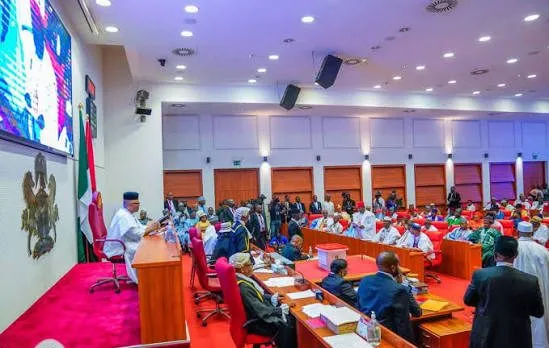
The landmark legislation, which has dominated national discourse for decades, scaled first, second and third readings during a special plenary session attended by state governors, senior presidential aides, security stakeholders and other prominent Nigerians who gathered at the National Assembly to witness what many lawmakers described as a defining moment in the country’s constitutional evolution.


The executive bill was formally presented by the Senate Leader, Senator Opeyemi Bamidele (Ekiti Central), who led an extensive debate on the need to decentralise policing and create a more responsive security architecture capable of addressing Nigeria’s growing and increasingly complex security challenges.
The Senate’s approval followed hours of deliberations and clause-by-clause consideration by lawmakers.
Although proceedings were briefly delayed by technical difficulties associated with the electronic voting system, senators eventually resorted to manual voting after several lawmakers reported that their electronic devices were malfunctioning.
Senate President Godswill Akpabio had initially conducted a test run of the electronic system in preparation for voting on the constitutional amendment.
However, complaints from lawmakers regarding technical glitches forced the chamber to abandon the electronic process.
With 87 senators present, the Senate proceeded with manual voting, requiring lawmakers to stand and raise their hands while officials of the Sergeant-at-Arms conducted the count.
The passage of the bill marks a significant shift from Nigeria’s long-standing centralised policing structure established under the 1999 constitution.
For years, advocates of state policing have argued that the country’s security realities have outgrown a single federal police force responsible for protecting over 230 million citizens spread across diverse ethnic, cultural and geographical environments.
Supporters have maintained that local authorities possess a better understanding of community dynamics, terrain, languages and security peculiarities, making them better positioned to tackle criminal activities within their jurisdictions.
Opening debate on the bill, Senator Bamidele described the proposal as one of the most consequential constitutional reforms since Nigeria’s return to democratic rule in 1999.
According to him, the current centralised policing framework was designed for a different era and has increasingly struggled to cope with modern security threats confronting the nation.
He noted that Nigeria’s security landscape has undergone dramatic transformation over the years, with terrorism, banditry, kidnapping, communal conflicts, cybercrime, farmer-herder clashes and organised criminal networks stretching the capacity of federal security agencies.
“The realities of contemporary Nigeria have exposed significant challenges associated with a centralised policing architecture,” Bamidele said.
“Nigeria is a vast federation comprising 36 states and the Federal Capital Territory, with diverse cultures, languages, geographical terrains, security dynamics and socio-economic conditions.
“The increasing complexity of security threats has placed enormous pressure on the existing policing framework. The present structure often limits the ability of local authorities to respond swiftly and effectively to security challenges within their jurisdictions.”
The Senate Leader said the bill seeks to establish a constitutional framework that would allow states to create and operate their own police services while preserving the authority and responsibilities of the Federal Police Service.
He explained that the proposed arrangement is designed to balance local security needs with national security coordination and constitutional safeguards.
Under the framework approved by the Senate, states that choose to establish their own police services would be empowered to do so within clearly defined constitutional parameters.
The legislation also provides for the retention of a Federal Police Service to continue handling federal offences, national security matters and crimes that transcend state boundaries.
To address fears of political abuse, the bill includes provisions for independent State Police Service Commissions as well as national oversight mechanisms intended to guarantee professionalism, accountability and adherence to established policing standards.
Bamidele said these safeguards were deliberately incorporated to prevent state police formations from becoming instruments of political intimidation or oppression.
He emphasised that national minimum standards would apply across all state police services to ensure consistency in recruitment, training, operations and respect for human rights.
According to him, the reform offers several advantages capable of transforming Nigeria’s security architecture.
Among the anticipated benefits are improved community policing, enhanced intelligence gathering, faster emergency response and reduced pressure on federal law enforcement agencies.
He argued that security agencies perform best when officers possess intimate knowledge of local communities, traditions, languages and social dynamics.
“Security is most effective when law enforcement personnel understand local communities, languages, customs and terrain,” he stated.
“State Police Services will strengthen intelligence gathering and community engagement.”
He further argued that decentralised policing would allow local authorities to respond more quickly to criminal activities and public safety emergencies, thereby improving overall security outcomes.
The passage of the bill comes amid growing public concern over persistent insecurity in several parts of the country.
From insurgency in the North-East to banditry in the North-West, kidnapping along major highways, communal conflicts in rural communities and organised criminal activities in urban centres, Nigeria has faced mounting pressure to rethink its security strategy.
Successive administrations have grappled with calls for state policing, but political disagreements, constitutional concerns and fears of abuse by state governments repeatedly stalled progress.
Advocates of the reform have often pointed to successful federal systems around the world where local, state and federal policing structures operate simultaneously under clearly defined legal frameworks.
The Senate’s approval, therefore, represents a major breakthrough in a debate that has endured for more than two decades.
In addition to the State Police Bill, the Senate also passed the Police Trust Fund (Amendment) Bill, aimed at strengthening the financial base of law enforcement agencies and improving police welfare, training and operational effectiveness.
Lawmakers argued that improved funding remains critical to achieving meaningful security reforms and enhancing the capacity of security personnel to perform their duties effectively.
Speaking after the passage of both bills, Senate President Akpabio expressed optimism that the reforms would significantly improve security across the country.
He said the amendment to the Police Trust Fund Act would enhance the welfare of police personnel and strengthen operational efficiency.
“I believe that the welfare of the police force will be enhanced and much more efficient operations will be carried out,” Akpabio said.
The Senate President also expressed confidence that the establishment of state police would contribute substantially to addressing terrorism, banditry and other violent crimes.
“I think Nigerians will be safer with these bills, and banditry and terrorism we are witnessing will not only be minimised but will be reduced to the barest minimum.
“I am of the opinion that Nigerians shall conquer terrorism and banditry. And so shall they be.”
Wednesday’s historic vote may ultimately be remembered as one of the most consequential actions taken by the 10th National Assembly.
However, the journey toward full implementation of state police is not yet complete.
As a constitutional amendment, the bill must still secure the approval of at least two-thirds of Nigeria’s State Houses of Assembly before being transmitted to President Bola Ahmed Tinubu for assent.
Political observers believe the coming months will test the strength of the national consensus that has emerged around the issue.
Nevertheless, the Senate’s action has fundamentally altered the trajectory of the debate.
For supporters, it signals a willingness by Nigeria’s political leadership to confront long-standing structural weaknesses in the country’s security framework.
For critics, attention will now shift to ensuring that adequate safeguards are put in place to prevent abuse and guarantee that state police serve the interests of citizens rather than political actors.
Either way, the passage of the State Police Bill marks a watershed moment in Nigeria’s ongoing search for a more effective, accountable and responsive security system.
If eventually ratified and implemented, the reform could redefine policing in Africa’s most populous nation and reshape the country’s security landscape for generations to come.