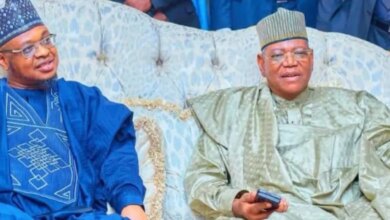
NDC Leaders Accuse Kwankwaso of Excluding Stakeholders, Reject One-Group Control of Kano Structure

By Chimezie Godfrey
Fresh cracks have emerged within the New Democratic Congress (NDC) in Kano State as the party’s North-West Vice Chairman, Mohammed Rabiu Serina, and Kano State Chairman, Hussaini Isa Mariga, accused former Kano State governor, Rabiu Musa Kwankwaso, of sidelining party stakeholders and attempting to monopolise the party’s structure in the state.
In a joint statement, Serina and Mariga alleged that Kwankwaso refused to accommodate party members outside the Kwankwasiyya movement during the nomination process, despite repeated interventions by the party leadership.
According to Serina, the party’s National Leader, Henry Seriake Dickson, initially appointed him and Mariga as pro tem officers upon the party’s registration before their positions were later ratified at congresses and the national convention.
He said both officials were subsequently tasked with building and strengthening the party’s structures across their jurisdictions before Kwankwaso and his supporters joined the party.
According to Serina, party leaders facilitated Kwankwaso’s admission into the NDC and were directed by the National Leader to work closely with him and provide him the necessary support to strengthen the party.
He explained that disagreements later emerged during the state congresses when Kwankwaso allegedly sought complete control of the party structure in Kano State.
According to him, following interventions by the National Leader, an agreement was reached under which Kwankwaso and his supporters would control 60 per cent of the party structure in Kano, while the existing party leadership retained 40 per cent.
Serina said the arrangement also preserved the positions of the State Chairman and National Vice Chairman, a resolution he claimed was accepted by all parties.
He maintained that despite the disagreements, party officials continued to work harmoniously with Kwankwaso and regularly consulted him in line with directives from the party leadership.
However, according to Serina, tensions resurfaced during the nomination process when nomination forms for elective offices were allegedly restricted to members of the Kwankwasiyya movement.
He claimed that despite handing over nomination forms to Kwankwaso as a mark of trust and cooperation, no forms were allocated to party members outside his political group.
“Unfortunately, despite repeated engagements, Senator Kwankwaso refused to allow access to nomination forms by party members outside the Kwankwasiyya group,” Serina stated.
According to him, Kwankwaso declined to allocate any of the 40 State House of Assembly forms, 24 House of Representatives forms, three Senatorial forms or the governorship form to non-Kwankwasiyya members.
Serina further alleged that neither he, the Kano State Chairman nor other party officials outside the movement were given access to nomination forms.
He said efforts to reach a compromise, including proposals to reserve a number of legislative tickets for non-Kwankwasiyya members while leaving senatorial positions under Kwankwaso’s control, were unsuccessful.
According to Serina, the matter was formally reported to both the National Leader and the National Working Committee, prompting multiple interventions aimed at resolving the dispute.
He disclosed that the National Leader personally met Kwankwaso on two occasions and urged him to accommodate other stakeholders, while the National Working Committee also sent a delegation to engage him.
Serina argued that no individual possesses a monopoly of political influence in Kano State, adding that several respected politicians who joined the NDC independently of Kwankwaso deserved consideration for elective positions.
He specifically mentioned former House of Representatives member, Nasiru Ali Ahmed, as one of the party figures allegedly affected by the nomination dispute.
The NDC North-West Vice Chairman also claimed that the situation affected the aspirations of prominent politicians, including Kabiru Gaya, who reportedly showed interest in contesting senatorial positions on the party’s platform.
According to Serina, Kwankwaso remained unwilling to compromise despite repeated appeals and allegedly indicated that he could leave the party if he was not granted total control of its Kano structure.
He said the development had raised concerns among party members regarding inclusiveness, internal democracy and collective ownership of the party.
“We are not members of the Kwankwasiyya movement, and we cannot accept a situation in which membership of a particular political group becomes the sole criterion for participation, recognition, or eligibility for elective office within our party,” Serina stated.
Addressing allegations relating to financial contributions, Serina said the decision requiring aspirants to pay nomination fees directly into the party’s official account was collectively approved by party organs and was not the initiative of any individual.
He maintained that party activities in Kano State had been funded independently before Kwankwaso joined the NDC and alleged that records available to the party did not indicate any financial contributions by the former governor to either the state or national structures.
According to him, the only formal request made to Kwankwaso by the National Working Committee related to contributions towards the Presidential Campaign Council.
Serina and Mariga further alleged that rather than strengthening the party platform, Kwankwaso’s actions and statements had contributed to internal tensions and threatened party cohesion.
The two party leaders nevertheless reaffirmed their commitment to working with the party’s National Leadership and members across the country to build what they described as a credible political alternative.
They stressed that the NDC belongs to all members and not to any individual or political movement and expressed willingness to continue working with Kwankwaso, provided such cooperation is based on mutual respect, inclusiveness and commitment to the party’s growth.
What do you think about this?
Drop your opinion in the comment section.
FOLLOW US & Share this with someone who needs to see this.