The Federal Government of Nigeria and the World Intellectual Property Organisation (WIPO) have agreed to actively deepen collaboration to turn the nation’s intellectual property (IP) into tangible financial assets.
The target is to commercialise research from Nigerian universities and support the creative economy through stronger technical cooperation, deeper institutional support, and expanded capacity-building, among others.


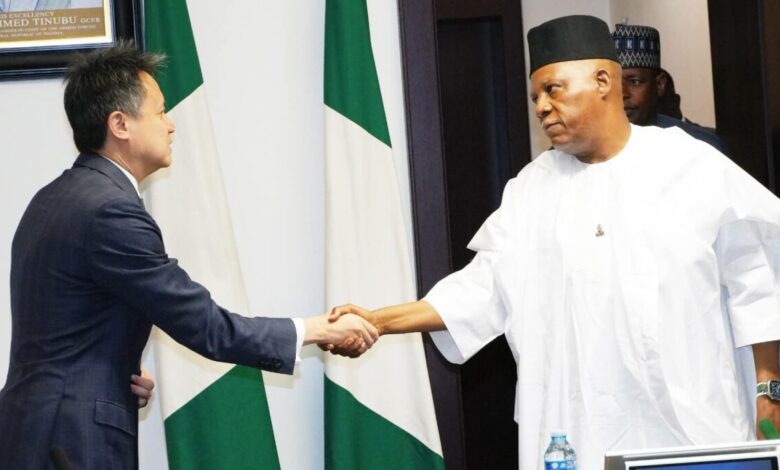
This was the outcome of a meeting between Nigeria’s Vice President, Senator Kashim Shettima, a delegation from WIPO led by its Director-General, Mr. Daren Tang, and top Nigerian government officials at the Presidential Villa, Abuja.
Categorically, the Vice President drew the WIPO delegation’s attention to Nigeria’s unmistakable ambition, which he said was to build an “intellectual property system that serves the inventor and the investor, the researcher and the entrepreneur, the artiste and the industrialist, the farmer and the software engineer.”
He welcomed the decision by WIPO to open its first office in Abuja, the first in Sub-Saharan Africa and one of only seven worldwide.
He recalled that the Federal Executive Council (FEC) had in November 2025 approved the National Intellectual Property Policy and Strategy “to provide Nigeria with its first comprehensive framework for the development, protection, promotion, management, and commercialisation of intellectual property.”
According to VP Shettima, there couldn’t have been a better time to take a deeper view of a nation whose creative and innovative energies were already shaping Africa and speaking to the world.
“As we deepen our collaboration with WIPO, we do so with gratitude and with great expectation. We look forward to stronger technical cooperation, deeper institutional support, expanded capacity-building, and practical pathways for the commercialisation of Nigerian creativity and research. We believe that the future belongs to nations that understand the dignity of the mind and the economy of ideas,” he declared, according to statement signed by Stanley Nkwocha
Senior Special Assistant to the President on Media & Communications in the Office of the Vice President, on Monday.
The Vice President noted that the administration of President Asiwaju Bola Tinubu was building an economy where investors will feel satisfied that innovation is protected, disputes are resolved with confidence, and intellectual assets can be converted into wealth.
He said, “The foresight of His Excellency, President Bola Ahmed Tinubu, GCFR, through the Renewed Hope Agenda, is anchored in unlocking productivity, expanding economic opportunity, attracting investment, creating jobs, and positioning Nigeria for long-term prosperity.
“At the heart of this agenda is a clear recognition that value in today’s economy is increasingly created through ideas, technology, innovation, data, brands, culture, and knowledge. The countries that will lead this century are those able to create, protect, commercialise, and scale intellectual assets.”
Senator Shettima also noted that with the right innovation, education and skills enhancement, Nigeria would make Africa great, even as he reaffirmed Nigeria’s commitment to innovation diplomacy and to WIPO’s mission to create a balanced and international ideal system.
While mandating the Ministers of Justice, Industry, Trade and Investment and Culture, Art and Creative Economy to work out a roadmap for a robust engagement with WIPO, he pledged more relationship between Nigeria and the organisation.
For his part, the Director-General of WIPO, Mr. Tang, noted that he was visiting Nigeria for the first time, assuring that WIPO remains committed to being part of Nigeria’s growth and prosperity.
He stressed that his visit was based on two milestones: the opening of the first WIPO office in Abuja—the first in Sub-Saharan Africa and one of only seven worldwide—and the launch of the National Intellectual Property Policy and Strategy (NIPPS) by the Tinubu administration.
He said the inaugurated WIPO office demonstrates the importance the international body places on Nigeria, adding that Nigerian entrepreneurs, innovators, and creators are shaping the world and serving as role models in the IP revolution across the continent.
He congratulated the Tinubu administration on the National IP Strategy, expressing optimism that the nation’s IP ecosystem will continue to serve as a platform for economic empowerment and job creation.
He observed that over 3,000 Nigerian startups, including seven unicorns, are already attracting significant financial capital to the country, demonstrating that intellectual property is increasingly being driven by emerging economies.
Earlier, the Attorney General of the Federation, Lateef Fagbemi (SAN), said the visit of the delegation reflected the growing partnership between Nigeria and WIPO, aimed at strengthening the country’s intellectual property ecosystem.
According to him, Nigeria is home to a vibrant community of investors, creators, startups, and technology-driven businesses, noting that for innovation to continue thriving, there must be a strong legal and institutional framework, such as the National Intellectual Property Policy and Strategy (NIPPS).