…One Meal Alone Gulps Two-Thirds Of Minimum Wage Earnings
…Ekiti Worker Must Spend 90% Of Earnings For Healthy Diet
…South-East Workers Spend 81% Earnings On Food
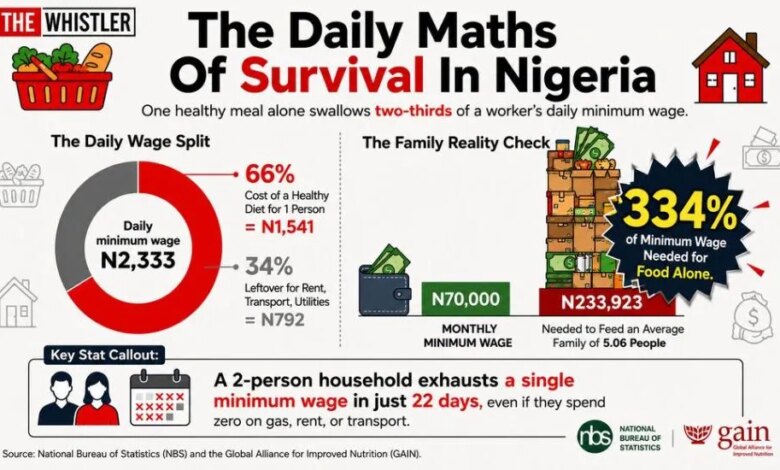
An average Nigerian family needs more than three times (334 per cent) the current national minimum wage to afford a healthy diet.
This is according to THE WHISTLER’s analysis of 15-month Cost of a Healthy Diet (CoHD) data sourced from the National Bureau of Statistics (NBS) and the Global Alliance for Improved Nutrition (GAIN).
A Nigerian worker earning the national minimum wage of N70,000 a month takes home N2,333 a day.
At the national average, the raw ingredients needed for one person’s healthy diet cost N1,541.
This leaves N792 for rent, school fees, transport, and the firewood or cooking gas needed to prepare the food, among other expenses.
According to the NBS, the average household size in Nigeria is 5.06 persons per family. In rural areas, the size is larger at 5.42 individuals and 4.50 persons in urban areas.
The highest household size is in Jigawa state at 8.15 persons, and the lowest is in Ekiti state, where an average household comprises 3.50 family members.
The Cost of a Healthy Diet (CoHD), developed by the NBS in partnership with the Global Alliance for Improved Nutrition, measures the least expensive combination of locally available foods required to meet internationally recognised dietary recommendations.
The estimate covers only food ingredients and excludes transportation to markets, cooking fuel, water and other meal preparation costs.
At the national average of N1,541, the CoHD consumes two-thirds of a minimum wage earner’s daily pay. For a single adult, the national average cost of a healthy diet translates to N46,230 per month, leaving N23,770 from the minimum wage for other expenses.
In a household of two persons supported by one person’s income, the CoHD cost is N92,460 monthly. This exceeds the N70,000 wage by N22,460. Even if the worker spent nothing on rent, transport, or cooking fuel, their income is exhausted after 22 days.
To feed an average Nigerian household, the cheapest diet that meets global nutritional standards, a worker would need N233,923 a month. This represents 334% of the current minimum wage, according to the CoHD data analysed by THE WHISTLER.
On May 30, the Nigeria Governors’ Forum (NGF) proposed raising the minimum wage from N70,000 to N100,000.
The Nigeria Labour Congress, however, rejected the figure and demanded N1m as new minimum wage.
The CoHD data indicates that even at the proposed N100,000 minimum wage, feeding an average family would require more than twice the amount.
THE WHISTLER’s analysis shows that the CoHD consumes nearly all of a minimum wage earner’s income in Ekiti State.
The March 2026 data put Ekiti’s daily CoHD at N2,091, the highest for any state in Nigeria.
A worker who earns a minimum wage of N2,333 per day in the state will spend 89.6 per cent of their daily wage on raw food for one person.
This leaves the worker with N242 to cover the cost of cooking the food and other expenses.
In Adamawa, which has the most affordable cost of a healthy diet at N1,004 daily, a minimum wage earner would be left with N1,329 after purchasing ingredients for one person’s healthy diet.
The South-East recorded the highest zonal average cost of a healthy diet at N1,899 per adult per day, meaning a minimum wage worker would spend more than 81 per cent of daily earnings on food alone.
The North-East recorded the lowest zonal average at N1,233 per day, equivalent to about 53 per cent of daily minimum wage earnings.
If the daily CoHD rate is adjusted for a household of two adults and three children, with the children consuming roughly 70 per cent of the adults’ quantities, the monthly estimate for the family comes to about N180,000 (257 per cent of the minimum wage).
In Jigawa State, where the average household size is 8.15 people (the largest in any state), feeding a family costs nearly five times the daily minimum wage at N11,141 per day based on the state’s March 2026 CoHD of N1,367.
In Yobe State, a healthy diet costs more in rural markets than in towns. The March 2026 data put the rural CoHD at N1,470, compared with N1,381 in urban areas.
In Kebbi, the CoHD is N1,465 in rural markets against N1,429 in towns. The NBS report attributes this to poor road infrastructure.
What do you think about this?
Drop your opinion in the comment section.
FOLLOW US & Share this with someone who needs to see this.