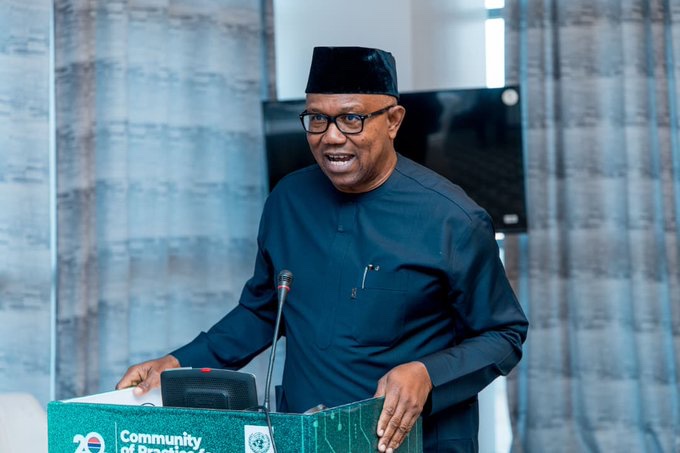
(Peter Obi. Photo by Arise News)
Peter Obi, former Anambra State governor and Nigeria Democratic Congress (NDC) presidential candidate for the 2027 election, on Monday called on President Bola Tinubu to follow the example of British Prime Minister Keir Starmer and step down from office, citing the administration’s alleged failure to meet the expectations of Nigerians amid deepening economic and social challenges.
The demand was swiftly rebuffed by the Presidency, which dismissed the call as childish, misplaced, and undemocratic, maintaining that Tinubu was elected through a constitutional process and remained committed to delivering on his mandate.
The exchange unfolded against the backdrop of Starmer’s announcement on Monday that he would be stepping down as leader of the governing Labour Party in the United Kingdom, with Andy Burnham, widely regarded as the party’s most popular politician, declaring his intention to seek the prime ministerial role and swiftly securing the backing of a potential rival.


Responding to the development in the UK, Obi, in a post on social media titled “Owning Up to Leadership Failures and Political Responsibility,” urged Tinubu to take a cue from the outgoing British leader and spare Nigeria from a further deterioration of its economic condition, having, in Obi’s assessment, fallen short on key electoral commitments.
Obi drew a historical parallel, noting that Tinubu had, in the past, called on then-President Goodluck Jonathan to resign when his administration appeared unable to meet public expectations, and urged the current president to apply that same standard to himself.
He noted that Starmer’s planned resignation came against a backdrop of growing public anger over a sluggish economy, a deepening cost-of-living crisis, and a perception that the government had failed to honour core campaign pledges conditions he said mirrored the situation in Nigeria.
Casting his mind back to the period before 2015, Obi recalled that Tinubu had on several occasions championed the call for Jonathan to resign over economic hardship and insecurity.
He specifically cited the Chibok school k!dn@p incident, during which Tinubu reportedly demanded Jonathan’s immediate resignation, arguing that the government had failed in its most basic duty of protecting lives.
The Labour Party’s 2023 presidential candidate also took direct aim at Tinubu’s failure to deliver on his promise of reliable electricity supply, reminding Nigerians that the president had, during the 2023 campaign, challenged the electorate not to re-elect him if he did not fulfil his commitments particularly on stable power, anti-corruption efforts, and improving citizens’ welfare.
Obi argued that far from improving, conditions across these areas had worsened since Tinubu assumed office.
He said electricity supply remained unreliable, insecurity had intensified across many states, and economic hardship had deepened rather than eased. He added that other critical sectors, including infrastructure, transportation, and security, had similarly regressed.
“I therefore join Nigerians of goodwill in calling for the resignation of the President over monumental failure in governance. Such a gesture would help enthrone a political culture rooted in accountability and responsibility, rather than further entrenching impunity,” he stated.
Obi maintained that such a step would also signal to future leaders that public office is a sacred trust, not an entitlement, and that failure in governance carries consequences. He insisted that ending the culture of impunity was the only path to building a better society for future generations.
The Presidency, however, formally responded to Obi’s remarks, with presidential spokesperson Bayo Onanuga describing the call as hollow political grandstanding, particularly coming just hours after the ruling All Progressives Congress recorded what it termed resounding victories in weekend by-elections.
Onanuga argued that Obi’s comparison between Nigeria and the United Kingdom was fundamentally flawed, pointing out that Nigeria operates a presidential system of government with a fixed four-year term, unlike the parliamentary system in the UK.
He said the outcome of the recent off-season elections in Ekiti State and several senatorial constituencies in Nasarawa, Enugu, Ondo, and Rivers states amounted to an early referendum of confidence in Tinubu’s administration.
The Presidency also pushed back on Obi’s characterisation of the security situation, noting that while the challenges were longstanding and deeply rooted, significant progress had been made under Tinubu’s watch.
It stated that hundreds of individuals had been rescued from captivity, including during high-profile operations in Borno and the Northwest, and that over 15,000 individuals described as t3rrorists had been neutralised or removed from the streets and forests, with security operations having intensified nationwide.
On the economy, the Presidency rejected Obi’s claim that Nigeria was in its worst possible condition, citing what it described as verifiable data supporting Tinubu’s economic stewardship.
It noted that Nigeria had recorded positive GDP growth every quarter since May 2023, that trade surpluses had been posted consistently, and that foreign reserves had climbed to over $50 billion.
Oil production, it said, had risen from under one million barrels per day to approximately 1.8 million, while federation revenue was projected to exceed N30 trillion this year, compared to N7.7 trillion in 2022.
The Presidency also noted that the All-Share Index on the Nigerian Stock Exchange had risen from 50,000 points to over 250,000 points, and that foreign direct and portfolio investments had reached record highs, reflecting renewed investor confidence. It credited Tinubu with significant infrastructure delivery, including concrete roads across all geopolitical zones and progress on the long-delayed Lagos-Calabar and Sokoto-Badagry superhighway projects.
On the electricity question, the Presidency said Obi had misrepresented Tinubu’s actual campaign promise, clarifying that the president had not pledged 24-hour power supply for all Nigerians.
It said what Tinubu actually committed to was ensuring Nigerians would have electricity and would no longer pay estimated bills a promise it argued was being pursued through the signing of the Electricity Act, the rollout of millions of prepaid meters, and increased off-grid solar power provision.
The Presidency also attributed current cost-of-living pressures to global factors, including disruptions to the global supply chain following military exchanges involving the United States, Israel, and Iran, and Iran’s subsequent closure of the Strait of Hormuz.
It concluded by describing Obi as living in a self-constructed echo chamber, dismissing his assessment of Nigeria’s condition as largely a product of his imagination.
Meanwhile, in the United Kingdom, Starmer formally announced that he would remain as prime minister until a new Labour Party leader was selected by September, rather than contest to retain his position.
His departure means Britain is set to have its seventh prime minister in a decade, extending a period of political instability that began with the country’s 2016 vote to leave the European Union.
Burnham, whose convincing victory in a recent special election had bolstered his leadership prospects, confirmed on social media that he would formally seek to replace Starmer, describing the transition as a positive process of renewal.
He swiftly received the backing of Wes Streeting, a former health secretary and potential rival, who urged the party to unite behind Burnham rather than engage in a divisive internal contest.
Starmer, who became prime minister in 2024 after Labour ended 14 years of Conservative Party rule with a large parliamentary majority, said his decision to step down was driven by the realisation that his parliamentary colleagues no longer believed he was best placed to lead the party into the next general election.
His tenure had been marred by controversy over his appointment of Peter Mandelson as ambassador to the United States, given Mandelson’s ties to the convicted sex offender Jeffrey Epstein, and by Labour’s heavy losses in local elections in May which proved a breaking point for many within the party.
In his resignation letter, Starmer highlighted a series of achievements during his two years in office, including economic growth surpassing that of the country’s peers, wages rising ahead of inflation each month, a reduction in National Health Service waiting lists, expanded rights for workers and renters, and what he described as the largest increase in defence spending since the Cold War.
He also cited the lifting of half a million children out of poverty, a reduction in small boat Channel crossings, and the restoration of Britain’s international standing.
He stressed, however, that the central question was no longer who was best placed to change the Labour Party but who was best placed to lead it into the next election and that he had accepted the answer his parliamentary colleagues had given him.