New posts
Featured entry
19:34
US And Gulf States Back Iran Nuclear Talks But Warn Sanctions Relief Is ‘Reversible’
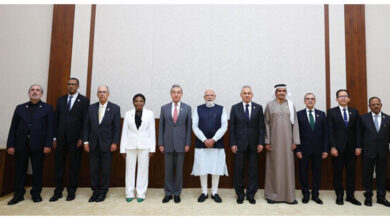
Foreign ministers of the Gulf Cooperation Council member states meet with US Secretary of State Marco Rubio in Manama on June 25.
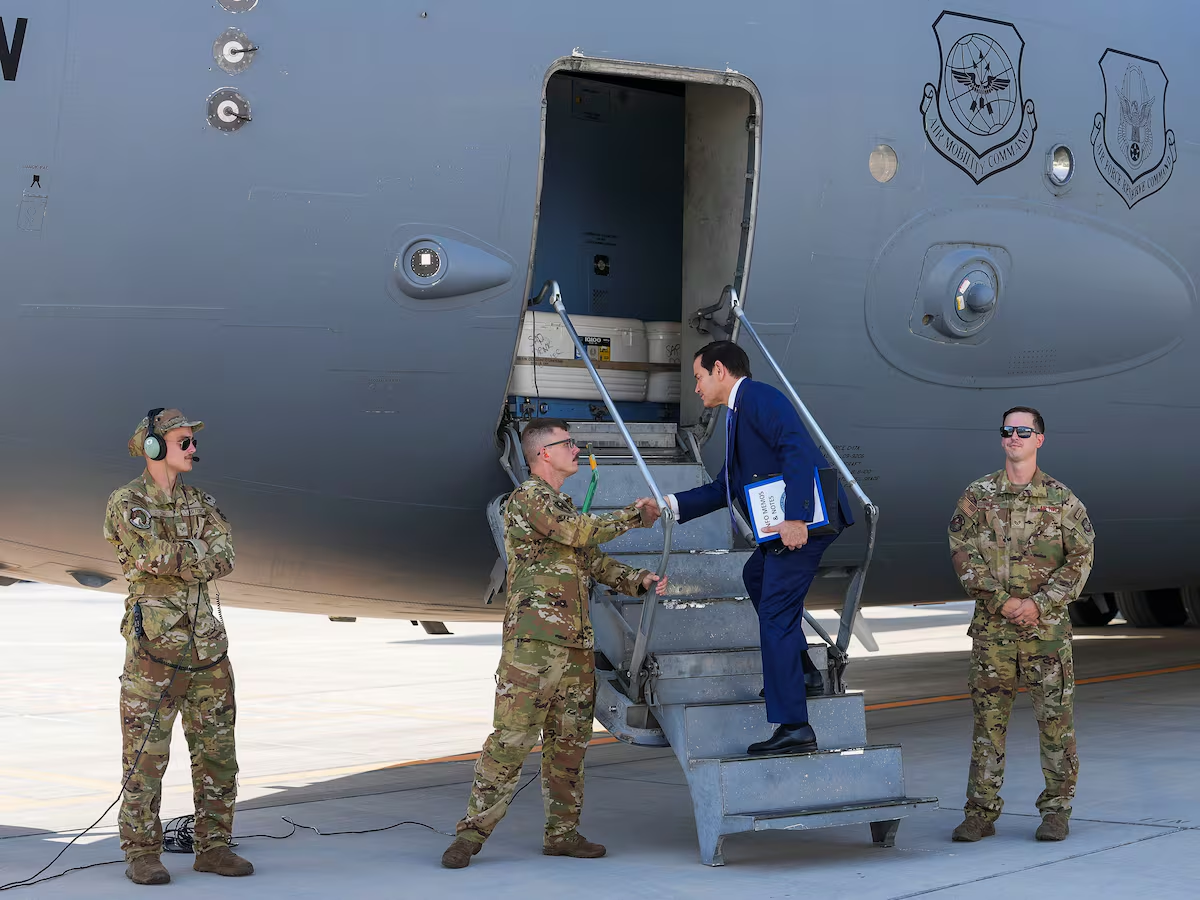

MANAMA — The United States and Persian Gulf Arab states have backed ongoing diplomacy with Iran but warned that any economic benefits from a recent framework agreement, which paves the way for negotiations on Iran’s nuclear program, could be quickly withdrawn if Tehran fails to meet its commitments or continues activities they view as destabilizing.
The warning came in a joint statement issued on June 25 after a ministerial meeting between US Secretary of State Marco Rubio and foreign ministers from the Gulf Cooperation Council (GCC) in Bahrain.
The statement welcomed the June 17 memorandum of understanding between Washington and Tehran as an important step toward reducing regional tensions and praised mediation efforts by Qatar and Pakistan.
But the ministers stressed that any lasting agreement must prevent Iran from developing a nuclear weapon and address what they called the “full spectrum” of Iranian threats, including its ballistic missile and drone programs, as well as support for armed groups across the Middle East.
They said future trade and investment with Iran would be “conditional and reversible,” depending on Tehran’s compliance with the memorandum and any final agreement reached in ongoing negotiations.
The ministers also called for unrestricted navigation through the Strait of Hormuz, rejecting any attempt to impose tolls or fees on shipping in the waterway.
Beyond Iran, the statement reaffirmed support for reconstruction in Syria, Lebanon’s sovereignty and efforts to disarm non-state armed groups, and US-led efforts to end the war in Gaza while opposing the forced displacement of Palestinians.
It also condemned attacks by Iran-aligned groups in Iraq against Gulf states.
Share
Copy link
Facebook
X (Twitter)
LinkedIn
Email
Share
20:17
Cargo Vessel Hit By Projectile Off Oman, Says Shipping Monitor
A cargo vessel was struck by an unknown projectile 7.5 nautical miles southeast of Dahit, Oman, on June 25, according to the United Kingdom Maritime Trade Operations (UKMTO), which monitors shipping security in the region.
UKMTO said the vessel was hit on its starboard side, causing damage to the bridge. The captain reported no casualties and no environmental impact.
The incident comes as the United States and Iranremain at oddsover navigation through the Strait of Hormuz. Under a June 17 framework agreement, Iran pledged to make its “best efforts” to ensure toll-free passage for 60 days, but Iranian officials have since said they intend to charge “service fees” for vessels using the waterway.
UKMTO advised vessels to transit with caution and report any suspicious activity.
Share
Copy link
Facebook
X (Twitter)
LinkedIn
Email
Share
15:25
Iran Denies Unfrozen Funds Will Be Used To Purchase US Crops
Iranian Parliament Speaker Mohammad Baqer Qalibaf (file photo)
Iran’s parliament speaker and top negotiator, Mohammad Baqer Qalibaf, has dismissed claims that Tehran will use its unfrozen assets to buy US agricultural products, calling them false.
“The US only exports GMO soybeans, broken promises and trash talks,” Qalibafsaid in an X poston June 25, a day after US President Donald Trump said that released Iranian assets will be “totally controlled” by the United States.
“We will be releasing some of their money, that is totally controlled by us, to our Farmers and Ranchers, for the purchase of Corn, Wheat, Soybeans, and more,” Trumpsaid in a Truth Social poston June 24.
He added that Iran “desperately needed” food and insisted that “we will be purchasing it for them exclusively from the United States,” following a deal with Washington.
The release of billions in Iranian funds held abroad is part of the memorandum of understanding (MOU) signed by Tehran and Washington on June 17 that aims to end months of war between the countries.
The prospect of purchasing US agricultural products using unfrozen funds hasnot gone down well with hard-liners in Iran, who say Iran is “gifting” billions to that United States and making its food security dependent on US farmers.
Share
Copy link
Facebook
X (Twitter)
LinkedIn
Email
Share
15:24
Rubio Seeks To Reassure US Gulf Allies At Talks In Bahrain
US Secretary of State Marco Rubio speaks with in Bahrain on June 25.
MANAMA — US Secretary of State Marco Rubio has been bringing US allies in the Persian Gulf up to speed on the framework agreement with Iran and related issues at a meeting of the Gulf Cooperation Council (GCC) in Bahrain.
Rubio acknowledged that GCC nations had concerns about the US-Iran deal, which set up a 60-day period for further talks with Tehran.
It’s important to point to a couple of things that are a priority to us. For while we want a deal, we don’t want a deal at any price. We want a deal that’s good, he said. We want to ensure that (in) any decisions that are made throughout this negotiating process, the interest of our partners and our allies in the region are always taken into account.
The GCC consists of Bahrain, Kuwait, Oman, Qatar, Saudi Arabia, and the United Arab Emirates (UAE). The meeting follows a tour Rubio has taken through the region.
Media reports have suggested GCC countries have reservations about the deal.
All of them were targeted by Iranian missiles following the US and Israeli air strikes that began the war on February 28.
At the meeting in Bahrain, Rubio again emphasized that indications by Iran that it would seek to impose tolls or fees for ships passing through the Strait of Hormuz were unacceptable.
You can call it a toll. You can call it a fee, whatever you want to call it, it’s a game of semantics. The reality of it is that no country on Earth has a right to charge for the use of international waterways, and that will never be an acceptable condition of any deal, he said.
Share
Copy link
Facebook
X (Twitter)
LinkedIn
Email
Share
12:53
Oil Prices Fall To Pre-War Levels For First Time
The price of Brent crude, the global benchmark oil, has fallen to below the level it was at before US and Israeli air strikes started the war with Iran on February 28.
The decline comes as increasing numbers of ships have been clearing the Strait of Hormuz, the key global artery for some 20 percent of global oil supplies prior to the war.
(illustration)
At one point, Brent was trading at $72.24 a barrel on June 25. According to theTrading Economicsweb monitor, it reached $73.48 on February 27.
Oil prices have been coming down all week as traffic increased in the strait, following the US-Iran framework agreement to end their conflict.
Shipping levels still have a long way to go before they reach pre-war levels and have also been boosted by an International Maritime Organization (IMO) operation to evacuate ships stranded when Iran closed the strait in early March.
IMO figures on June 25 showed 13 vessels passed the strait on June 23, followed by 32 the next day, and 12 vessels by midday local time on June 25. These were just vessels exiting the strait as part of the IMO operation.
Global oil supply has been further boosted by the US waiver on sanctions applying to Iranian oil, bringing extra barrels to market that were previously not legally available — although Chinese refineries did buy large amounts of oil transported by Iranian shadow fleet vessels.
Kpler, a commodities intelligence company, noted 70 crossings in both directions on June 24, the highest figure since March 1. The same day, maritime intelligence company Windward noted a 48 percent increase in traffic through the strait.
Share
Copy link
Facebook
X (Twitter)
LinkedIn
Email
Share
12:30
Veterans Of Iran Talks Say Verification Will Be Heavy Slog With Details Of Access Key To Success
IAEA officials carry out an inspection at Iran’s Natanz nuclear power plant in 2014.
Amid an ongoing row between Washington and Tehran over whether international monitors can verify Iranian compliance with its nuclear nonproliferation commitments, former officials have told RFE/RL that the scale, scope, and degree of access are crucial to the success of inspections.
Details on those have yet to be determined, though Raffael Grossi, head of the International Atomic Energy Agency (IAEA) said the UN body “will be working on the modalities — dates, procedures, places — very soon.”
That doesn’t mean, according to experts, that the organization hasn’t already drawn up a wish list for any eventual inspections.
“They almost certainly have a plan for when they go back in, what the priorities are, where they would want to go first, second, third,” Laura Rockwood, a former IAEA negotiator on Iran, told RFE/RL.
To read the full report, clickhere.
Share
Copy link
Facebook
X (Twitter)
LinkedIn
Email
Share
11:15
Iran Agreed To Downblend Its Uranium. But How Do You ‘Dilute’ A Radioactive Metal?
In the 1990s, US and Russian scientists pulled off the ultimate nuclear magic trick: “downblending” weapons-grade uranium so it could never be used in a bomb.
Now, the US and Iran are trying to repeat history.
Under the new 60-day peace roadmap, Iran has agreed to downblend its current stockpile.
But how exactly do you “dilute” a radioactive metal? Its not as simple as adding water.