Realist explanatory models are experiencing a renaissance not seen since the end of the Cold War. A single question dominates the global security policy agenda: How do states and alliances secure their existence?
The international order is undergoing profound change. On the one hand, traditional alliances are faltering; on the other, the proliferation of drones and unmanned weapons systems is fundamentally altering the nature of modern warfare.
Even states with limited industrial capacity can now inflict significant damage on major powers. Europe is directly affected by both developments.
The transatlantic alliance is losing reliability, while the Russia-Ukraine war is shaking the European security order.
The US increasingly appears as an unreliable guarantor of European security, while Russia continues to increase its military pressure.
Nevertheless, Europe has so far failed to establish an independent security leadership or to sufficiently strengthen its defence capabilities.
Under such conditions, it would be logical to reconsider existing alliances and forge new partnerships.
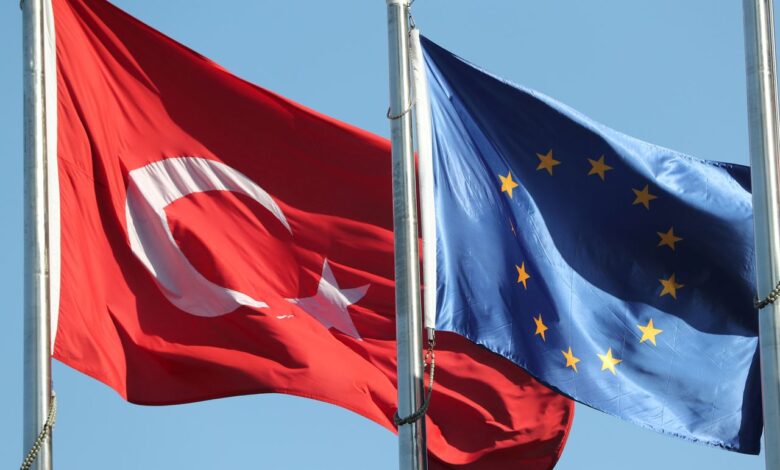
The most important candidate in Europe’s neighbourhood is undoubtedly Türkiye. Nevertheless, the country continues to be ignored by many European decision-makers.
For example, EU Commission President Ursula von der Leyen recently bracketed Türkiye with China and Russia, claiming that the “EU must shape its future” away from these three countries. A recent report by the European Council on Foreign Relations (ECFR) also reflects this stance.
This article takes this report as its starting point and examines why Europe often hinders itself in addressing its security policy challenges.
Related
‘Making defence European again’ – and how exactly?
The authors of the ECFR report outline three steps to restore Europe’s ability to defend itself: a common decision-making architecture comprising NATO structures, EU instruments and flexible coalitions; powerful and rapidly deployable armed forces; and a coordinated European defence industry as its industrial backbone.
The first reaction upon reading this is: That sounds sensible. The second question is: But how exactly?
And the third leads to the real problem: If these proposals are so obvious, why hasn’t Europe implemented them in recent decades?
Not to mention a European army – not even a common defence mechanism has been created.
Yet, since Trump’s first term in the White House in 2016, it had already become clear that the American security guarantee could no longer be taken for granted. At the same time, a war has been raging on Europe’s borders for years.
So why did the promised paradigm shift in security policy fail to materialise? A look at the positions of leading European decision-makers provides some clues.
As early as 2015, then-President of the European Commission Jean-Claude Juncker called for a European army to signal resolve to Russia. EC vice-president Kaja Kallas, on the other hand, recently described such an idea as “extremely dangerous” and questioned whether its proponents had considered the practical consequences.
The clearest assessment came from NATO Secretary General Mark Rutte before the European Parliament: anyone who believes Europe can defend itself without the US should “keep dreaming”.