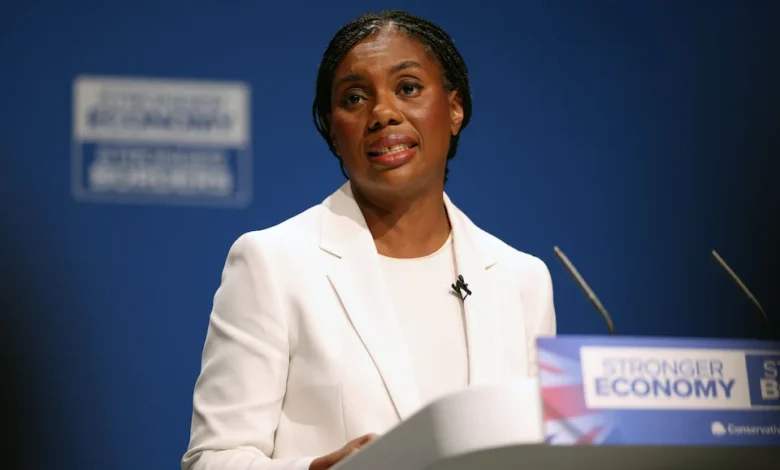
Kemi Badenoch, the conservative leader has said police should not be afraid to stop and search more Black boys if the policy helps save lives.
Badenoch said officers must be allowed to use the tactic without being held back by fears of race rows. She argued that stop and search can help remove weapons from the streets and protect young people from knife crime.
The Tory leader said a future Conservative government would triple the use of stop and search and recruit 10,000 more police officers. She said the party’s aim was to make streets safer and restore confidence in law enforcement.
Speaking at a press conference on Tuesday, Badenoch said the Conservatives were the party of law and order. She said her party wanted to support the police, not weaken them.


Her comments are expected to cause a strong debate because stop and search has long been one of the most controversial police powers in Britain. Supporters say it helps officers find knives, drugs and other weapons before they are used. Critics say it has often been used unfairly against Black communities and has damaged trust between police and young people.
Badenoch said the concern should be saving lives. She argued that if more Black boys were searched and more lives were saved, then police should not be afraid to act.
Read related news:
Badenoch says centrists no longer fit conservatives
Conservatives win German election; Trump-supported far-right party places second
Stop and search was used far more widely in the past. The number of searches reached about 1.5 million in 2008-2009. A decade later, the figure had dropped to around 279,000.
The sharp fall followed changes introduced when Theresa May was home secretary. May was concerned that the power was being used too heavily in Black communities and that this was weakening public trust in the police.
Badenoch now believes the policy has been reduced too much. The Conservatives first promised to triple stop and search last month as part of a set of proposed laws described as an alternative King’s Speech.
Her remarks came as she also criticised the Equality Act 2010, especially the Public Sector Equality Duty. This duty requires public bodies to consider how their decisions affect people with protected characteristics, including race, sex, religion, disability and age.
Badenoch said she supports equal treatment under the law, but she argued that the public sector equality duty has encouraged some institutions to focus too much on identity. She claimed this has made some public bodies afraid to act properly in sensitive cases involving race or minority groups.
She linked her argument to the murder of 18-year-old Henry Nowak. His death has caused anger after reports that police arrested and handcuffed him while he was dying from stab wounds. At the same time, Hampshire Police initially treated his killer, Vickrum Digwa, as a victim after he falsely claimed he had been racially abused.
Badenoch said the case showed how public services can fail when they become too focused on identity and not enough on their basic duty to protect citizens.
She also referred to other serious cases, including the Manchester Arena bombing, the Southport murders and the Nottingham attacks. She said these cases were different, but showed a wider problem in how authorities respond when race, religion or minority status is involved.
The Tory leader said police had spent too long worrying about being called institutionally racist. She argued that this had weakened decision-making and damaged public confidence.
Badenoch also said people were losing trust in institutions because they believed there were different rules for different groups. She referred to concerns about two-tier policing, women’s prisons, pro-Palestinian protests and the way some communities are treated by public bodies.
In a BBC Radio 4 interview, Badenoch said the police response to a stabbing should not be treated as less serious than an allegation of racism. She argued that this problem was linked to the Equality Act and the way it is being applied.
She also rejected the idea that identity-based staff groups should have influence over police policy. Badenoch said Britain needed the same rules for everyone.
The Conservative leader, who spent part of her childhood in Nigeria and is the first Black leader of a major British political party, also insisted that Britain is not a racist country.
She said Britain is now a multi-racial society and argued that individual incidents should not be used to define the whole country. She said the country still has crime, but that does not make it a criminal country.
Shadow equalities minister Claire Coutinho also criticised what she called an ideology inside public institutions. She said there was not enough focus on white working-class boys, compared with other groups.
Badenoch’s comments are likely to divide opinion. Her supporters will see her remarks as a direct response to knife crime and public concern about policing. Critics will argue that increasing stop and search could deepen mistrust, especially among Black communities.
The debate now places stop and search, race, equality law and public confidence in the police at the centre of British politics.