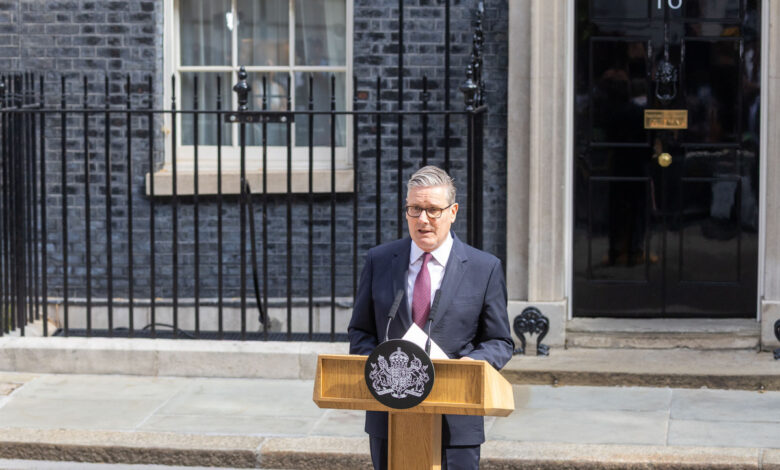
Keir Starmer is set to leave office after announcing his resignation on Monday, ending a premiership marked by collapsing public support, internal party discipline battles and deep anger over his handling of Gaza.
His departure follows months of pressure inside Labour and a bruising set of local election results in which the party suffered heavy losses while Reform UK made major gains. Labour lost 1,496 council seats and control of 38 councils in the 2026 local elections, while Reform UK gained 1,451 seats and emerged as the major beneficiary of public discontent.
Starmer’s resignation confirmed the fragility of the mandate he won in 2024. Labour secured a landslide majority in Parliament, but did so with only around a third of the vote. The result was made possible by the collapse of the Conservative vote and the split on the right created by Reform.

Labour’s vote share under Starmer was also lower than Jeremy Corbyn’s in both 2017 and 2019, even though Starmer won a far larger parliamentary majority. Critics argued at the time that Labour’s victory reflected the distortions of the first-past-the-post system as much as public enthusiasm for its leader.
Starmer entered Downing Street with the Conservatives at their weakest point in modern electoral history. Yet his government quickly alienated many voters who had expected Labour to reverse years of austerity and poverty. One early flashpoint came over the two-child benefit cap. Labour had criticised the policy in opposition, but when seven Labour MPs voted to scrap it in July 2024, Starmer suspended them from the parliamentary party. The cap affects around 1.6 million children, and campaigners say it has pushed hundreds of thousands deeper into poverty.
For many on the Labour left, that episode confirmed a wider pattern. Starmer had presented himself as a unity candidate when he ran for the Labour leadership, but his leadership became associated with strict party discipline, abandoned pledges and the exclusion of left-wing figures. Jeremy Corbyn was blocked from standing again as a Labour candidate, while other left-wing MPs and candidates faced suspension, deselection or removal from the party machine.
Starmer’s critics also point to the scale of suspensions under his leadership, arguing that party discipline became a central tool for remaking Labour and marginalising the left. The use of the whip, the removal of candidates and the treatment of dissenting MPs helped create a party that was electorally successful in 2024 but increasingly hollowed out ideologically.
Gaza intensified that rupture. After 7 October, 2023, Starmer repeatedly defended Israel’s “right to defend itself”. In an LBC interview, when asked whether Israel had the right to cut off power and water to Gaza, he said: “I think that Israel does have that right.” He later insisted that his comments had been misunderstood and Labour said his answer had referred to Israel’s right to self-defence, not to cutting off basic supplies. However, the remarks caused deep anger among Palestinians, British Muslims and many Labour members.
For months, Labour resisted calls for an immediate ceasefire, instead backing “humanitarian pauses”. Critics argued that this language failed to confront the scale of Israel’s assault and risked giving political cover to forced displacement in Gaza. When MPs voted in November 2023 on a motion calling for an immediate ceasefire, Starmer ordered Labour MPs not to support it. Ten frontbenchers either resigned or were removed after backing the motion. The episode became one of the clearest signs that Gaza had become a test of loyalty inside Starmer’s Labour.
READ: Over 300 Muslim councillors demand UK’s Labour Party to call for ceasefire in Gaza
Labour’s position shifted gradually. In December 2023, after then Foreign Secretary David Cameron wrote in favour of a “sustainable ceasefire” while stopping short of an immediate ceasefire, Labour adopted similar language. By February 2024, following pressure from Scottish Labour leader Anas Sarwar and others, Starmer backed an immediate ceasefire in principle. Yet critics argued that Labour’s wording still left room for Israel to continue military operations.
That dispute came to a head on 21 February, 2024, when the Scottish National Party tabled a Commons motion calling for an immediate ceasefire and an end to collective punishment in Gaza. Labour put forward its own amendment, which called for an immediate humanitarian ceasefire but added conditions, including language stating that Israel could not be expected to stop fighting if Hamas continued violence. Critics said the amendment allowed Labour to appear supportive of an immediate ceasefire while weakening the demand.
The Speaker, Lindsay Hoyle, selected Labour’s amendment in a controversial break with convention, triggering a parliamentary row and walkouts by Conservative and SNP MPs. Hoyle later apologised to MPs for the handling of the vote, saying he had acted out of concern for MPs’ safety. For Starmer, the amendment helped avoid a larger rebellion. For his critics, it showed how procedural manoeuvring was used to contain dissent over Gaza.
The Fire Brigades Union said MPs should have backed the SNP motion as the only one calling for an immediate ceasefire “without caveats”. Momentum described Labour’s amendment as “conditional and caveated”. The episode received far less sustained media scrutiny than many other parliamentary controversies, a silence that critics say reflected the wider failure of British public debate to treat Palestinian deaths with the same urgency afforded to other conflicts.
The controversy over Gaza cannot be separated from the internal politics of Labour under Starmer. Labour Together, the factional organisation closely associated with Morgan McSweeney, Starmer’s former chief of staff, played a major role in the party’s transformation after the Corbyn years. The group was fined by the Electoral Commission in 2021 for failing to properly report donations. The Commission found offences including failure to deliver donation reports within 30 days and inaccurate reporting of a donation.
Labour Together was originally presented as a project to bridge divides inside the party, but it later became closely associated with opposition to Corbyn’s leadership and with the campaign that brought Starmer to power in 2020. McSweeney went on to run Starmer’s leadership campaign and later became one of the most powerful figures in Downing Street. For critics of Starmer, this reinforced concerns about the influence of a small factional network around the prime minister.
Labour Together also received support from wealthy donors, including figures associated with pro-Israel networks. Trevor Chinn, a long-standing Labour donor and reported supporter of pro-Israel organisations, served as a director of Labour Together until September 2024 and was later named as a recipient of Israel’s Presidential Medal of Honour. Rachel Reeves also received registered donations or support from Labour Together, David Sainsbury, Clive Hollick and Chinn. These links do not prove direct control over policy, but they have contributed to concerns among Labour critics about the influence of a narrow donor and adviser network around the party leadership
READ: Defying government, Britain’s Labour members vote to accept genocide is taking place in Gaza
Starmer’s government also faced growing scrutiny over Britain’s material support for Israel. In September 2024, the UK suspended 30 out of around 350 arms export licences to Israel after concluding there was a clear risk that some equipment could be used in serious violations of international humanitarian law. However, campaigners argued that the partial suspension left major loopholes, including components linked to the F-35 programme.
Further controversy surrounded British surveillance flights over Gaza. The Ministry of Defence said the unarmed flights were tasked solely with locating hostages, but reports by flight trackers, campaigners and media outlets raised questions about how intelligence was used and shared with Israel. The Guardian reported that specialist flight trackers estimated more than 600 RAF Shadow flights over Gaza from RAF Akrotiri since December 2023, while the government maintained that the mission was focused on hostage recovery.
That record made Starmer’s resignation speech difficult for many Palestinians and their supporters to watch. He spoke of wanting to spend more time with his wife and children, presenting himself as a family man leaving the “biggest job in the country”. To critics, the carefully staged family imagery jarred with Britain’s continued military, diplomatic and intelligence cooperation with Israel while Gaza was being devastated.
Starmer leaves behind a Labour Party that won power but lost much of the moral authority it claimed under previous leaders. His defenders will point to stability after years of Conservative crisis. His critics will remember a leader who used party discipline to crush dissent, abandoned promises made to win the leadership and treated Gaza not as a moral catastrophe demanding urgent action, but as a loyalty test inside Labour.
For many voters who broke with Labour over Palestine, Starmer’s resignation will not close the matter. The deeper question is whether the party he reshaped can escape the political and moral legacy of its stance on Gaza.
OPINION: UK crackdown on pro-Palestine speech faces landmark legal test
The views expressed in this article belong to the author and do not necessarily reflect the editorial policy of Middle East Monitor.