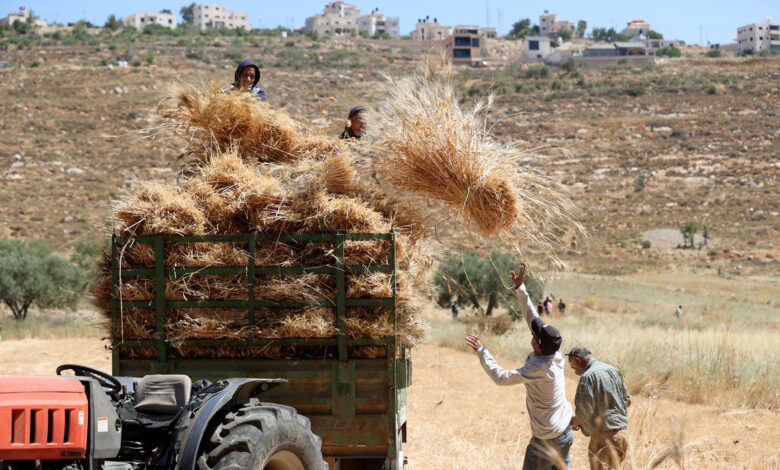
For generations of Palestinian farmers, the June harvest was a sacred time of community, folklore, and relief from the winter’s anxieties. But in recent years, a systematic campaign of arson and violence by Israeli terrorist settlers has turned Palestine’s historic wheat fields and threshing floors from spaces of celebratory feasts into dangerous frontlines of popular resistance.
From our fields in the village of Qira, the struggle to reap what we sow has become an urgent testament to our unyielding steadfastness on our ancestors’ land.
June: the month of wheat harvest
Historically, Palestinians named June “Iqlaash” after the “Qaloosha” (sickle). This directly reflects the primary work of the month: the wheat harvest and the threshing floor (Baydar) operations, which represent—alongside the olive harvest—the most critical agricultural seasons in Palestine. The Baydar symbolized the end of winter scarcity and the beginning of abundance. Blessings were sought, weddings were postponed until the yield could cover expenses, and the community united through “Al-Ouna”—a system of communal volunteerism to complete the heavy labor swiftly. Even the vulnerable were cared for; portions known as “Al-Luqat” (gleanings) were left in field corners so those in need could gather them with dignity.


Harvesting Rituals: The Joyous Summer Wedding
The harvest timeline follows strict cues: drying legumes in late April, barley in mid-May, and wheat in June. The decision to reap relies on astronomical signs like “the rising of the Pleiades” (Tulou’ Al-Thurayya), bringing the intense heatwaves that fully harden the grain (Al-Jumadi), protecting it from pests during long storage.
Labor begins at the crack of dawn while the morning dew still softens the fragile stalks, preventing them from snapping. With the Talqa—an opening invocation of God’s name—the harvester grips the stalks with his left hand and strikes with the sickle. Each single swing yields a Shimal; these form small piles called Ghumor, which are bundled into a Katti, and finally stacked into a massive load called a Hilla. These giant bundles are transported on the backs of animals (Al-Sheel) to the village Baydar.
Deeply rooted social rituals governed this time:
- Al-Luqatat (gleaners) Poor women and orphans followed the harvesters to gather fallen ears of wheat. Turning back to collect dropped grain was forbidden, as it was believed to strip away the season’s blessings.
- Shayeb Al-Haseeda (The Old Man of the Harvest): The very last bundle of wheat was ritually “buried” in the soil as a symbolic offering to ensure future fertility, accompanied by chants mourning the “dying old man” and mutual requests for forgiveness among the exhausted workers.
- Misht Al-Qamh (The Wheat Comb): Farmers artistically wove golden wheat stalks into the shape of an open palm, hung in homes or local sanctuaries (Maqams) to ward off envy and express gratitude.
Lost Seasons of Joy: My Memories on the Baydar of Qira
I carry these traditions as the lived reality of my childhood in my home village of Qira, where the wheat fields and Baydar was our community’s beating heart. Following the reap, the Baydar—our village “Jurn”, a flat, rocky clearing outside the houses—became a hive of activity. The crop was arranged into a massive mound called the “Armi” or “Saleebi,” kickstarting the traditional stages of processing:
- Al-Taqsheesh: Women gathered long golden stalks to weave vibrant traditional trays and baskets.
- Al-Diras (Threshing): Livestock were driven in hours-long circular motions to crush the sheaves, often pulling a “Newraj” (threshing board) upon which we would sit as children to add weight.
- Al-Tadhriya (Winnowing): Using a wooden pitchfork (Midhrah), the men tossed the crushed mixture into the “western breeze”. The wind blew the light chaff into a mound called the “Tabbana”, leaving the heavy, pure grain to drop into a clean pile called the “Saleebit Al-Qamh” (the wheat cross).
- Al-Keil wa Al-Ubour (Measuring): The harvest was measured using the traditional “Sa’a” to calculate yields, Zakat (alms), and shares for village workers such as barber and guards.
- Al-Jawra’a (The Harvest Feast): The threshing floor owner slaughtered a sheep, cooking it with wheat (Jreesha) to feed all workers, helpers, and passersby. At night, the Bayadir transformed into vibrant spaces for Dabke dances under the moonlight.
This entire process was guarded by spiritual reverence. Farmers recited the Basmala to ward off Jinn, avoided sitting cross-legged while measuring out of respect for the food, and counted the yield using prayers rather than numbers, beginning with “God is One.”
The Bitter Present: How Settlers Transformed Joy into Ashes
Today, that idyllic image of mutual solidarity has been replaced by a harsh reality bleeding with sorrow. As a farmer who still works the land, I feel this pain acutely. The agricultural seasons on our fields and Bayadir are no longer a time of celebration; they have morphed into a grueling daily battle for survival where we can no longer even enjoy our harvest.
Where my ancestors once eagerly anticipated the “western breeze” to winnow grain, we now scan the horizon with constant anxiety, fearing the thick black smoke of settler fires.
In recent times, across towns in Ramallah, Salfit, and the villages south of Nablus, vast golden fields are deliberately set ablaze just days before harvest, turning a year of sweat and toil into cold black ash.
These crimes have escalated into violent warfare. Farmers are routinely attacked with live ammunition and stones, forced off their own lands at gunpoint under the protection of the occupation army. Tractors are confiscated, harvesting machinery is vandalized, and filled sacks of grain are stolen right off the scales.
This brutal reality has forced our traditional “Al-Ouna” to assume a critical new dimension. Today, Al-Ouna means risking our lives—rushing out to urgent distress calls broadcast from mosque loudspeakers to extinguish fires collectively, standing as human shields to protect the land, and racing against time to salvage whatever grain remains before the hands of destruction reach it.
Steadfast on Our Ancestors’ Land
Yet, despite the raging fires, the suffocating ashes, and the bitter grief planted in our hearts, our message to the world remains unyielding. We are deeply steadfast (Samedoun) in this land, rooted like our ancient olive trees. No matter the scale of the terror, the burnings, or the intimidation, we will never leave, and we will never abandon or surrender the land of our ancestors. We will continue to sow the seeds of wheat with every new season, watering them with our sweat, tears, and patience. Our connection to this soil is infinitely deeper than any fire they kindle, and the story of our harvest, our survival, and life itself on this land will never end in ashes.
But while our steadfastness is absolute, we cannot carry this burden alone. The scale of violence we face daily threatens our very existence. We urgently call upon the international community to break its silence and step forward to provide immediate help, support, and tangible protection.
We need protection for our children, who deserve to grow up without the terror of fire and bullets; protection for our farmers, who have a fundamental right to reap what they sow; and protection for our ancestral land, which is systematically being reduced to ash.
Our resilience will keep us here, but international action is required to ensure that our future generations can once again harvest in peace and celebrate the crops.
The views expressed in this article belong to the author and do not necessarily reflect the editorial policy of Middle East Monitor.