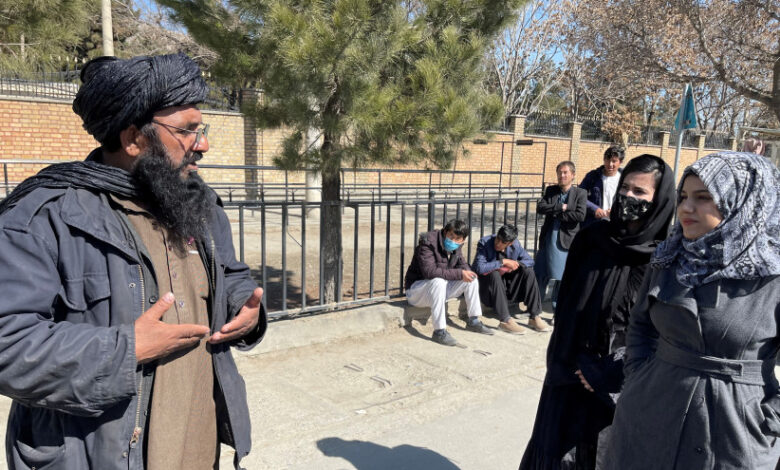
The Taliban has continued to employ excessive force against protesters and abduct women over what it claims are violations of the country’s Islamic dress code, according to the United Nations, multiple NGOs, and international media reports.
Taliban authorities in Afghanistan’s western city of Herat arrested at least 30 women, accusing them of violating dress rules imposed by the Taliban government, the UN agency for women’s rights confirmed late last week, adding that some of the women were later released.
Among the 30 women, Médecins Sans Frontières (MSF), known as Doctors Without Borders, confirmed on Friday that a staff member was held for two days in early June after she was stopped by representatives of the Promotion of Virtue and Prevention of Vice Ministry on her way to Herat Regional hospital over allegations she was failing to comply with the Taliban’s dress code for women.
The staff member was released on June 8 after she, her husband, and her family signed a commitment to wear clothes specifically selected by the ministry.

Protests broke out in Herat before being violently suppressed
Local anger over the Taliban’s mistreatment of women led to protests breaking out in Herat, which were violently suppressed by the Islamist terror group. They were said to have called for “Work, Education, and Freedom.” These protests were met with violence.
“According to the independent experts, Taliban security forces allegedly opened fire on protesters – men, women and children – administering beatings to some,” the UN agency added in a statement. “At least two people, including a boy, were killed and more than 20 were injured.”
One witness told Human Rights Watch, “When the shooting began, people started to escape, and I saw the Taliban shooting toward those attempting to flee. I witnessed some people getting injured. The Taliban even went to the streets and beat children to send them home. Everyone was terrified … some of the wounded [said] they didn’t go to the hospital [for fear of arrest]. I saw the 11-year-old who had been killed. He was bleeding terribly.”
Local sources told the diaspora media site Afghanistan International that, after suppressing the protests, Taliban forces conducted house-to-house and hospital-to-hospital searches for injured protesters.
Despite the various media reports, credible witnesses and footage of the incidents, the Taliban has denied the reports of mass human rights violations, dismissing them as rumors. The Prevention of Vice Ministry added that the “hijab is a divine command, a law that we are obliged to implement.”
Under the Taliban’s morality law, a woman’s face is considered awrah (intimate parts of the human body), so women are forced to wear clothing that fully covers their faces.
“The Taliban authorities fear any dissent and so are escalating their repression of free expression and other basic rights,” said Fereshta Abbasi, Afghanistan researcher at Human Rights Watch.
Afghan women have experienced increasingly restrictive policies
Since the Taliban seized control in 2021, Afghan women have seen increasingly oppressive policies restrict their individual freedoms. Only last month, the Taliban introduced a decree which experts warn will prevent child brides from obtaining a divorce.
Article 5 instructed that “Upon reaching puberty, the minor has the option to dissolve the marriage” that a relative may have contracted for her, and that if she does not openly object, it will be treated as consent.
Zabiullah Mujahid, the Taliban’s spokesman, told The New York Times that, “A marriage proposal is something that a girl may feel shy or embarrassed about, and she may not be able to openly say that she agrees to marry. Therefore, her silence is regarded as consent.”
Girls are also now restricted from attending school above sixth grade, largely forbidden from entering public spaces, and husbands are permitted to beat their wives so long as the beating does not cause broken bones, bruising or injury.
Under Article 32 of the penal code, “If a husband strikes his wife with excessive beating resulting in fracture, injury, or the appearance of bruising on her body, and the wife proves her claim before the judge, the husband is deemed a criminal; the judge shall sentence him to fifteen days of imprisonment,” while under Article 70, those who cause animals to fight can receive a five month sentence.
“The Taliban authorities appear determined to silence those who try to speak out against their abusive practices,” Abbasi said. “By punishing people for exercising their free expression rights, the Taliban authorities aren’t silencing the message but only adding to their mounting list of human rights abuses.”